


Insights into the Methodological, Biotic and Abiotic Factors Influencing the Characterization of Xylem-Inhabiting Microbial Communities of Olive Trees
- PMID: 36840260
- PMCID: PMC9967459
- DOI: 10.3390/plants12040912
Insights into the Methodological, Biotic and Abiotic Factors Influencing the Characterization of Xylem-Inhabiting Microbial Communities of Olive Trees
Abstract
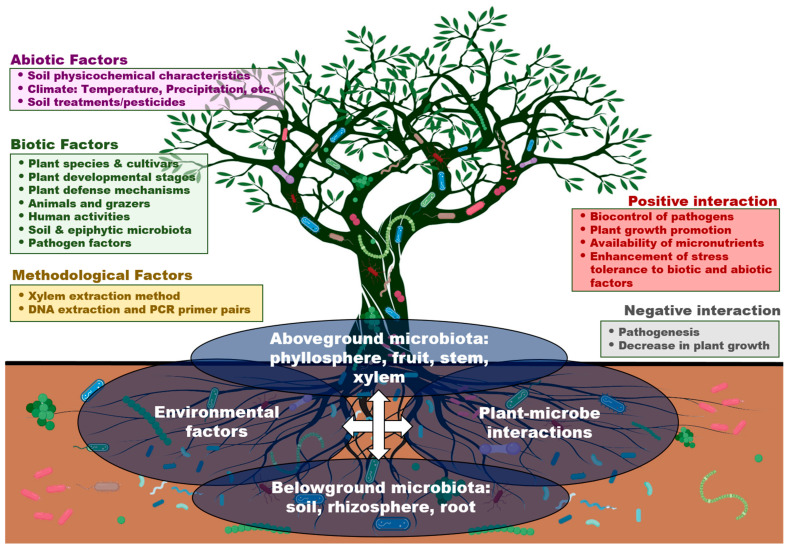
Vascular pathogens are the causal agents of some of the most devastating plant diseases in the world, which can cause, under specific conditions, the destruction of entire crops. These plant pathogens activate a range of physiological and immune reactions in the host plant following infection, which may trigger the proliferation of a specific microbiome to combat them by, among others, inhibiting their growth and/or competing for space. Nowadays, it has been demonstrated that the plant microbiome can be modified by transplanting specific members of the microbiome, with exciting results for the control of plant diseases. However, its practical application in agriculture for the control of vascular plant pathogens is hampered by the limited knowledge of the plant endosphere, and, in particular, of the xylem niche. In this review, we present a comprehensive overview of how research on the plant microbiome has evolved during the last decades to unravel the factors and complex interactions that affect the associated microbial communities and their surrounding environment, focusing on the microbial communities inhabiting the xylem vessels of olive trees (Olea europaea subsp. europaea), the most ancient and important woody crop in the Mediterranean Basin. For that purpose, we have highlighted the role of xylem composition and its associated microorganisms in plants by describing the methodological approaches explored to study xylem microbiota, starting from the methods used to extract xylem microbial communities to their assessment by culture-dependent and next-generation sequencing approaches. Additionally, we have categorized some of the key biotic and abiotic factors, such as the host plant niche and genotype, the environment and the infection with vascular pathogens, that can be potential determinants to critically affect olive physiology and health status in a holobiont context (host and its associated organisms). Finally, we have outlined future directions and challenges for xylem microbiome studies based on the recent advances in molecular biology, focusing on metagenomics and culturomics, and bioinformatics network analysis. A better understanding of the xylem olive microbiome will contribute to facilitate the exploration and selection of specific keystone microorganisms that can live in close association with olives under a range of environmental/agronomic conditions. These microorganisms could be ideal targets for the design of microbial consortia that can be applied by endotherapy treatments to prevent or control diseases caused by vascular pathogens or modify the physiology and growth of olive trees.
Keywords: determining factors; endophytes; microbiome; olive; xylem.
Conflict of interest statement
The authors declare no conflict of interest. The funders had no role in the design of the study; in the collection, analyses, or interpretation of data; in the writing of the manuscript, or in the decision to publish the results.
Figures

References
-
- Chaparro J.M., Sheflin A.M., Manter D.K., Vivanco J.M. Manipulating the soil microbiome to increase soil health and plant fertility. Biol. Fertil. Soils. 2012;48:489–499. doi: 10.1007/s00374-012-0691-4. - DOI
-
- Anguita-Maeso M., Trapero-Casas J.L., Olivares-García C., Ruano-Rosa D., Palomo-Ríos E., Jiménez-Díaz R.M., Navas-Cortés J.A., Landa B.B. Verticillium dahliae inoculation and in vitro propagation modify the xylem microbiome and disease reaction to Verticillium wilt in a wild olive genotype. Front. Plant Sci. 2021;12:250. doi: 10.3389/fpls.2021.632689. - DOI - PMC - PubMed
Publication types
Grants and funding
- AGL2016-75606-R and PID2020-114917RB-I00/Programa Estatal de I+D Orientado a los Retos de la Sociedad from Spanish Government, the Spanish State Research Agency and FEDER-EU
- TED2021-130110B-C41/Proyectos Orientados a la Transición Ecológica y a la Transición Digital-Plan de Recuperación, Transformación y Resiliencia from Spanish Government, the Spanish State Research Agency
- grant 727987/XF-ACTORS (Xylella fastidiosa Active Containment Through a Multidisciplinary Oriented Research Strategy; from the European Union's Horizon 2020 Framework Research Programme
LinkOut - more resources
Full Text Sources
