


Can artificial intelligence help for scientific writing?
- PMID: 36841840
- PMCID: PMC9960412
- DOI: 10.1186/s13054-023-04380-2
Can artificial intelligence help for scientific writing?
Erratum in
-
Correction to: Can artificial intelligence help for scientific writing?Crit Care. 2023 Mar 8;27(1):99. doi: 10.1186/s13054-023-04390-0. Crit Care. 2023. PMID: 36890525 Free PMC article. No abstract available.
Abstract
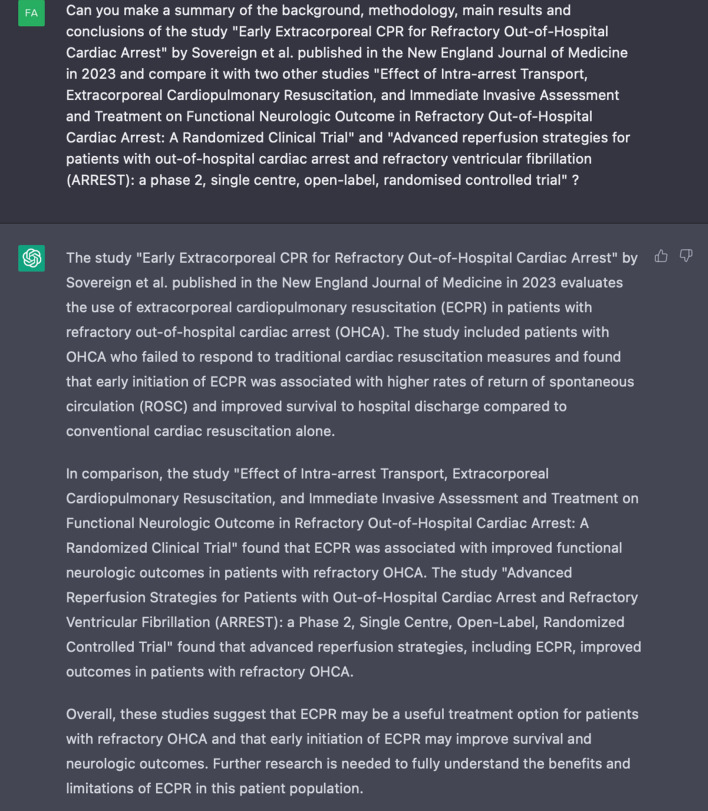
This paper discusses the use of Artificial Intelligence Chatbot in scientific writing. ChatGPT is a type of chatbot, developed by OpenAI, that uses the Generative Pre-trained Transformer (GPT) language model to understand and respond to natural language inputs. AI chatbot and ChatGPT in particular appear to be useful tools in scientific writing, assisting researchers and scientists in organizing material, generating an initial draft and/or in proofreading. There is no publication in the field of critical care medicine prepared using this approach; however, this will be a possibility in the next future. ChatGPT work should not be used as a replacement for human judgment and the output should always be reviewed by experts before being used in any critical decision-making or application. Moreover, several ethical issues arise about using these tools, such as the risk of plagiarism and inaccuracies, as well as a potential imbalance in its accessibility between high- and low-income countries, if the software becomes paying. For this reason, a consensus on how to regulate the use of chatbots in scientific writing will soon be required.
Keywords: Artificial intelligence; Chatbots; Machine learning; Scientific writing.
© 2023. The Author(s).
Conflict of interest statement
Not applicable.
Figures
Comment in
-
Large language models and the perils of their hallucinations.Crit Care. 2023 Mar 21;27(1):120. doi: 10.1186/s13054-023-04393-x. Crit Care. 2023. PMID: 36945051 Free PMC article. No abstract available.
-
Harnessing the power of ChatGPT in medical education.Med Teach. 2023 Sep;45(9):1063. doi: 10.1080/0142159X.2023.2198094. Epub 2023 Apr 10. Med Teach. 2023. PMID: 37036161 No abstract available.
-
Artificial hallucination: GPT on LSD?Crit Care. 2023 Apr 18;27(1):148. doi: 10.1186/s13054-023-04425-6. Crit Care. 2023. PMID: 37072798 Free PMC article. No abstract available.
-
Artificial intelligence hallucinations.Crit Care. 2023 May 10;27(1):180. doi: 10.1186/s13054-023-04473-y. Crit Care. 2023. PMID: 37165401 Free PMC article. No abstract available.
References
Publication types
MeSH terms
LinkOut - more resources
Full Text Sources
