


Cystic echinococcosis in donkeys in eastern Africa
- PMID: 36843475
- PMCID: PMC10089808
- DOI: 10.1017/S0031182023000173
Cystic echinococcosis in donkeys in eastern Africa
Abstract
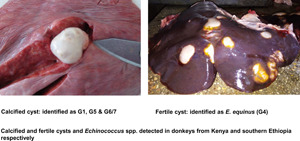
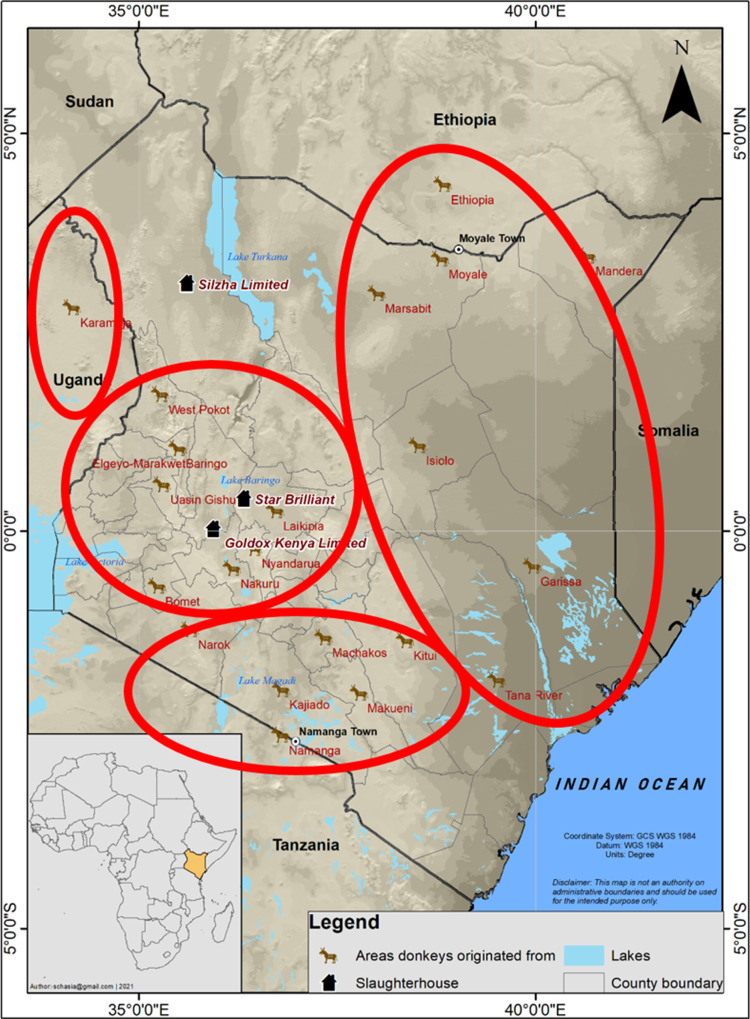
Cystic echinococcosis (CE) is endemic in humans and domestic animals in eastern Africa. All the species of the Echinococcus granulosus sensu lato complex have been reported in this region except for E. equinus, possibly due to the small number of studies involving equids. This study reports the frequency of different Echinococcus species in donkeys from eastern Africa. A total of 5961 donkeys were examined during meat inspection in 3 slaughterhouses in Kenya. Identification of Echinococcus spp. was achieved through polymerase chain reaction-restriction fragment-length polymorphism and sequencing of the mitochondrial nicotinamide adenine dinucleotide (NADH) dehydrogenase subunit 1 gene. The prevalence of CE was 5.7% (337/5961). The 263 genotyped cysts belonged to E. equinus (n = 163), E. granulosus sensu stricto (n = 70), E. canadensis (G6/7) (n = 26) and E. ortleppi (n = 4). One donkey harboured a metacestode of Spirometra theileri. All E. equinus cases, except 2, originated from southern Ethiopia, whereas the other species were more evenly distributed across the study area. Most of the cysts belonging to E. equinus were fertile (111/163), while those of the other species were non-fertile. This is the first report of Echinococcus spp. in donkeys from sub-Saharan Africa and the first confirmation of E. equinus in East Africa. The frequent fertility of E. equinus cysts in donkeys affirms their suitability as intermediate hosts of this species, while low frequency and cyst fertility suggest a marginal role of donkeys in the transmission of E. granulosus s. s., E. canadensis (G6/7) and E. ortleppi.
Keywords: Cystic echinococcosis; Echinococcus equinus; Echinococcus granulosus sensu lato; donkeys; eastern Africa.
Conflict of interest statement
None.
Figures
References
-
- Abo-Shehada M (1988) Prevalence of hydatidosis in donkeys from central Jordan. Veterinary Parasitology 30, 125–130. - PubMed
-
- Aboelhadid S, El-Dakhly K, Yanai T, Fukushi H and Hassanin K (2013) Molecular characterization of Echinococcus granulosus in Egyptian donkeys. Veterinary Parasitology 193, 292–296. - PubMed
-
- Addy F, Alakonya A, Wamae N, Magambo J, Mbae C, Mulinge E, Zeyhle E, Wassermann M, Kern P and Romig T (2012) Prevalence and diversity of cystic echinococcosis in livestock in Maasailand, Kenya. Parasitology Research 111, 2289–2294. - PubMed
-
- Addy F, Wassermann M, Banda F, Mbaya H, Aschenborn J, Aschenborn O, Koskei P, Umhang G, De La Rue M, Elmahdi I, Mackenstedt U, Kern P and Romig T (2017a) Genetic polymorphism and population structure of Echinococcus ortleppi. Parasitology 144, 450–458. - PubMed
-
- Addy F, Wassermann M, Kagendo D, Ebi D, Zeyhle E, Elmahdi I, Umhang G, Casulli A, Harandi M, Aschenborn O, Kern P, Mackenstedt U and Romig T (2017b) Genetic differentiation of the G6/7 cluster of Echinococcus canadensis based on mitochondrial marker genes. International Journal for Parasitology 47, 923–931. - PubMed
Publication types
MeSH terms
LinkOut - more resources
Full Text Sources
Research Materials
Miscellaneous
