


Post-incarceration outcomes of a comprehensive statewide correctional MOUD program: a retrospective cohort study
- PMID: 36844014
- PMCID: PMC9950664
- DOI: 10.1016/j.lana.2022.100419
Post-incarceration outcomes of a comprehensive statewide correctional MOUD program: a retrospective cohort study
Abstract
Background: As opioid overdoses surge, medications for opioid use disorder (MOUD) remain underutilized. MOUD is rarely offered in correctional facilities although individuals involved in the criminal justice system have higher rates of OUD and mortality relative to the general population.
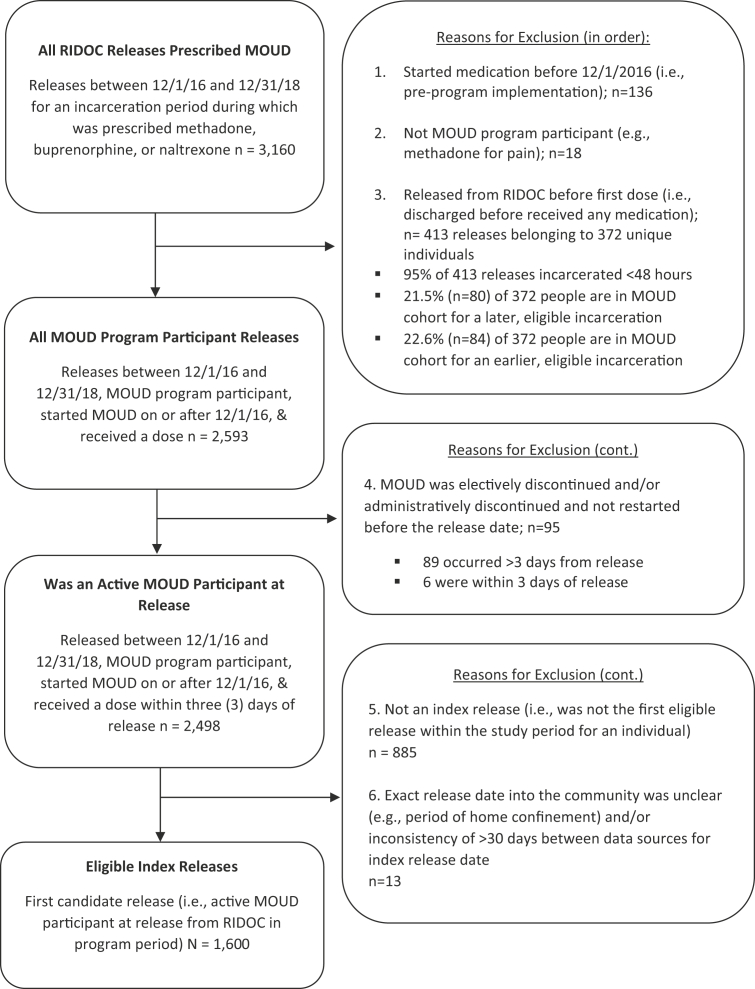
Methods: A retrospective cohort design examined the effect of MOUD while incarcerated on 12 months post-release treatment engagement and retention, overdose mortality, and recidivism. Individuals (N = 1600) who participated in the Rhode Island Department of Corrections (RIDOC) MOUD program (the United States' first statewide program) and were released from incarceration from December 1, 2016, to December 31, 2018, were included. The sample was 72.6% Male (27.4% female) and 80.8% White (5.8% Black, 11.4% Hispanic, 2.0% another race).
Findings: 56% were prescribed methadone, 43% buprenorphine, and 1% naltrexone. During incarceration, 61% were continued on MOUD from the community, 30% were inducted onto MOUD upon incarceration, and 9% were inducted pre-release. At 30 days and 12 months post-release, 73% and 86% of participants engaged in MOUD treatment, respectively, and those newly inducted had lower post-release engagement than those who continued from the community. Reincarceration rates (52%) were similar to the general RIDOC population. Twelve overdose deaths occurred during the 12-month follow-up, with only one overdose death during the first two weeks post-release.
Interpretations: Implementing MOUD in correctional facilities, with seamless linkage to community care is a needed life-saving strategy.
Funding: Rhode Island General Fund, the NIH of Health HEAL Initiative, the NIGMS, and the NIDA.
Keywords: Access to care; Correctional facilities; Health services research; Incarceration; Medications for opioid use disorder; Opioid use disorder.
© 2022 The Authors.
Conflict of interest statement
We declare no competing interests.
Figures
References
-
- National Academies of Sciences E, Medicine . In: Medications for opioid use disorder save lives. Leshner A.I., Mancher M., editors. The National Academies Press; Washington, DC: 2019. p. 174. - PubMed
-
- Degenhardt L., Bucello C., Mathers B., et al. Mortality among regular or dependent users of heroin and other opioids: a systematic review and meta-analysis of cohort studies. Addiction. 2011;106(1):32–51. - PubMed
Grants and funding
LinkOut - more resources
Full Text Sources
Research Materials
