


Case report: Applicability of breastfeeding the child of a patient with kidney failure with replacement therapy
- PMID: 36844211
- PMCID: PMC9950765
- DOI: 10.3389/fmed.2023.1098324
Case report: Applicability of breastfeeding the child of a patient with kidney failure with replacement therapy
Abstract
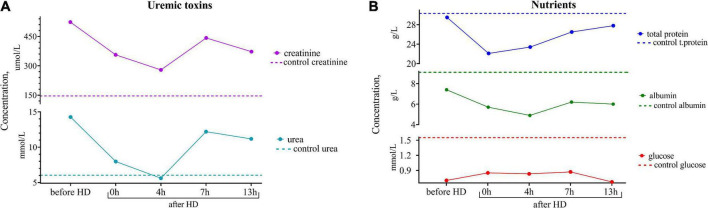
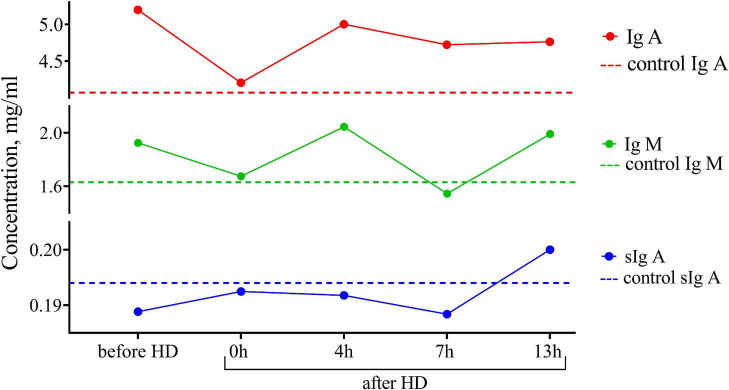
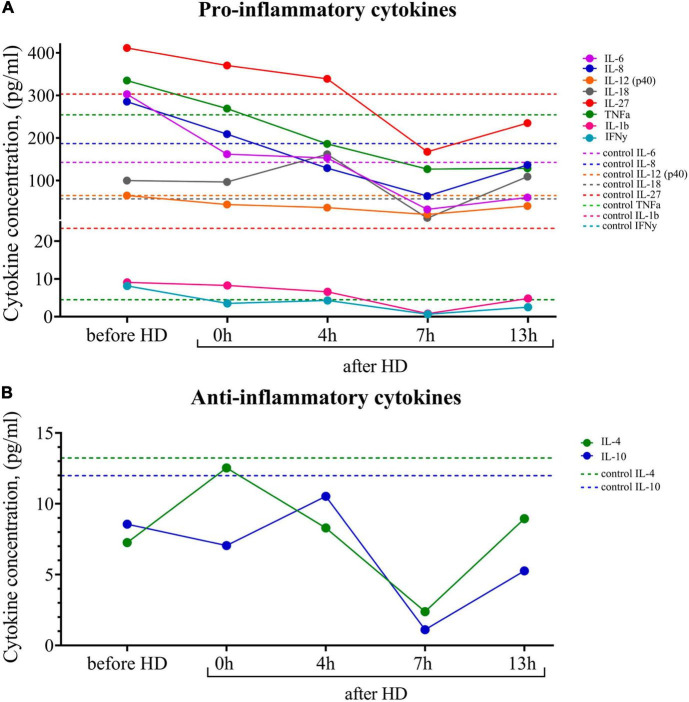
This case report highlights the benefit or harm of breastfeeding in a patient with Kidney Failure with Replacement Therapy (KFRT) undergoing program hemodialysis. This is a unique clinical case, as pregnancy and successful delivery are rare in this group of females. With a favorable outcome, the possibility of breastfeeding is especially relevant for doctors and the mother. The patient was a 31-year-old female who was diagnosed in 2017 with end-stage renal disease associated with chronic glomerulonephritis. Against the background of hemodialysis, pregnancy, accompanied by polyhydramnios, anemia, and secondary arterial hypertension, occurred in 2021. At 37 weeks, a healthy, full-term baby girl was born, and breastfeeding was started. In this study, we conducted a detailed analysis of toxic substances and immunologically significant proteins using high-tech analysis methods. In addition, we studied different portions of milk before and after hemodialysis at different time intervals. After a wide range of experiments, our study did not reveal an optimal time interval for breastfeeding a baby. Despite the decrease in the level of the major uremic toxins 4 h after the hemodialysis procedure, their level remained high. In addition, the content of nutrients did not reach acceptable limits and the immune status was characterized as pro-inflammatory. In our opinion, breastfeeding is not advisable for this group of patients since the concentration of nutrients is low, and the content of toxic substances exceeds the permissible limits. In this clinical case, the patient decided to stop breastfeeding one month after delivery due to insufficient breast milk and the inability to express it in a certain period of time.
Keywords: Kidney Failure with Replacement Therapy (KFRT); biochemistry; breastfeeding; case report; immunology; molecular physics.
Copyright © 2023 Kondakova, Filat’eva, Lobanova, Nagaev, Sarimov, Gudkov and Vedunova.
Conflict of interest statement
NL was employed by Branch FESFARM NN. The remaining authors declare that the research was conducted in the absence of any commercial or financial relationships that could be construed as a potential conflict of interest.
Figures
References
-
- Piccoli G, Cabiddu G, Daidone G, Guzzo G, Maxia S, Ciniglio I, et al. The children of dialysis: live-born babies from on-dialysis mothers in Italy—an epidemiological perspective comparing dialysis, kidney transplantation and the overall population. Nephrol Dial Transplant. (2014) 29:1578–86. 10.1093/ndt/gfu092 - DOI - PubMed
-
- Greer F, Sicherer S, Burks A. Committee on Nutrition, Section on Allergy and Immunology, Abrams S, et al. The effects of early nutritional interventions on the development of atopic disease in infants and children: the role of maternal dietary restriction, breastfeeding, hydrolyzed formulas, and timing of introduction of allergenic complementary foods. Pediatrics. (2019) 143:e20190281. 10.1542/peds.2019-0281 - DOI - PubMed
Publication types
LinkOut - more resources
Full Text Sources
