


Evaluation of genetic alterations in hereditary cancer susceptibility genes in the Ashkenazi Jewish women community of Mexico
- PMID: 36845387
- PMCID: PMC9950094
- DOI: 10.3389/fgene.2023.1094260
Evaluation of genetic alterations in hereditary cancer susceptibility genes in the Ashkenazi Jewish women community of Mexico
Abstract
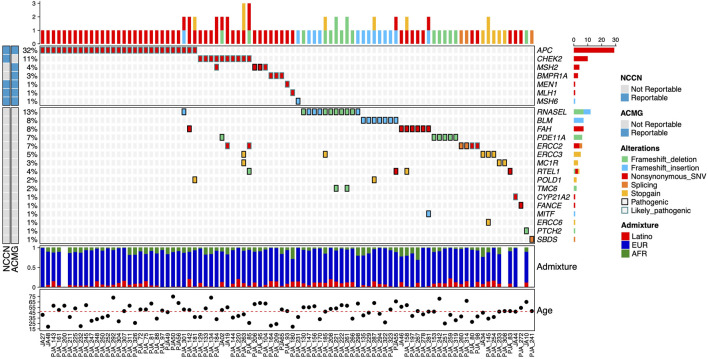
Background: Individuals of Ashkenazi Jewish ancestry have been identified as having higher prevalence of specific pathogenic variants associated with susceptibility to specific rare and chronic diseases. In Mexico, the prevalence and composition of rare cancer predisposing germline variants in Ashkenazi Jewish individuals has not been evaluated. Aim and methods: We aimed to evaluate the prevalence of pathogenic variants by massive parallel sequencing in a panel of 143 cancer-predisposing genes in 341 women from the Ashkenazi Jewish community of Mexico, who were contacted and invited to participate in the study through the ALMA Foundation for Cancer Reconstruction. Pre- and posttest genetic counseling was given and a questionnaire on personal, gyneco-obstetric, demographic and lifestyle variables was conducted. From peripheral blood DNA, the complete coding region, and splicing sites of a panel of 143 cancer susceptibility genes, including 21 clinically relevant genes, were sequenced. The Mexican founder mutation BRCA1 ex9-12del [NC_000017.10(NM_007294):c. (825+1-826-1)_(4,589+1-4,590-1)del] was also evaluated. Results: Among study participants (mean age ±standard deviation: 47 ± 14) 15% reported a personal history of cancer (50/341). Fourteen percent of participants (48/341) were carriers of pathogenic and likely pathogenic variants distributed among seven high-risk genes (APC, CHEK2, MSH2, BMPR1A, MEN1, MLH1, and MSH6), whereas 18.2% (62/341) had variants of uncertain clinical significance in genes associated with breast and ovarian cancer susceptibility (list of genes with VUS). Pathogenic and likely pathogenic variants in 16 susceptibility genes with ambiguous or non-well-established risk association for cancer were detected in 17.6% (60/341) of participants. Sixty four percent of participants reported current alcohol consumption compared with the 39 percent prevalence of alcohol consumption in Mexican women. None of the participants carried the recurrent Ashkenazi and Mexican founder mutations in BRCA1 or BRCA2, but 2% (7/341) had pathogenic Ashkenazi Jewish founder variants in BLM. Conclusion: Our findings show a diverse pathogenic variant composition among the recruited individuals of Ashkenazi Jewish ancestry in Mexico consistent with being a high-risk population for genetic diseases, which warrants further investigation to adequately assess the burden of hereditary breast cancer in this group and implement appropriate preventative programs.
Keywords: APC; Ashkenazi Jews; founder variant; genetic screening; massive parallel sequencing; panel of genes.
Copyright © 2023 Díaz-Velásquez, Gitler, Antoniano, Kershenovich Sefchovich, De La Cruz-Montoya, Martínez-Gregorio, Rojas-Jiménez, Cortez Cardoso Penha, Terrazas, Wegman-Ostrosky, Levi-Lahad, Zabaleta, Perdomo and Vaca-Paniagua.
Conflict of interest statement
The authors declare that the research was conducted in the absence of any commercial or financial relationships that could be construed as a potential conflict of interest.
Figures
References
-
- Avni H., Liwerant J. B., Pergola S. D. (2011). Pertenencia y alteridad: Judíos en/de América latina: Cuarenta años de cambios. America: Iberoamericana.
Grants and funding
LinkOut - more resources
Full Text Sources
Miscellaneous
