


Societal burden of work on injury deaths in New Zealand, 2005-14: An observational study
- PMID: 36845672
- PMCID: PMC9945765
- DOI: 10.1016/j.ssmph.2023.101353
Societal burden of work on injury deaths in New Zealand, 2005-14: An observational study
Abstract
Background: Work poses increased risk of injury not only for workers but also for the public, yet the broader impact of work-related injury is not quantified. This study, utilising population data from New Zealand, estimates the societal burden of work-related fatal injury (WRFI) by including bystanders and commuters.
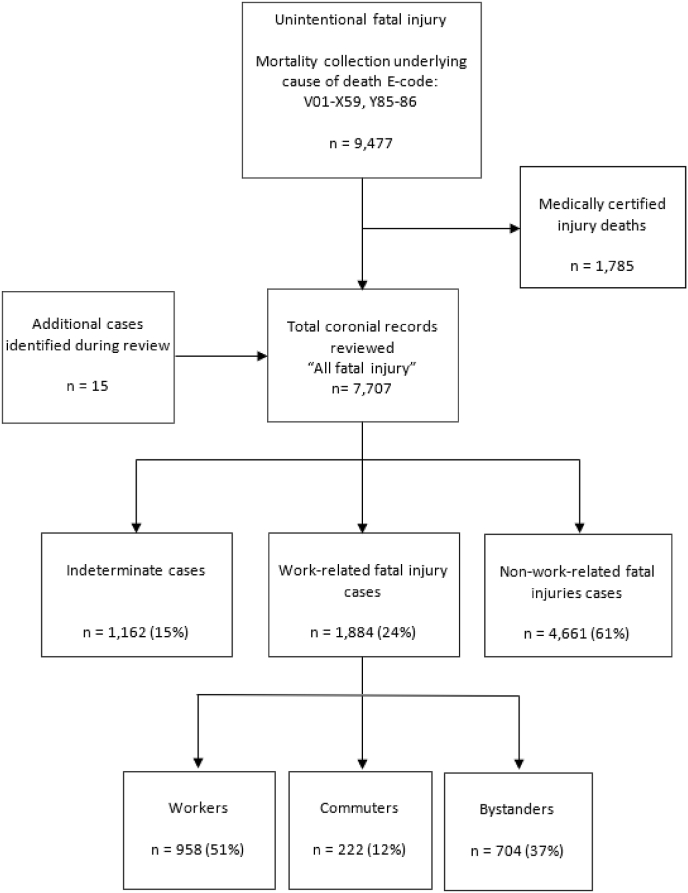
Methods: This observational study selected deaths due to unintentional injury, in persons aged 0-84 years using International Classification of Disease external cause codes, matched to coronial records, and reviewed for work-relatedness. Work-relatedness was determined by the decedent's circumstances at the time of the incident: working for pay, profit, in kind, or an unpaid capacity (worker); commuting to or from work (commuter); or a bystander to another's work activity (bystander). To estimate the burden of WRFI, frequencies, percentages, rates, and years-of-life lost (YLL) were estimated.
Results: In total 7,707 coronial records were reviewed of which 1,884 were identified as work-related, contributing to 24% of the deaths and 23% of the YLL due to injury. Of these deaths close to half (49%) occurred amongst non-working bystanders and commuters. The overall burden of WRFI was widespread across age, sex, ethnic and deprivation sub-groups. Injury deaths due to machinery (97%) and due to being struck by another object (69%) were predominantly work-related.
Interpretation: When utilising a more inclusive definition of work-relatedness the contribution of work to the societal burden of fatal injuries is substantial, conservatively estimated at one quarter of all injury deaths in New Zealand. Other estimates of WRFI likely exclude a similar number of fatalities occurring among commuters and bystanders. The findings, also relevant to other OECD nations, can guide where public health efforts can be used, alongside organisational actions, to reduce WRFI for all those impacted.
Keywords: Bystanders; Commuters; Fatal injury; New Zealand; Societal burden; Work; Workers.
© 2023 The Authors. Published by Elsevier Ltd.
Conflict of interest statement
None.
Figures
References
-
- Access Economics . National Occupational Health and Safety Advisory Committee; Wellington: 2006. The economic and social costs of occupational disease and injury in New Zealand.
-
- Allen, Clarke . National Occupational Health and Safety Advisory Committee; Wellington: 2009. Defining work-related harm. Implications for diagnosis, rehabilitation, compensation and prevention.
-
- Atkinson J., Salmond C., Crampton P. University of Otago; Wellington: 2014. NZDep2013 index of deprivation.
-
- Breslin F., Shannon H. Injury prevention across work and other settings. Scandinavian Journal of Work, Environment & Health. 2005;31(5):401–403. - PubMed
LinkOut - more resources
Full Text Sources
