


Nutritional and prognostic value of bioelectrical phase angle as a potentially modifiable marker in acute myeloid leukemia
- PMID: 36845950
- PMCID: PMC9947571
- DOI: 10.3892/etm.2023.11841
Nutritional and prognostic value of bioelectrical phase angle as a potentially modifiable marker in acute myeloid leukemia
Abstract
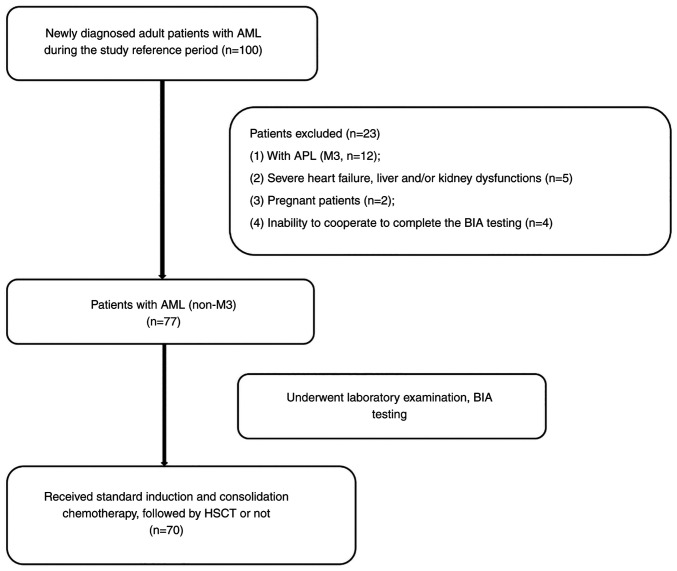
Phase angle (PhA), as measured by bioelectrical impedance analysis, is an important parameter in nutritional assessment and is highly predictive of clinical outcomes in various diseases; however, there is little research on its use in acute myeloid leukemia (AML). Therefore, the present study was conducted to determine the association between PhA and malnutrition and to clarify the prognostic significance of PhA for progression-free survival (PFS) and overall survival (OS) in adult patients with AML (excluding acute promyelocytic leukemia) who were undergoing chemotherapy. A total of 70 patients with newly diagnosed AML were enrolled. After chemotherapy, the nutritional risk for patients with a reduced baseline PhA increased significantly. Disease progression occurred in 28 patients, of which 23 died, with a median follow-up of 9.3 months. A reduced baseline PhA was associated with poor PFS (7.1 months vs. 11.6 months; P=0.001) and OS (8.2 months vs. 12.1 months; P=0.011). A multivariate analysis revealed that a reduced PhA was an independent risk factor for disease progression (hazard ratio, 3.13; 95% CI, 1.21-8.11; P=0.019). Overall, these results suggested that PhA is an effective and sensitive indicator that may provide important nutritional and prognostic information in patients with AML.
Keywords: acute myeloid leukemia; bioelectrical impedance analysis; chemotherapy; nutrition; phase angle; survival.
Copyright © 2020, Spandidos Publications.
Conflict of interest statement
The authors declare that they have no competing interests.
Figures

References
-
- Krug U, Röllig C, Koschmieder A, Heinecke A, Sauerland MC, Schaich M, Thiede C, Kramer M, Braess J, Spiekermann K, et al. Complete remission and early death after intensive chemotherapy in patients aged 60 years or older with acute myeloid leukaemia: A web-based application for prediction of outcomes. Lancet. 2010;376:2000–2008. doi: 10.1016/S0140-6736(10)62105-8. - DOI - PubMed
-
- Döhner H, Estey EH, Amadori S, Appelbaum FR, Büchner T, Burnett AK, Dombret H, Fenaux P, Grimwade D, Larson RA, et al. Diagnosis and management of acute myeloid leukemia in adults: Recommendations from an international expert panel, on behalf of the European LeukemiaNet. Blood. 2010;115:453–474. doi: 10.1182/blood-2009-07-235358. - DOI - PubMed
-
- Le Blanc K, Ringdén O, Remberger M. A low body mass index is correlated with poor survival after allogeneic stem cell transplantation. Haematologica. 2003;88:1044–1052. - PubMed
-
- Bay JO, Dendoncker C, Angeli M, Biot T, Chikhi M, Combal C, Jouannic L, Kermeur G, Lopvet L, Marchand T, et al. Nutritional management for patients hospitalized during allogeneic stem cell transplantation: Guidelines from the Francophone society of bone marrow transplantation and cellular therapy (SFGM-TC) Bull Cancer. 2016;103 (11S):S201–S206. doi: 10.1016/j.bulcan.2016.09.014. (In French) - DOI - PubMed
LinkOut - more resources
Full Text Sources