


Is the myth of left-wing authoritarianism itself a myth?
- PMID: 36846476
- PMCID: PMC9944136
- DOI: 10.3389/fpsyg.2022.1041391
Is the myth of left-wing authoritarianism itself a myth?
Abstract
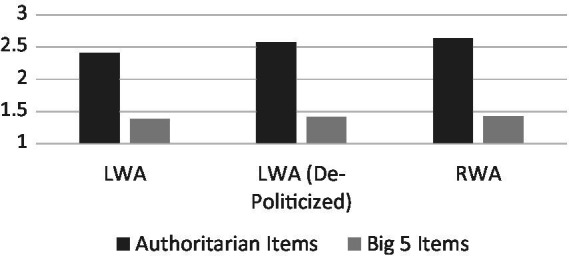
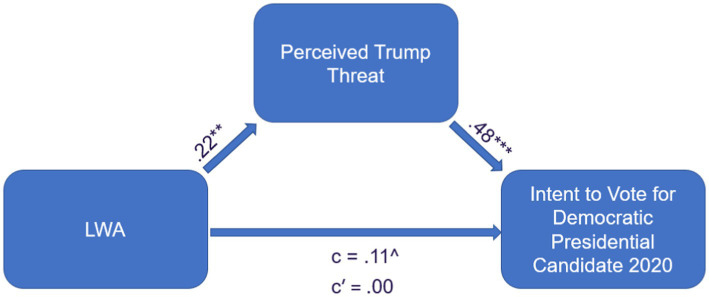
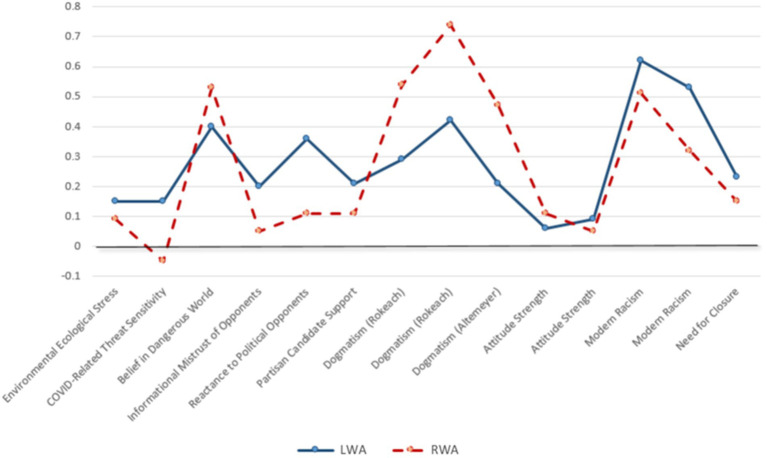
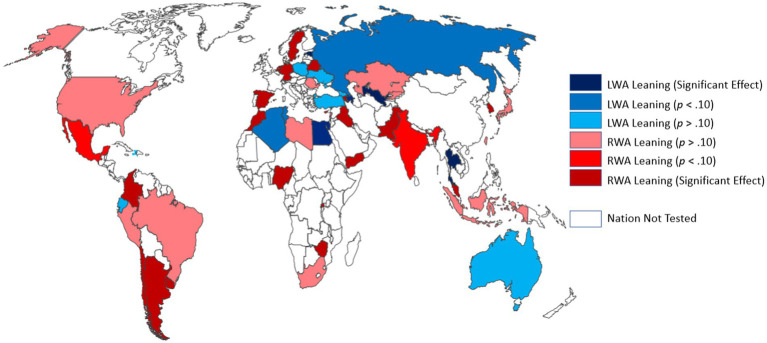
Is left-wing authoritarianism (LWA) closer to a myth or a reality? Twelve studies test the empirical existence and theoretical relevance of LWA. Study 1 reveals that both conservative and liberal Americans identify a large number of left-wing authoritarians in their lives. In Study 2, participants explicitly rate items from a recently-developed LWA measure as valid measurements of authoritarianism. Studies 3-11 show that persons who score high on this same LWA scale possess the traits associated with models of authoritarianism: LWA is positively related to threat sensitivity across multiple areas, including general ecological threats (Study 3), COVID disease threat (Study 4), Belief in a Dangerous World (Study 5), and Trump threat (Study 6). Further, high-LWA persons show more support for restrictive political correctness norms (Study 7), rate African-Americans and Jews more negatively (Studies 8-9), and show more cognitive rigidity (Studies 10 and 11). These effects hold when controlling for political ideology and when looking only within liberals, and further are similar in magnitude to comparable effects for right-wing authoritarianism. Study 12 uses the World Values Survey to provide cross-cultural evidence of Left-Wing Authoritarianism around the globe. Taken in total, this large array of triangulating evidence from 12 studies comprised of over 8,000 participants from the U.S. and over 66,000 participants world-wide strongly suggests that left-wing authoritarianism is much closer to a reality than a myth.
Keywords: conservatism; ideology; left-wing authoritarianism; political psychology; right-wing authoritarianism.
Copyright © 2023 Conway, Zubrod, Chan, McFarland and Van de Vliert.
Conflict of interest statement
The authors declare that the research was conducted in the absence of any commercial or financial relationships that could be construed as a potential conflict of interest.
Figures
References
-
- Altemeyer R. A. (1996). The authoritarian spectre. Cambridge, MA: Harvard University Press.
-
- Altemeyer B. (1998). The other “authoritarian” personality. Adv. Exp. Soc. Psychol. 30, 47–91. doi: 10.1027/1614-0001.27.3.117 - DOI
-
- Ariely G., Davidov E. (2010). Can we rate public support for democracy in comparable way? Cross-national equivalence of democratic attitudes in the world value survey. Soc. Indic. Res. 104, 271–286. doi: 10.1007/s11205-010-9693-5 - DOI
-
- Banaji M. R., Nosek B. A., Greenwald A. G. (2004). No place for nostalgia in science: a response to Arkes and Tetlock. Psychol. Inq. 15, 279–310. doi: 10.1207/s15327965pli1504_02 - DOI
-
- Bates D., Maechler M., Bolker B., Walker S. (2015). Fitting linear mixed effects models using lme4. J. Stat. Softw. 67, 1–48. doi: 10.18637/jss.v067.i01 - DOI
LinkOut - more resources
Full Text Sources
