


Demographic and anthropometric characteristics and their effect on the concentration of heavy metals (arsenic, lead, chromium, zinc) in children and adolescents
- PMID: 36846698
- PMCID: PMC9950940
- DOI: 10.1016/j.heliyon.2023.e13621
Demographic and anthropometric characteristics and their effect on the concentration of heavy metals (arsenic, lead, chromium, zinc) in children and adolescents
Abstract
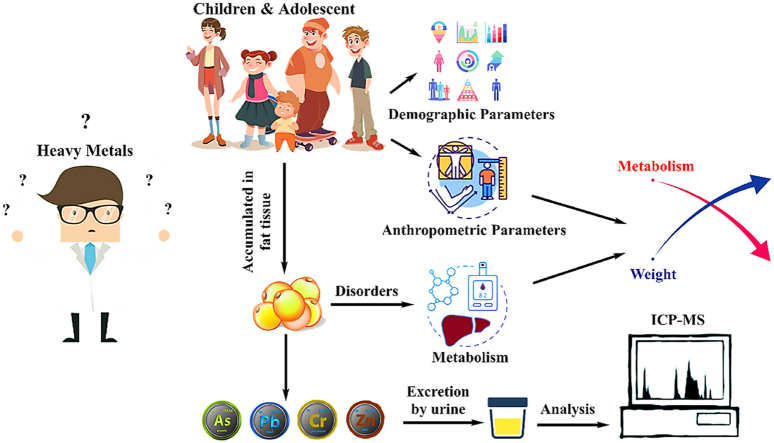
Background: Biomonitoring is a well-established method for assessing people's exposure to contaminants in the environment. Many non-communicable diseases can be prevented or aggravated by physiologically monitoring heavy metals in biological matrices such as urine, evaluating their association with non-communicable diseases, and attempting to limit exposure to them. The focus of this research was to determine the association between potentially toxic elements (PTE) such as arsenic (As), lead (Pb), chromium (Cr), and zinc (Zn) urine concentrations and anthropometric indices and demographic data in children and adolescents aged 6-18 years in Kerman, Iran.
Methods: 106 children and adolescents aged 6-18 years in Kerman were randomly selected. A questionnaire was used to acquire demographic information from the participants' parents. Height, weight, and waist circumference (WC) were all assessed, as well as body mass index (BMI) and BMI Z-score. Induced Coupled Plasma Mass Spectrometry (ICP/MS) was used to quantify As, Pb, Cr, and Zn concentrations in participants' urine.
Results: The geometric mean concentrations were As (38.72 ± 39.30), Pb (19.58 ± 22.91), Cr (1.06 ± 0.28), and Zn (344.72 ± 288.16) μg/creatinine. Boys aged 12-18 years old had higher mean concentration of As than boys aged 6-11 years old (p = 0.019) according to two measurement standards, μg/L, and μg/creatinine, whereas girls had no significant difference. In general, there was a strong association between parental education and metal concentrations of As, Pb, and Cr. As, Pb, and Zn (μg/creatinine) had a significant positive association with BMI z-score and BMI. As, Pb, and Zn metals were shown to have a substantial positive association (p < 0.001). There was no evidence of an association between the metals evaluated and WC.
Conclusions: The findings of this study generally showed that there was a significant association between demographic characteristics and exposure to these metals in children and adolescents, indicating that these people were exposed to these metals, which can harm their health. As a result, the pathways of exposure to metals must be limited.
Keywords: Adolescents; Body mass index; Children; Demographic factors; Heavy metals; Obesity.
© 2023 The Authors.
Conflict of interest statement
The authors declare that they have no known competing financial interests or personal relationships that could have appeared to influence the work reported in this paper.
Similar articles
-
Association of As, Pb, Cr, and Zn urinary heavy metals levels with predictive indicators of cardiovascular disease and obesity in children and adolescents.Chemosphere. 2022 May;294:133664. doi: 10.1016/j.chemosphere.2022.133664. Epub 2022 Jan 20. Chemosphere. 2022. PMID: 35066075
-
Blood and urinary levels of metals and metalloids in the general adult population of Northern France: The IMEPOGE study, 2008-2010.Int J Hyg Environ Health. 2017 Apr;220(2 Pt B):341-363. doi: 10.1016/j.ijheh.2016.09.020. Epub 2016 Oct 3. Int J Hyg Environ Health. 2017. PMID: 27931767
-
[Health risk assessment of exposure to metals in the workers of the steel foundry and in the general population of Taranto (Italy)].G Ital Med Lav Ergon. 2012 Oct-Dec;34(4):381-91. G Ital Med Lav Ergon. 2012. PMID: 23477104 Italian.
-
Pollution status and human health risk assessments of selected heavy metals in urban dust of 16 cities in Iran.Environ Sci Pollut Res Int. 2020 Jun;27(18):23094-23107. doi: 10.1007/s11356-020-08585-8. Epub 2020 Apr 24. Environ Sci Pollut Res Int. 2020. PMID: 32329009 Review.
-
A review of Human Biomonitoring studies of trace elements in Pakistan.Chemosphere. 2016 Nov;163:153-176. doi: 10.1016/j.chemosphere.2016.08.011. Epub 2016 Aug 13. Chemosphere. 2016. PMID: 27529382 Review.
Cited by
-
Benefits of fermented synbiotic soymilk containing Lactobacillus acidophilus, Bifidobacterium lactis, and inulin towards lead toxicity alleviation.Heliyon. 2023 Jun 23;9(6):e17518. doi: 10.1016/j.heliyon.2023.e17518. eCollection 2023 Jun. Heliyon. 2023. PMID: 37408889 Free PMC article.
-
As, Cd, Hg, and Pb Biological Concentrations and Anthropometry in Slovak Adolescents.Biol Trace Elem Res. 2025 Aug;203(8):4052-4064. doi: 10.1007/s12011-024-04484-y. Epub 2024 Dec 19. Biol Trace Elem Res. 2025. PMID: 39699706
-
Mitigating the Accumulation of Mercury (Hg) and Lead (Pb) through Humic Acid Application under Aquaponic Conditions Using Watercress (Nasturtium officinale R. Br.) as a Model Plant.Plants (Basel). 2024 Aug 27;13(17):2386. doi: 10.3390/plants13172386. Plants (Basel). 2024. PMID: 39273870 Free PMC article.
-
Monitoring of urinary nickel and chromium in metal industries workers in Alborz, Iran.Sci Rep. 2024 Oct 26;14(1):25492. doi: 10.1038/s41598-024-77566-5. Sci Rep. 2024. PMID: 39462091 Free PMC article.
-
Per- and poly-fluoroalkyl substances as forever chemicals in drinking water: Unraveling the nexus with obesity and endocrine disruption - A mini review.Heliyon. 2025 Feb 18;11(4):e42782. doi: 10.1016/j.heliyon.2025.e42782. eCollection 2025 Feb 28. Heliyon. 2025. PMID: 40066031 Free PMC article. Review.
References
-
- Samiee F., et al. Exposure to heavy metals released to the environment through breastfeeding: a probabilistic risk estimation. Sci. Total Environ. 2019;650:3075–3083. - PubMed
-
- Shao W., et al. Association between level of urinary trace heavy metals and obesity among children aged 6–19 years: NHANES 1999–2011. Environ. Sci. Pollut. Control Ser. 2017;24(12):11573–11581. - PubMed
LinkOut - more resources
Full Text Sources
Research Materials
