


doi: 10.1002/mds.29362.
Epub 2023 Feb 27.
Redefining Bradykinesia
Affiliations
- PMID: 36847357
- PMCID: PMC10387192
- DOI: 10.1002/mds.29362
Item in Clipboard
Redefining Bradykinesia
Mov Disord.
2023 Apr.
No abstract available
Keywords: Parkinson's disease; atypical parkinsonism; bradykinesia.
Conflict of interest statement
Conflict of Interest
None of the authors have any potential conflicts of interest to disclose.
Figures
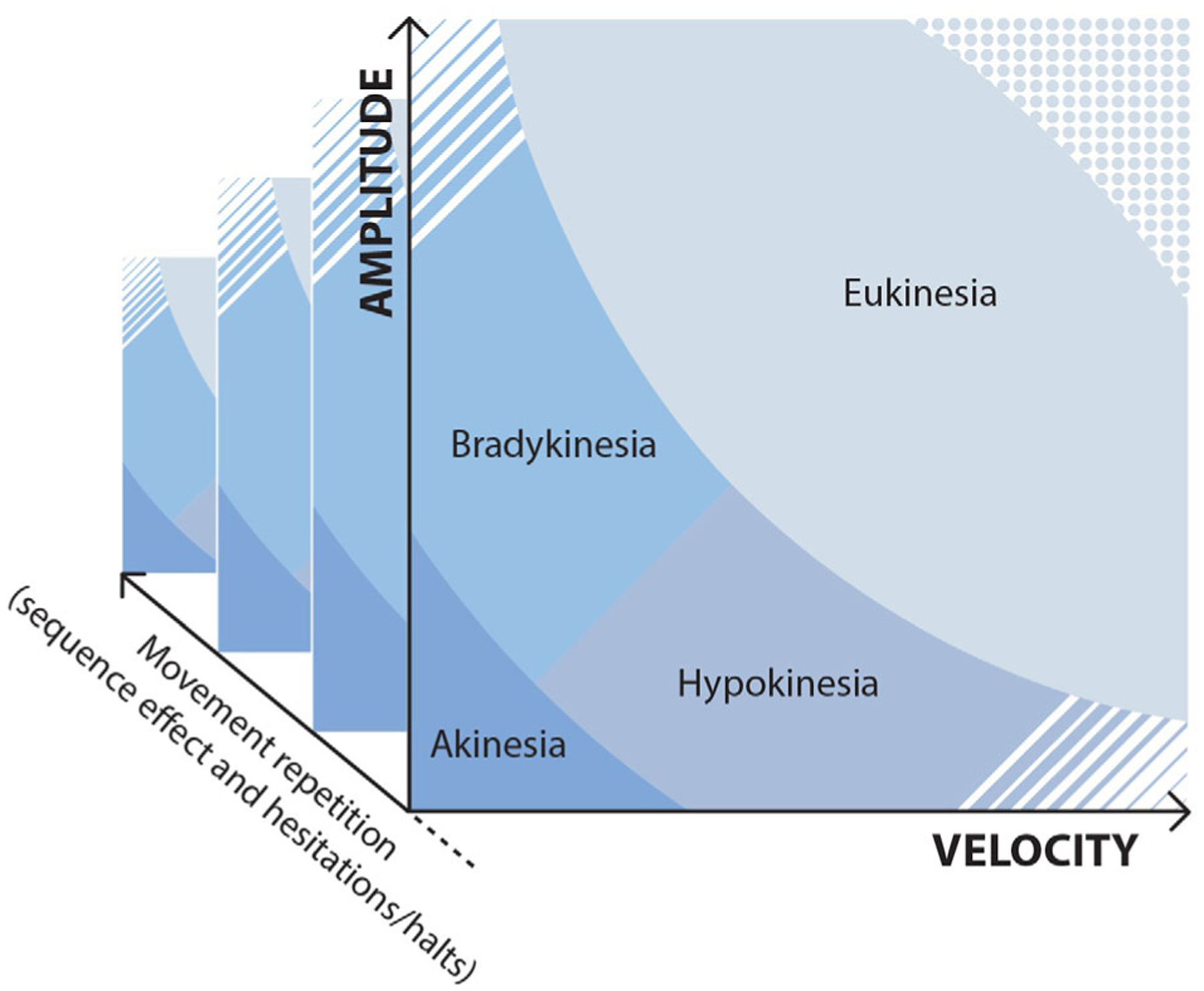
The figure schematically represents the two main dimensions of voluntary movement, namely velocity (x-axis) and amplitude (y-axis). Based on these two values, the movement can be considered predominantly bradykinetic if of reduced velocity or hypokinetic if of reduced amplitude. If both parameters are markedly reduced, the movement is defined as akinetic. Conversely, amplitude and velocity may be within a normal range (eukinesia). In some cases, velocity and amplitude may have values that exceed normal limits, as observed in some hyperkinesias, for example, ballismus. The dashed area at the lower right indicates markedly reduced amplitude but high velocity movements. The dashed area at the upper left indicates markedly reduced velocity but high amplitude movements. Dotted and dashed areas overall indicate unlikely movement values. With the repetition of the movement (z-axis), changes in motor performance can be observed in terms of amplitude and/or velocity reduction (sequence effect) or motor hesitations/halts. Note that although in this figure distinct limits are depicted to differentiate the various areas, these limits may be blurred in the reality. Again, the limits for the definition of movement abnormalities are arbitrary and may be modified in future experimental studies, though the conceptual framework of the new definition of bradykinesia elaborated here should remain unchanged.
References
Publication types
MeSH terms
Grants and funding
LinkOut - more resources
Full Text Sources
Medical
