


Rising Mortality in Coronavirus-19 Patients Supported With Extracorporeal Membrane Oxygenation
- PMID: 36847807
- PMCID: PMC9949370
- DOI: 10.1097/MAT.0000000000001837
Rising Mortality in Coronavirus-19 Patients Supported With Extracorporeal Membrane Oxygenation
Abstract
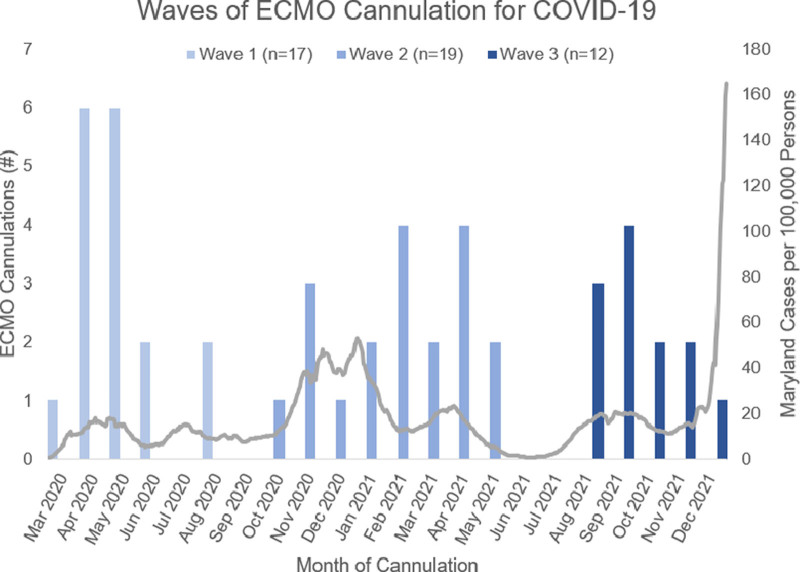
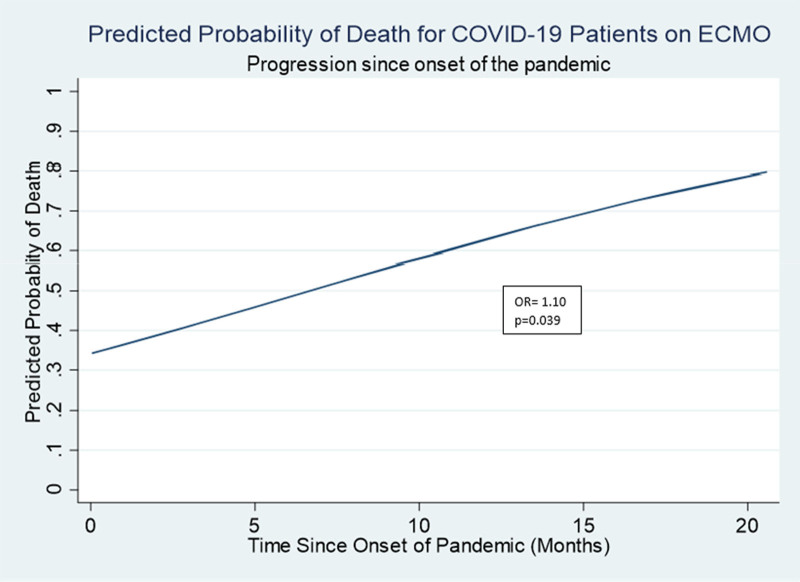
We aimed to describe practice patterns and outcomes in patients with extracorporeal membrane oxygenation (ECMO) support throughout the coronavirus 2019 (COVID-19) pandemic, with the hypothesis that mortality would improve as we accumulated knowledge and experience. We included 48 patients supported on veno-venous ECMO (VV-ECMO) at a single institution between April 2020 and December 2021. Patients were categorized into three waves based on cannulation date, corresponding to the wild-type (wave 1), alpha (wave 2), and delta (wave 3) variants. One hundred percent of patients in waves 2 and 3 received glucocorticoids, compared with 29% in wave 1 ( p < 0.01), and the majority received remdesivir (84% and 92% in waves 2 and 3, vs . 35% in wave 1; p < 0.01). Duration of pre-ECMO noninvasive ventilation was longer in waves 2 and 3 (mean 8.8 days and 3.9 days, vs . 0.7 days in wave 1; p < 0.01), as was time to cannulation (mean 17.2 and 14.6 days vs . 8.8 days in wave 1; p < 0.01) and ECMO duration (mean 55.7 days and 43.0 days vs . 28.4 days in wave 1; p = 0.02). Mortality in wave 1 was 35%, compared with 63% and 75% in waves 2 and 3 ( p = 0.05). These results suggest an increased prevalence of medically refractory disease and rising mortality in later variants of COVID-19.
Copyright © ASAIO 2023.
Conflict of interest statement
Disclosure: The authors have no conflicts of interest to report.
Figures
References
-
- Shekar K, Badulak J, Peek G, et al. ; ELSO Guideline Working Group: Extracorporeal life support organization coronavirus disease 2019 interim guidelines: A consensus document from an international group of interdisciplinary extracorporeal membrane oxygenation providers. ASAIO J 66: 707–721, 2020. - PMC - PubMed
-
- Grasselli G, Pesenti A, Cecconi M: Critical care utilization for the COVID-19 outbreak in Lombardy, Italy: Early experience and forecast during an emergency response. JAMA 323: 1545–1546, 2020. - PubMed
Publication types
MeSH terms
Grants and funding
LinkOut - more resources
Full Text Sources
Medical
Miscellaneous
