


Evaluation and comparison of four quantitative SARS-CoV-2 serological assays in COVID-19 patients and immunized healthy individuals, cancer patients, and patients with immunosuppressive therapy
- PMID: 36849050
- PMCID: PMC9968448
- DOI: 10.1016/j.clinbiochem.2023.02.010
Evaluation and comparison of four quantitative SARS-CoV-2 serological assays in COVID-19 patients and immunized healthy individuals, cancer patients, and patients with immunosuppressive therapy
Abstract
Background: Semi-quantitative and quantitative immunoassays are the most commonly used methodology to evaluate immunity post immunization.
Objectives: To compare four quantitative SARS-CoV-2 serological assays in COVID-19 patients and immunized healthy individuals, cancer patients, and patients with immunosuppressive therapy.
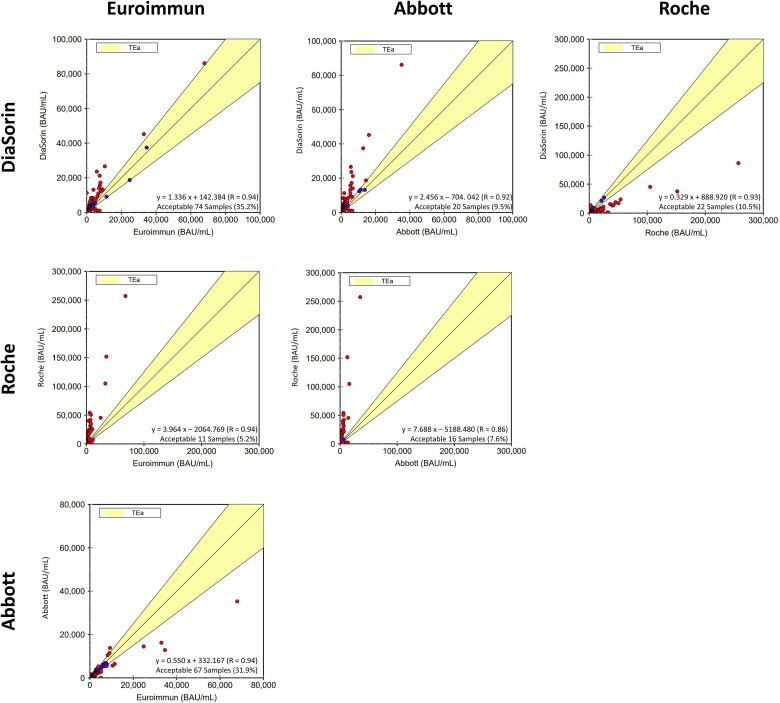
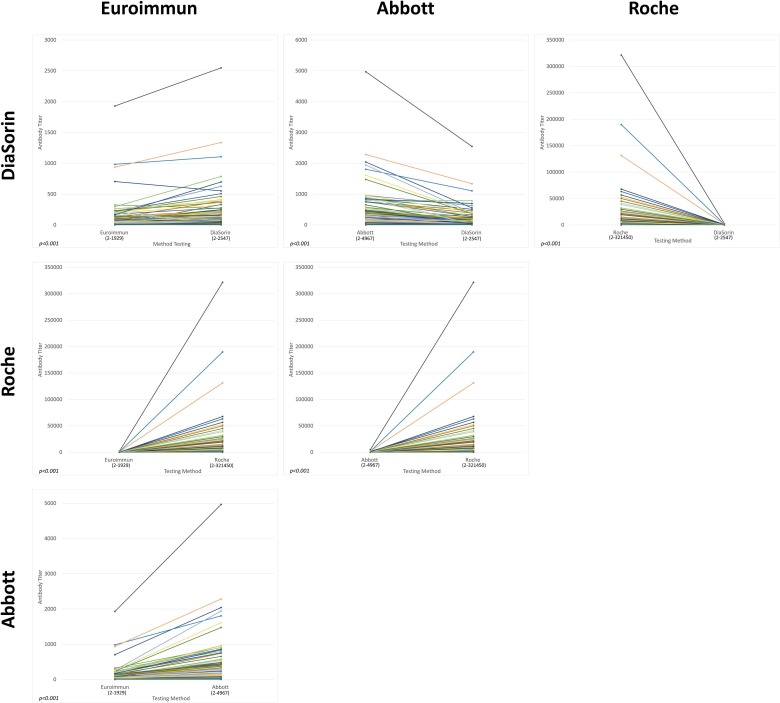
Study design: 210 serological samples from COVID-19 infection and vaccination cohorts were used to create a serological sample repository. Serological methods from four manufacturers, namely Euroimmun, Roche, Abbott, and DiaSorin, were evaluated for quantitative, semi-quantitative, and qualitative antibody measurements. All four methods measure IgG antibodies against the SARS-CoV-2 spike receptor-binding domain and report the results in Binding Antibody Unit/mL (BAU/mL). A Total Error Allowable (TEa) of ±25% was chosen as the criteria to determine whether two methods are clinically equivalent quantitatively. Semi-quantitative results (titers) were derived using numeric antibody concentration divided by the cut-off value for each method.
Results: All paired quantitative comparisons demonstrated unacceptable performance. With ±25% as TEa, the best agreement was 74 (35.2% out of 210 samples) between Euroimmun and DiaSorin, whereas the lowest agreement was 11 (5.2% out of 210 samples) between Euroimmun and Roche. Antibody titers amongst all four methods were significantly different (p < 0.001). The highest titer difference from the same sample is between Roche and DiaSorin with a 1392-fold difference. On qualitative comparison, none of the paired comparison showed acceptable comparison (p < 0.001).
Conclusions: Poor correlation exists between four evaluated assays, quantitatively, semi-quantitatively, and qualitatively. Further harmonization of assays is required to achieve comparable measurements.
Keywords: Comparability; SARS-CoV-2 vaccination; Serological assays; Standardization.
Copyright © 2023 The Canadian Society of Clinical Chemists. Published by Elsevier Inc. All rights reserved.
Conflict of interest statement
Declaration of Competing Interest The study was funded by the PSI foundation: 2020–1972, and Southeastern Ontario Academic Medical Organization Innovation Fund 2021. The study received in-kind reagent support and limited financial support from EUROIMMUN AG, Abbott, Roche, and DiaSorin.
Figures
References
-
- Statistics and Research Coronavirus (COVID-19) Vaccinations. https://ourworldindata.org/covid-vaccinations, (accessed on August 03, 2022). .
-
- Health Canada, Approved COVID-19 Vaccines, (accessed on August 03, 2022). https://www.canada.ca/en/health-canada/services/drugs-health-products/co....
-
- The U.S. Food and Drug Administration, “COVID-19 Vaccines,” (accessed on August 03, 2022). https://www.fda.gov/emergency-preparedness-and-response/coronavirus-dise....
MeSH terms
Substances
LinkOut - more resources
Full Text Sources
Medical
Miscellaneous
