. 2023 Apr;15(4):468-474.
doi: 10.1038/s41557-023-01137-w. Epub 2023 Feb 27.

Janus-type emission from a cyclometalated iron(III) complex

Affiliations

Janus-type emission from a cyclometalated iron(III) complex

Jakob Steube et al. Nat Chem. 2023 Apr.

Abstract

Although iron is a dream candidate to substitute noble metals in photoactive complexes, realization of emissive and photoactive iron compounds is demanding due to the fast deactivation of their charge-transfer states. Emissive iron compounds are scarce and dual emission has not been observed before. Here we report the FeIII complex [Fe(ImP)2][PF6] (HImP = 1,1'-(1,3-phenylene)bis(3-methyl-1-imidazol-2-ylidene)), showing a Janus-type dual emission from ligand-to-metal charge transfer (LMCT)- and metal-to-ligand charge transfer (MLCT)-dominated states. This behaviour is achieved by a ligand design that combines four N-heterocyclic carbenes with two cyclometalating aryl units. The low-lying π* levels of the cyclometalating units lead to energetically accessible MLCT states that cannot evolve into LMCT states. With a lifetime of 4.6 ns, the strongly reducing and oxidizing MLCT-dominated state can initiate electron transfer reactions, which could constitute a basis for future applications of iron in photoredox catalysis.


Conflict of interest statement

The authors declare no competing interests.

Figures
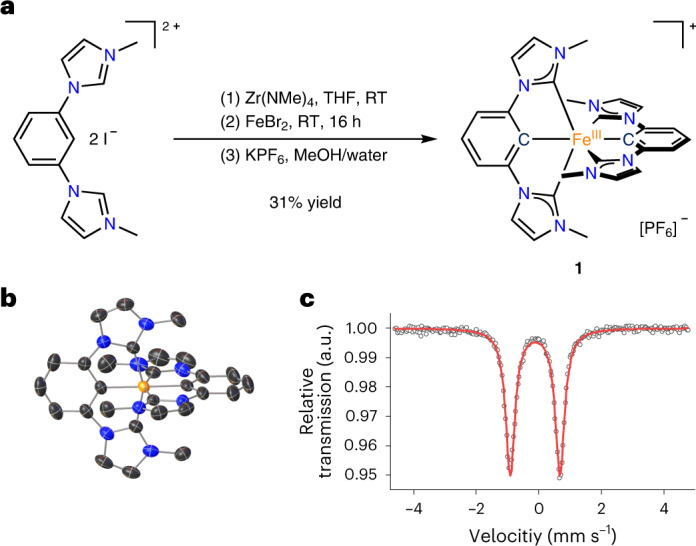
Fig. 1
Fig. 1. Synthesis, X-ray structure and Mössbauer spectrum of 1.
a, Activation of the pro-ligand using a zirconium reagent with subsequent transmetalation onto iron. MeOH, methanol; RT, room temperature; THF, tetrahydrofuran. Due to the donor strength of the ligand, the FeII complex is oxidized under air to the FeIII complex 1. b, Structure of the cation of 1, as determined by X-ray diffraction. Hydrogen atoms and counter ion are omitted for clarity. c, Mössbauer spectrum of 1 at 80 K showing the characteristic doublet of a low-spin FeIII complex. Source data
Fig. 2
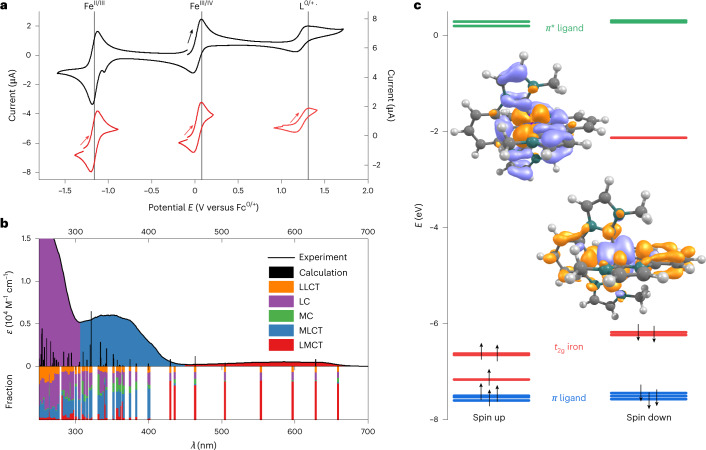
Fig. 2. Electrochemical, optical and electronic properties of 1.
a, Cyclic voltammogram of 1 (10−3 M) in MeCN with 0.1 M [nBu4N][PF6] as the electrolyte at a scan rate of 100 mV s−1. Left y axis, whole voltammogram; right y axis, individual voltammograms. b, Ultraviolet–visible spectrum of 1 in MeCN (10−4 M) with TDDFT-calculated transitions and contributions from ligand-to-ligand charge-transfer (LLCT), ligand-centred ππ* (LC), metal-centred (MC), LMCT and MLCT states. c, Molecular orbital scheme showing the highest occupied orbitals (t 2g orbitals (red) and ligand-based orbitals (blue)) and the lowest unoccupied orbitals (π* orbitals of the ligand moiety (green)). The transition densities of the dominant LMCT (left) and MLCT (right) transitions are also depicted (hole, purple; electron, orange). Source data
Fig. 3
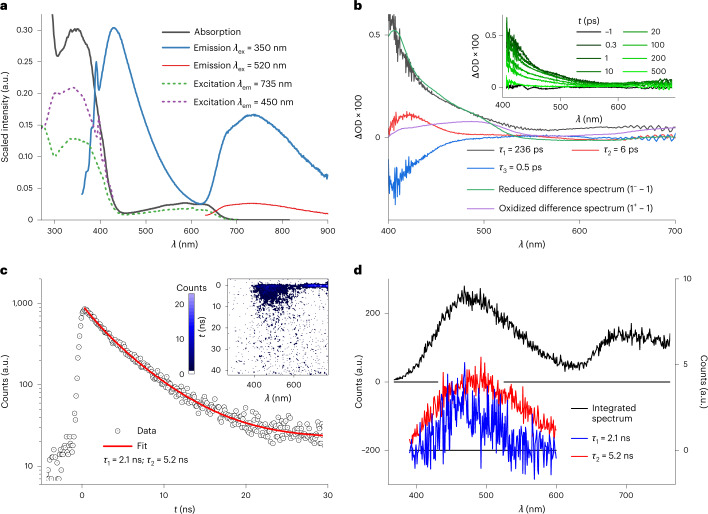
Fig. 3. Excited-state spectroscopy and characterization of 1.
a, Absorption and emission spectra of 1 at λ ex = 350 and 520 nm. The excitation spectra measured at 735 and 450 nm are shown as dashed lines. b, DAAS with τ 1 = 236 ps, τ 2 = 6.1 ps and τ 3 = 0.5 ps, obtained from femtosecond transient absorption data after excitation at 330 nm and compared with the reduction and oxidation difference spectra obtained from spectroelectrochemical measurements as rough models for LMCT and MLCT excited states neglecting the radical cation and radical anion character of the ligands in these excited states. Inset, transient absorption spectra at the given delay times. ΔOD, change in the optical density. c, Decay of the fluorescence between 390 and 600 nm obtained from SCMs (inset) of a degassed solution of 1 in MeCN after 330 nm excitation, showing a double exponential decay with time constants of 2.1 ns (27.3%) and 5.2 ns (72.7%). d, Time-integrated spectrum obtained from SCMs with λ ex = 330 nm (left y axis), showing a close resemblance with the fluorescence spectrum and the amplitude spectra of the 2.1 and 5.2 ns components (right y axis). Source data
Fig. 4
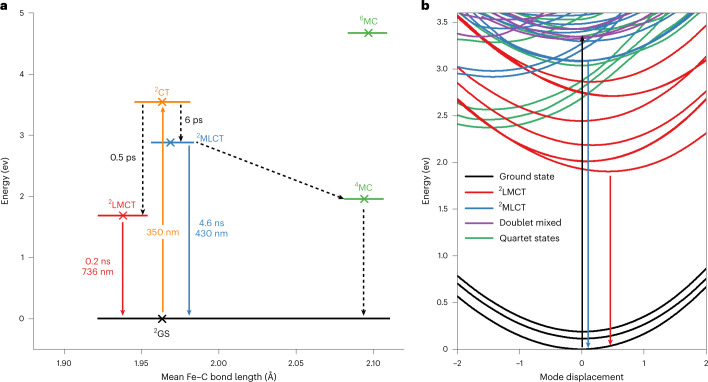
Fig. 4. Summary of deactivation pathways and associated time scales of 1.
a, Jablonski diagram based on the experimental results and calculated ground-state DFT energies of the optimized doublet, quartet and sextet states in their respective geometries (crosses). The 2LMCT and 2MLCT geometries are approximated from the calculated geometries of 1 and 1 +. The orange arrow indicates the excitation at 350 nm, the dotted arrows indicate non-radiative transitions, the blue arrow indicates the MLCT emission and the red arrow indicates the LMCT emission. GS, ground state; CT, charge transfer; MC, metal centred. b, TDDFT potential energy curves for displacement along with the a1 symmetry vibrational mode (in D2d symmetry), showing doublet LMCT, MLCT and mixed LMCT/ligand-centred states, as well as quartet metal-centred states. The black arrow indicates the excitation at 350 nm, the blue arrow indicates the MLCT emission and the red arrow indicates the LMCT emission.

References

    1. McCusker JK. Electronic structure in the transition metal block and its implications for light harvesting. Science. 2019;363:484–488. doi: 10.1126/science.aav9104. - DOI - PubMed
    1. Monat JE, McCusker JK. Femtosecond excited-state dynamics of an iron(ii) polypyridyl solar cell sensitizer model. J. Am. Chem. Soc. 2000;122:4092–4097. doi: 10.1021/ja992436o. - DOI
    1. Liu Y, Persson P, Sundstrom V, Wärnmark K. Fe N-heterocyclic carbene complexes as promising photosensitizers. Acc. Chem. Res. 2016;49:1477–1485. doi: 10.1021/acs.accounts.6b00186. - DOI - PubMed
    1. Zimmer P, et al. The connection between NHC ligand count and photophysical properties in Fe(ii) photosensitizers. An experimental study. Inorg. Chem. 2018;57:360–373. doi: 10.1021/acs.inorgchem.7b02624. - DOI - PubMed
    1. Zimmer P, et al. Towards noble-metal-free dyads: ground and excited state tuning by a cobalt dimethylglyoxime motif connected to an iron N-heterocyclic carbene photosensitizer. Eur. J. Inorg. Chem. 2018;2018:5203–5214. doi: 10.1002/ejic.201800946. - DOI