


Sievert or Gray: Dose Quantities and Protection Levels in Emergency Exposure
- PMID: 36850517
- PMCID: PMC9959072
- DOI: 10.3390/s23041918
Sievert or Gray: Dose Quantities and Protection Levels in Emergency Exposure
Abstract
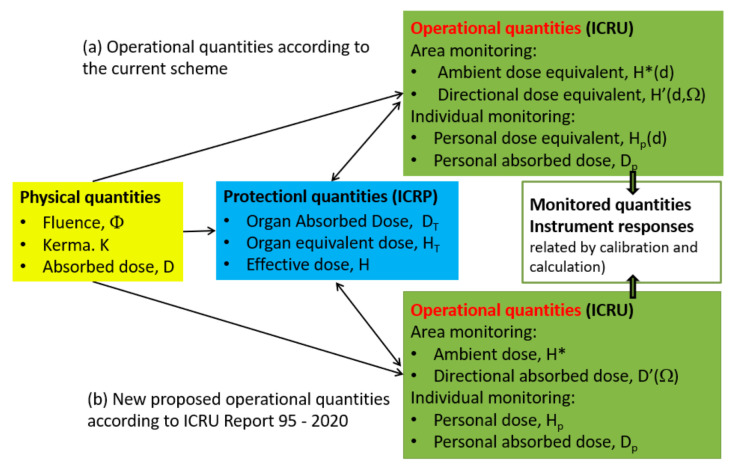
Mitigation or even elimination of adverse effects caused by ionizing radiation is the main scope of the radiation protection discipline. The interaction of radiation with living matter is quantified and correlated with biological effects by dose. The Sievert is the most well-known quantity, and it is used with the equivalent and effective dose to minimize stochastic effects. However, Gray is the reference quantity for sizing tissue reactions that could occur under high-exposure conditions such as in a radiation emergency. The topics addressed in this review are the choice to move from Sievert to Gray, how the operational quantities for environmental and individual monitoring of the detectors should consider such a change of units, and why reference levels substitute dose levels in emergency exposure.
Keywords: dose quantities; dose reference levels; radiation emergency.
Conflict of interest statement
The authors declare no conflict of interest.
Figures
References
-
- ICRP 1990 Recommendations of the International Commission on Radiological Protection, ICRP Publication 60. Ann. ICRP. 1991;21:1–201. - PubMed
-
- ICRP 1977 Recommendations of the International Commission on Radiological Protection, ICRP Publication 26. Ann. ICRP. 1977;1:1–87.
-
- ICRP The 2007 Recommendations of the International Commission on Radiological Protection, ICRP Publication 103. Ann. ICRP. 2007;37:1–339. - PubMed
Publication types
MeSH terms
LinkOut - more resources
Full Text Sources
Medical
