


Advances in High-Energy-Resolution CdZnTe Linear Array Pixel Detectors with Fast and Low Noise Readout Electronics
- PMID: 36850765
- PMCID: PMC9960822
- DOI: 10.3390/s23042167
Advances in High-Energy-Resolution CdZnTe Linear Array Pixel Detectors with Fast and Low Noise Readout Electronics
Abstract
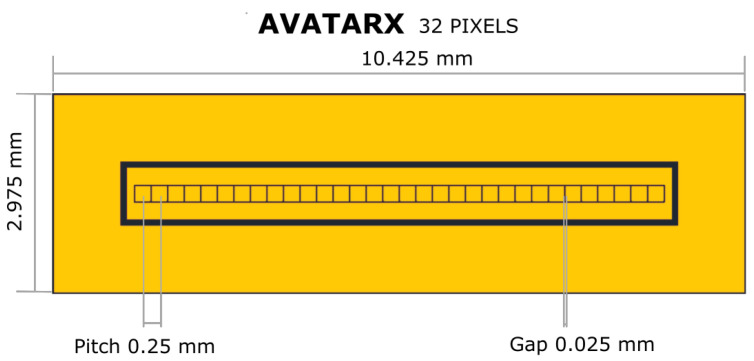
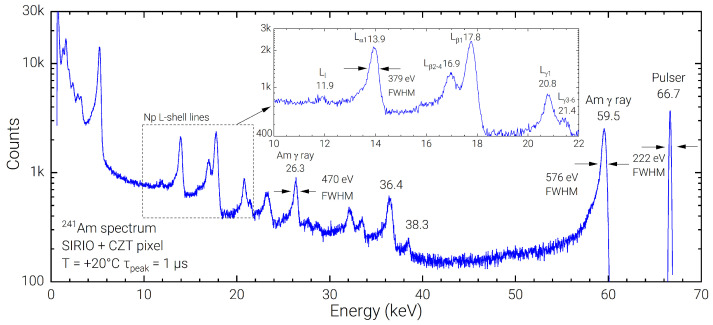
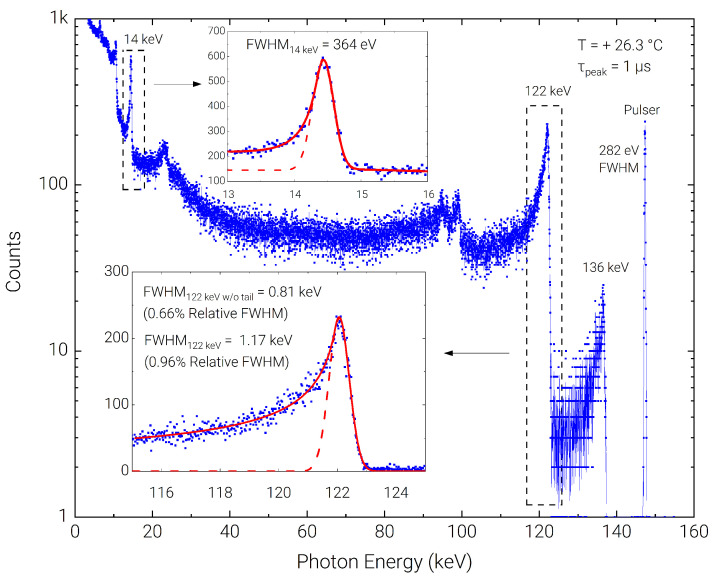
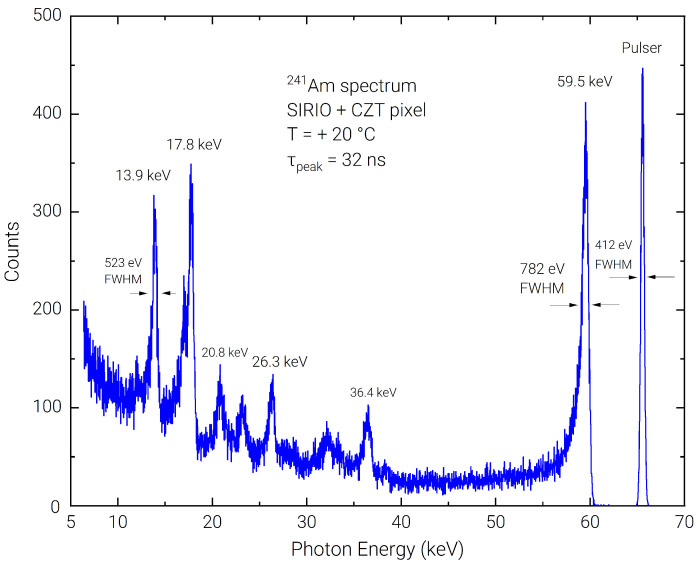
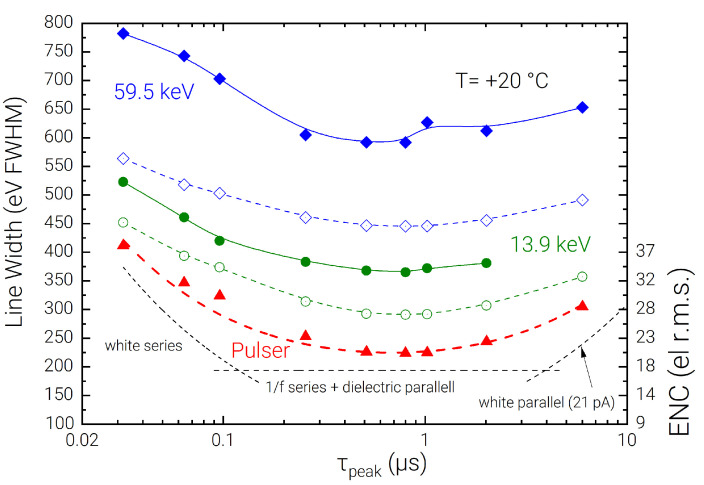
Radiation detectors based on Cadmium Zinc Telluride (CZT) compounds are becoming popular solutions thanks to their high detection efficiency, room temperature operation, and to their reliability in compact detection systems for medical, astrophysical, or industrial applications. However, despite a huge effort to improve the technological process, CZT detectors' full potential has not been completely exploited when both high spatial and energy resolution are required by the application, especially at low energies (<10 keV), limiting their application in energy-resolved photon counting (ERPC) systems. This gap can also be attributed to the lack of dedicated front-end electronics which can bring out the best in terms of detector spectroscopic performances. In this work, we present the latest results achieved in terms of energy resolution using SIRIO, a fast low-noise charge sensitive amplifier, and a linear-array pixel detector, based on boron oxide encapsulated vertical Bridgman-grown B-VB CZT crystals. The detector features a 0.25-mm pitch, a 1-mm thickness and is operated at a -700-V bias voltage. An equivalent noise charge of 39.2 el. r.m.s. (corresponding to 412 eV FWHM) was measured on the test pulser at 32 ns peaking time, leading to a raw resolution of 1.3% (782 eV FWHM) on the 59 keV line at room temperature (+20 °C) using an uncollimated 241Am, largely improving the current state of the art for CZT-based detection systems at such short peaking times, and achieving an optimum resolution of 0.97% (576 eV FWHM) at 1 µs peaking time. The measured energy resolution at the 122 keV line and with 1 µs peaking time of a 57Co raw uncollimated spectrum is 0.96% (1.17 keV). These activities are in the framework of an Italian collaboration on the development of energy-resolved X-ray scanners for material recycling, medical applications, and non-destructive testing in the food industry.
Keywords: CZT; CdZnTe; Gamma-ray spectroscopy; X-ray spectroscopy; nuclear microelectronics; semiconductor radiation detectors.
Conflict of interest statement
The authors declare no conflict of interest.
Figures
References
-
- Garavelli B., Pozzi P., Macera D., Zanotti L., Mencarelli A., Bubba G., Bertoni P., Sammartini M., Bettelli M., Bertuccio G., et al. XSpectra®: An Advanced Real-Time Food Contaminants Detector; Proceedings of the 2019 IEEE Nuclear Science Symposium and Medical Imaging Conference (NSS/MIC); Manchester, UK. 26 October–2 November 2019; pp. 1–3.
-
- Nguyen J., Rodesch P.A., Richtsmeier D., Iniewski K., Bazalova-Carter M. Optimization of a CZT photon counting detector for contaminant detection. J. Instrum. 2021;16:P11015. doi: 10.1088/1748-0221/16/11/P11015. - DOI
-
- Richtsmeier D., Guliyev E., Iniewski K., Bazalova-Carter M. Contaminant detection in non-destructive testing using a CZT photon-counting detector. J. Instrum. 2021;16:P01011. doi: 10.1088/1748-0221/16/01/P01011. - DOI
-
- Takahashi T., Watanabe S. Recent progress in CdTe and CdZnTe detectors. IEEE Trans. Nucl. Sci. 2001;48:950–959. doi: 10.1109/23.958705. - DOI
Grants and funding
LinkOut - more resources
Full Text Sources
Miscellaneous
