. 2023 Jan 30;15(2):397.
doi: 10.3390/v15020397.

Propagation of SARS-CoV-2 in a Closed Cell Culture Device: Potential GMP Compatible Production Platform for Live-Attenuated Vaccine Candidates under BSL-3 Conditions?

Affiliations

Propagation of SARS-CoV-2 in a Closed Cell Culture Device: Potential GMP Compatible Production Platform for Live-Attenuated Vaccine Candidates under BSL-3 Conditions?

Stephan Klessing et al. Viruses. .

Abstract

Live-attenuated SARS-CoV-2 vaccines present themselves as a promising approach for the induction of broad mucosal immunity. However, for initial safety assessment in clinical trials, virus production requires conditions meeting Good Manufacturing Practice (GMP) standards while maintaining biosafety level 3 (BSL-3) requirements. Since facilities providing the necessary complex ventilation systems to meet both requirements are rare, we here describe a possibility to reproducibly propagate SARS-CoV-2 in the automated, closed cell culture device CliniMACS Prodigy® in a common BSL-3 laboratory. In this proof-of-concept study, we observed an approximately 300-fold amplification of SARS-CoV-2 under serum-free conditions with high lot-to-lot consistency in the infectious titers obtained. With the possibility to increase production capacity to up to 3000 doses per run, this study outlines a potential fast-track approach for the production of live-attenuated vaccine candidates based on highly pathogenic viruses under GMP-like conditions that may contribute to pandemic preparedness.

Keywords: CliniMACS Prodigy®; GMP; SARS-CoV-2; human challenge study; live-attenuated vaccines; virus propagation.


Conflict of interest statement

Author Hans-Dieter Steibl was employed by the company Miltenyi Biotec B.V. & Co. KG, Bergisch Gladbach, Germany. The author declares that the research was conducted in the absence of any commercial or financial relationships that could be construed as a potential conflict of interest.

Figures
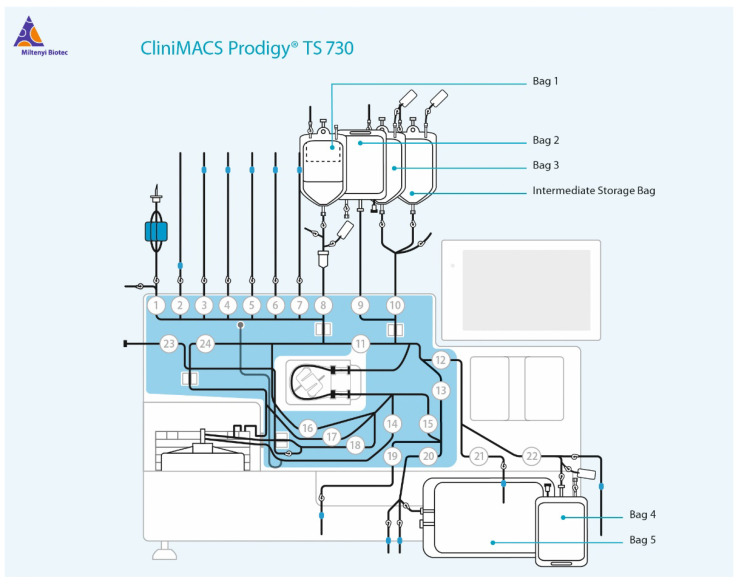
Figure A1
Figure A1
Schematic overview of the CliniMACS Prodigy® with tubing set TS730. Additional bags can be attached by sterile welding to the tubes at valves 1–7 and contained liquids (buffer, media, cells, etc.) are transferred through the device by a peristaltic pump (central position) directed by opening/closing of valves (1–24). Here, several predefined modules allow the user to operate the device through the touchscreen (top right). In the Centricult unit (bottom left), cells can be cultured, centrifuged or a microscopic picture can be taken at conditions chosen by the user. Supernatants are discarded in the waste bag (Bag 5) or to additional sample bags attached by sterile welding. Copyright © 2023 Miltenyi Biotec B.V. & Co. KG. All rights reserved.
Figure 1
Figure 1
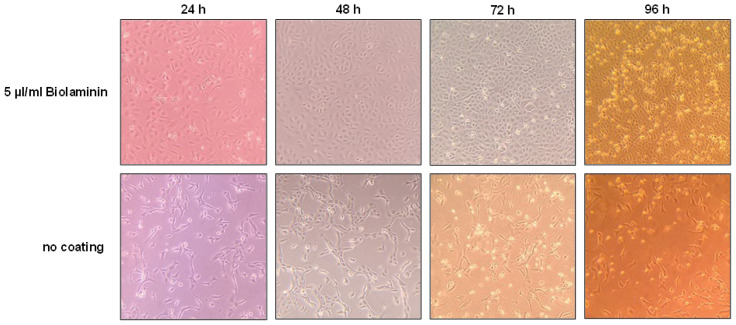
Establishing Vero-E6 cell culture conditions in the CliniMACS Prodigy CentriCult™ Units (CCU) were either coated with 30 mL 5 µg/mL Biolaminin in PBS or 30 mL PBS for 3 h at 37 °C. Subsequently, 4.5 × 10⁶ freshly thawed Vero-E6 cells were added to each CCU and incubated at 37 °C for 4 days. A picture was taken every 24 h, followed by a media change to 30 mL fresh glutamine-supplemented OptiPRO.
Figure 2
Figure 2
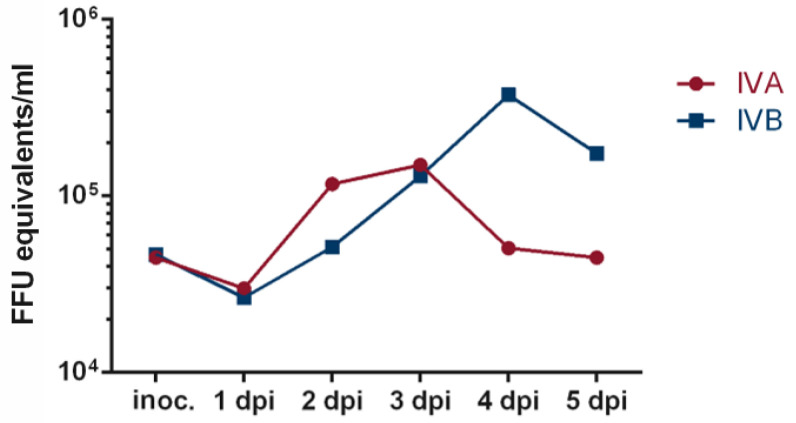
Fluenz® Tetra infection of Vero-E6 cells. A CCU was coated with laminin in the CliniMACS Prodigy® and subsequently seeded with 4.5 × 10⁶ freshly thawed Vero-E6 cells. After a 48-h incubation period at 39 °C, the culture was infected with Fluenz® Tetra at a dose of 106 FFU per strain. Media was changed and a sample taken after 4 h at 35 °C (corresponding to 33 °C in the CCU) followed by a daily media change and sample collection. Purified RNA from the samples was analyzed by Influenza A (IVA) and Influenza B (IVB)-specific reverse transcriptase qPCR. Purified RNA from Fluenz® Tetra was assigned the FFUs contained in the volume of Fluenz® Tetra the RNA was extracted from and used as a standard. Shown are FFU equivalents/mL for individual samples for IVA and IVB, respectively.
Figure 3
Figure 3
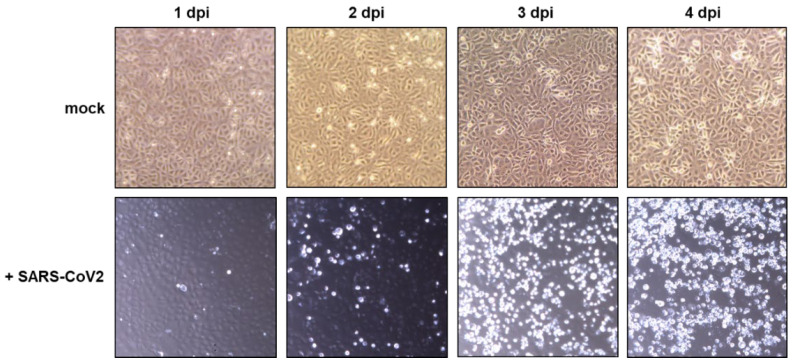
Optical comparison of mock and SARS-CoV-2 infected VeroE6 cells. An amount of 4.5 × 10⁶ freshly thawed Vero-E6 cells were seeded in a laminin-coated CCU and incubated at 37 °C for 48 h. For mock infection, media was changed every 24 h and a microscopic picture was taken. For SARS-CoV-2 infection, cells were infected with an MOI of 0.01 for 4 h, after which media was changed every 24 h and an automatic picture was taken every 12 h. Shown are representative pictures for matched time points as indicated. All steps of the SARS-CoV-2 infection were performed within the CliniMACS Prodigy, while the mock control cultures were maintained without CliniMACS Prodigy. Dpi: days post infection.
Figure 4
Figure 4
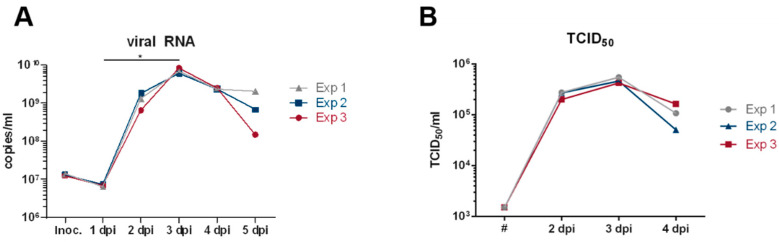
Analysis of SARS-CoV-2 propagation in the CliniMACS Prodigy®. An amount of 4.5 × 10⁶ freshly thawed Vero-E6 cells were seeded in a laminin-coated CCU. After 48 h of incubation at 39 °C (corresponding to 37 °C in the chamber) cells were infected with SARS-CoV-2 at a MOI of 0.01. After 4 h, media was changed and a sample taken (Inoc.) followed by cultivation for 5 days. During the culture period, media was exchanged and a sample taken every 24 h. (A) Purified RNA was analyzed by reverse transcriptase qPCR in duplicates and mean values for the respective samples are depicted from three independent experiments. For statistical analysis, Friedmans’ test with Dunn’s multiple comparison between all groups with log-transformed values was performed (* p < 0.05). (B) The infectious titers (TCID50) of samples of the three independent experiments on the indicated days post infection (dpi) are shown. # The TCID50 of the culture medium after inoculation was calculated from the TCID50 of the SARS-CoV-2 working stock and the applied dilution.
Figure 5
Figure 5
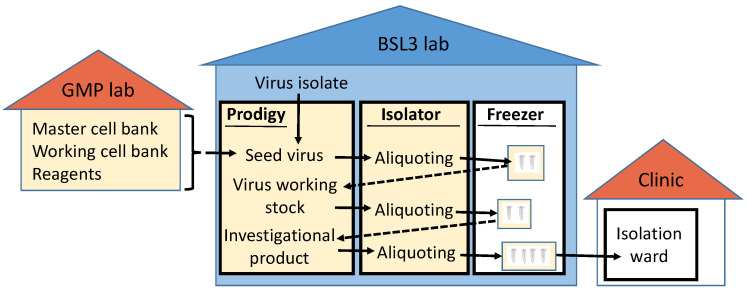
Concept for production of live-attenuated vaccines of SARS-CoV-2 under biosafety level 3 conditions. GMP-compatible working steps are shown in yellow boxes; BSL-3-containment is indicated by the blue background.

References

    1. WHO COVID-19 Weekly Epidemiological Update. Oct 19, 2022. [(accessed on 31 October 2022)]. Available online: https://www.who.int/docs/default-source/coronaviruse/situation-reports/2....
    1. Saborni C., Vamsee M., Cristina M.T., Gene S.T., Taia T.W. SARS-CoV-2 vaccines in advanced clinical trials: Where do we stand? Adv. Drug Deliv. Rev. 2021;172:314–338. - PMC - PubMed
    1. Florian K. SARS-CoV-2 vaccines in development. Nature. 2020;586:516–527. - PubMed
    1. Polack F.P., Thomas S.J., Kitchin N., Absalon J., Gurtman A., Lockhart S., Perez J.L., Pérez Marc G., Moreira E.D., Zerbini C., et al. Safety and Efficacy of the BNT162b2 mRNA Covid-19 Vaccine. N. Engl. J. Med. 2020;383:2603–2615. doi: 10.1056/NEJMoa2034577. - DOI - PMC - PubMed
    1. Voysey M., Clemens S.A.C., Madhi S.A., Weckx L.Y., Folegatti P.M., Aley P.K., Angus B., Baillie V.L., Barnabas S.L., Bhorat Q.E., et al. Safety and efficacy of the ChAdOx1 nCoV-19 vaccine (AZD1222) against SARS-CoV-2: An interim analysis of four randomised controlled trials in Brazil, South Africa, and the UK. Lancet. 2021;397:99–111. doi: 10.1016/S0140-6736(20)32661-1. - DOI - PMC - PubMed

Publication types