. 2021 Oct 18;2(2):94-102.
doi: 10.1021/acsmaterialsau.1c00029. eCollection 2022 Mar 9.

Carbon Nanotube PtSn Nanoparticles for Enhanced Complete Biocatalytic Oxidation of Ethylene Glycol in Biofuel Cells

Affiliations

Carbon Nanotube PtSn Nanoparticles for Enhanced Complete Biocatalytic Oxidation of Ethylene Glycol in Biofuel Cells

Jesimiel Glaycon Rodrigues Antonio et al. ACS Mater Au. .

Abstract

We report a hybrid catalytic system containing metallic PtSn nanoparticles deposited on multiwalled carbon nanotubes (Pt65Sn35/MWCNTs), prepared by the microwave-assisted method, coupled to the enzyme oxalate oxidase (OxOx) for complete ethylene glycol (EG) electrooxidation. Pt65Sn35/MWCNTs, without OxOx, showed good electrochemical activity toward EG oxidation and all the byproducts. Pt65Sn35/MWCNTs cleaved the glyoxilic acid C-C bond, producing CO2 and formic acid, which was further oxidized at the electrode. Concerning EG oxidation, the catalytic activity of the hybrid system (Pt65Sn35/MWCNTs+OxOx) was twice the catalytic activity of Pt65Sn35/MWCNTs. Long-term electrolysis revealed that Pt65Sn35/MWCNTs+OxOx was much more active for EG oxidation than Pt65Sn35/MWCNTs: the charge increased by 65%. The chromatographic results proved that Pt65Sn35/MWCNTs+OxOx collected all of the 10 electrons per molecule of the fuel and was able to catalyze EG oxidation to CO2 due to the associative oxidation between the metallic nanoparticles and the enzymatic pathway. Overall, Pt65Sn35/MWCNTs+OxOx proved to be a promising system to enhance the development of enzymatic biofuel cells for further application in the bioelectrochemistry field.


Conflict of interest statement

The authors declare no competing financial interest.

Figures

Figure 1
Figure 1
XRD data of the (A) Pt/MWCNT and (B) Pt65Sn35/MWCNTs nanoparticles prepared by the microwave method.
Figure 2
Figure 2
Cyclic voltammetry curves (A) and current peak (B) of EG in the presence of Pt65Sn35/MWCNTs+OxOx (blue/circle), Pt65Sn35/MWCNTs (red/square), or pure enzyme (carbon vitreous electrode in the presence of 0.03 U mL–1 OxOx) (green/circle). The solid lines refer to the presence of EG; the dashed lines refer to the absence of EG; supporting electrolyte of 150 mmol L–1 citric acid/phosphate buffer (pH = 5.5), [EG] = 100 mmol L–1, [OxOx] = 0.03 U mL–1, scan rate = 10 mV s–1.
Figure 3
Figure 3
Chronoamperometric assay performed in the presence of Pt65Sn35/MWCNTs+OxOx (blue line), Pt65Sn35/MWCNTs (red line), and control experiment (carbon vitreous electrode in the electrolyte) (gray dash line). Successive additions of 20 mmol L–1 ethylene glycol (a), glycolic acid (b), glyoxylic acid (c), and oxalic acid (d) at a fixed oxidation potential (0.900 V vs Ag/AgCl). Supporting electrolyte of 150 mM citric acid/phosphate buffer (pH = 5.5), [OxOx] = 0.03 U mL–1.
Figure 4
Figure 4
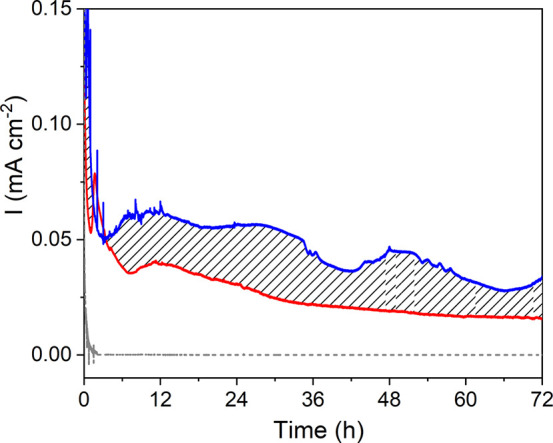
Amperometric it curves that were measured during long-term bulk EG electrolysis in the presence of Pt65Sn35/MWCNTs+OxOx (blue line), Pt65Sn35/MWCNTs (red line), and pure enzyme (carbon paper electrode in the presence of 0.03 U mL–1 OxOx) (green line) and control experiment (Pt65Sn35/MWCNTs+OxOx in the electrolyte) (gray dashed line). Supporting electrolyte of 150 mmol L–1 citric acid/phosphate buffer (pH = 5.5), [EG] = 100 mmol L–1, Eap = 0.5 V vs Ag/AgCl, [OxOx] = 0.03 U mL–1.
Figure 5
Figure 5
Distribution of products from EG oxidation (100 mmol L–1) after electrolysis for 12 h at Pt65Sn35/MWCNTs+OxOx (blue) and Pt65Sn35/MWCNTs (red). Support electrolyte of 150 mmol L–1 citric acid/phosphate buffer (pH = 5.5), [OxOx] = 0.03 U mL–1, Eap = 0.5 V versus Ag/AgCl.
Figure 6
Figure 6
Proposed cascade mechanism for ethylene glycol oxidation at the hybrid electrode system Pt65Sn35/MWCNTs+OxOx. Oxidation mediated by Pt65Sn35 (red line) and bioenzymatic oxidation mediated by OxOx (black line).
Figure 7
Figure 7
Power density curves of ethylene glycol/O2 biofuel cell employing the hybrid system (Pt65Sn35/MWCNTs+OxOx) (blue line) and the metallic system (Pt65Sn35/MWCNTs) (red line) (100 mmol L–1 EG). Inset: profile in the absence of EG (green, Pt65Sn35/MWCNTs; black, Pt65Sn35/MWCNTs+OxOx). Supporting electrolyte of 150 mmol L–1 citric acid/phosphate buffer (pH = 5.5), scan rate of 1 mV s–1, [OxOx] = 0.03 U mL–1.

References

    1. Rasmussen M.; Abdellaoui S.; Minteer S. D. Enzymatic biofuel cells: 30 years of critical advancements. Biosens. Bioelectron. 2016, 76, 91–102. 10.1016/j.bios.2015.06.029. - DOI - PubMed
    1. Katz E.; Bollella P. Fuel Cells and Biofuel Cells: From Past to Perspectives. Isr. J. Chem. 2021, 61, 68–84. 10.1002/ijch.202000039. - DOI
    1. Jeerapan I.; Sempionatto J. R.; Wang J. On-Body Bioelectronics: Wearable Biofuel Cells for Bioenergy Harvesting and Self-Powered Biosensing. Adv. Funct. Mater. 2020, 30, 1906243.10.1002/adfm.201906243. - DOI
    1. Xu S.; Minteer S. D. Enzymatic Biofuel Cell for Oxidation of Glucose to CO 2. ACS Catal. 2012, 2, 91–94. 10.1021/cs200523s. - DOI
    1. Kang Z.; Job Zhang Y.-H. P.; Zhu Z. A shriveled rectangular carbon tube with the concave surface for high-performance enzymatic glucose/O2 biofuel cells. Biosens. Bioelectron. 2019, 132, 76–83. 10.1016/j.bios.2019.02.044. - DOI - PubMed

LinkOut - more resources