. 2023 Feb 14:38:102129.
doi: 10.1016/j.jcot.2023.102129. eCollection 2023 Mar.

Strain reduction screws for nonunions following fixation around the elbow - A case series and review of the literature

Affiliations

Strain reduction screws for nonunions following fixation around the elbow - A case series and review of the literature

S F Bellringer et al. J Clin Orthop Trauma. .

Abstract

Background: Nonunions following fracture fixation result in significant patient morbidity and financial burden. Traditional operative management around the elbow consists of removal of metalwork, debridement of the nonunion and re-fixation with compression, often with bone grafting. Recently, some authors in the lower limb literature have described a minimally invasive technique used for select nonunions where simply placing screws across the nonunion facilitates healing by reducing inter-fragmentary strain. To our knowledge, this has not been described around the elbow, where traditional more invasive techniques continue to be employed.

Aims: The aim of this study was to describe the application of strain reduction screws for management of select nonunions around the elbow.

Methods & results: We describe 4 cases (two humeral shaft, one distal humerus and one proximal ulna) of established nonunion following previous internal fixation, where minimally invasive placement of strain reduction screws were used. In all cases, no existing metal work was removed, the nonunion site was not opened, and no bone grafting or biologic stimulation was used. Surgery was performed between 9 and 24 months after the original fixation. 2.7 mm or 3.5 standard cortical screws were placed across the nonunion without lagging. Three fractures went on to unite with no further intervention required. One fracture required revision fixation using traditional techniques. Failure of the technique in this case did not adversely affect the subsequent revision procedure and has allowed refinement of the indications.

Conclusion: Strain reduction screws are safe, simple and effective technique to treat select nonunions around the elbow. This technique has potential to be a paradigm shift in the management of these highly complex cases and is the first description in the upper limb to our knowledge.

Keywords: Elbow; Humerus; Nonunion; Strain; Ulna.


Figures

Fig. 1
Fig. 1
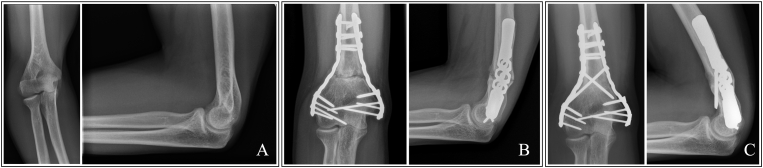
A - Pre-operative radiographs. B - Non Union at 18 months post osteotomy and LIPUS therapy. C - Radiographic Union 2 months after strain reduction screw fixation.
Fig. 2
Fig. 2
A - Periprosthetic fracture of proximal left ulna. B - Post operative radiographs following tension band suture fixation. C - C - Stress fracture noted distal to tension band fixation on posterior ulna cortex. D - Completed stress fracture of proximal ulna distal to previous fracture treated with tension band suture. Varus and apex posterior deformity has developed. E − Radiographic union 5 months post strain reduction screw fixation.
Fig. 3
Fig. 3
A - Segmental Left Humeral Shaft Fracture. B - Non union of proximal fracture segment at 1 year. C - Intra-operative imaging of strain reduction screw fixation. D - 7 months post op demonstrating bridging callus.
Fig. 4
Fig. 4
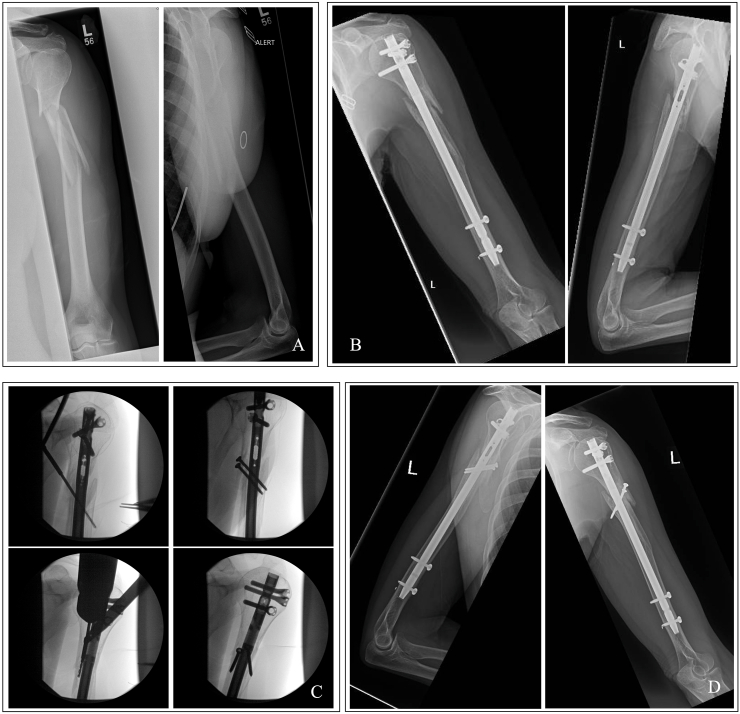
A - Left Humerus Shaft Fracture. B - Non Union of Humeral Shaft Fracture 7 months after fixation with early evidence of failure of fixation. C - Intra-operative Imaging Demonstrating Strain Reduction Screw Fixation. D - Post Operative Radiographs at 3 months demonstrating persistent non-union and further failure of metalwork.
Fig. 5
Fig. 5
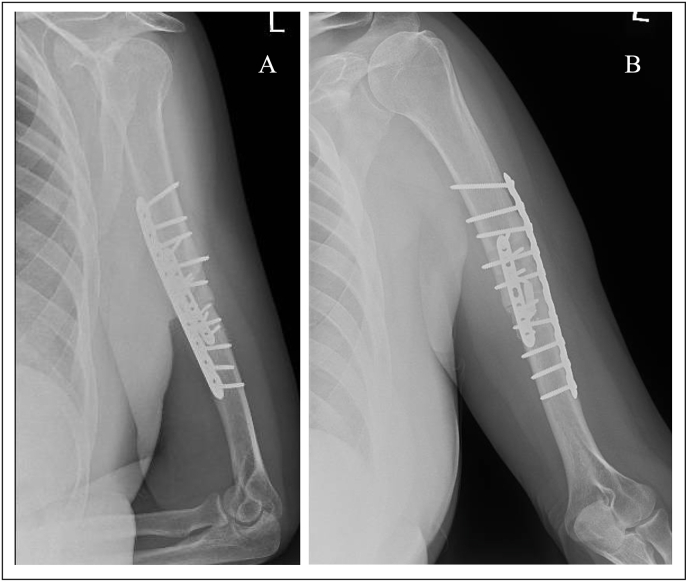
A/B - Lateral and AP left humerus demonstrating radiographic union after traditional revision open reduction internal fixation with no bone grafting.

References

    1. Kanakaris N.K., Giannoudis P.V. The health economics of the treatment of long-bone non-unions [published correction appears in Injury. Injury. 2007 Oct;38(10):S77–S84. doi: 10.1016/s0020-1383(07)80012-x. 1224. 2007;38 Suppl 2. - DOI - PubMed
    1. Peters R.M., Claessen F.M., Doornberg J.N., Kolovich G.P., Diercks R.L., van den Bekerom M.P. Union rate after operative treatment of humeral shaft nonunion--A systematic review. Injury. 2015;46(12):2314–2324. doi: 10.1016/j.injury.2015.09.041. - DOI - PubMed
    1. Vauclair F., Goetti P., Nguyen N.T.V., Sanchez-Sotelo J. Distal humerus nonunion: evaluation and management. EFORT Open Rev. 2020;5(5):289–298. doi: 10.1302/2058-5241.5.190050. Published 2020 May 1. - DOI - PMC - PubMed
    1. Regan D.K., Crespo A.M., Konda S.R., Egol K.A. Functional outcomes of compression plating and bone grafting for operative treatment of nonunions about the forearm. J Hand Surg Am. 2018;43(6):564.e1–564.e9. doi: 10.1016/j.jhsa.2017.10.039. - DOI - PubMed
    1. Schulte L.M., Meals C.G., Neviaser R.J. Management of adult diaphyseal both-bone forearm fractures. J Am Acad Orthop Surg. 2014;22(7):437–446. doi: 10.5435/JAAOS-22-07-437. - DOI - PubMed

LinkOut - more resources