. 2023 Feb 14:5:100172.
doi: 10.1016/j.ijpx.2023.100172. eCollection 2023 Dec.

Aptamer-based nanotrains and nanoflowers as quinine delivery systems

Affiliations

Aptamer-based nanotrains and nanoflowers as quinine delivery systems

Mengyuan Cao et al. Int J Pharm X. .

Abstract

In this study, we designed aptamer-based self-assemblies for the delivery of quinine. Two different architectures were designed by hybridizing quinine binding aptamers and aptamers targeting Plasmodium falciparum lactate dehydrogenase (PfLDH): nanotrains and nanoflowers. Nanotrains consisted in controlled assembly of quinine binding aptamers through base-pairing linkers. Nanoflowers were larger assemblies obtained by Rolling Cycle Amplification of a quinine binding aptamer template. Self-assembly was confirmed by PAGE, AFM and cryoSEM. The nanotrains preserved their affinity for quinine and exhibited a higher drug selectivity than nanoflowers. Both demonstrated serum stability, hemocompatibility, low cytotoxicity or caspase activity but nanotrains were better tolerated than nanoflowers in the presence of quinine. Flanked with locomotive aptamers, the nanotrains maintained their targeting ability to the protein PfLDH as analyzed by EMSA and SPR experiments. To summarize, nanoflowers were large assemblies with high drug loading ability, but their gelating and aggregating properties prevent from precise characterization and impaired the cell viability in the presence of quinine. On the other hand, nanotrains were assembled in a selective way. They retain their affinity and specificity for the drug quinine, and their safety profile as well as their targeting ability hold promise for their use as drug delivery systems.

Keywords: DNA aptamer; Malaria; Nanoflower; Nanotrain; Quinine; Targeted delivery.


Conflict of interest statement

The authors declare that they have no known competing financial interests or personal relationships that could have appeared to influence the work reported in this paper.

Figures

Unlabelled Image
Graphical abstract
Fig. 1
Fig. 1
Formation and characterization of Nanotrains (NT) and Nanoflowers (NF). (A) Scheme of aptamer self-assembled nanotrain NT0. (B) Characterization of the assembly of nanotrains by native PAGE (8%, Acry/Bis 19:1, 4 W, 2 h, total [Aptamer] = 1 μM). (C) AFM image using PeakForce Tapping mode of NT0 in liquid environment. Scale bar is 50 nm. (D) Scheme of aptamer nanoflower NF0. (E) Agarose gel (2%, 100 V, 30 min, 10 μL of NF0 raw solution, [Template], [Ligated] = 0.3 μM, [Primer] = 0.6 μM) after NF0_6 h formation. (F) AFM image in liquid environment using PeakForce Tapping mode of NF0_6h. Scale bar is 2 μm. Diameter range: 0.4–0.7 μM, height range: 0.3–0.7 nm. (G) CryoSEM images of NF0 formed in 6 h (NF0_6 h). Mean diameter 0.8 ± 0.1 μm (n = 10, estimated by Image J software). The samples were analyzed by Zeiss Gemini 300 SEM operating system at a maximum voltage of 3.0 kV. Scale bar is 300 nm.
Fig. 2
Fig. 2
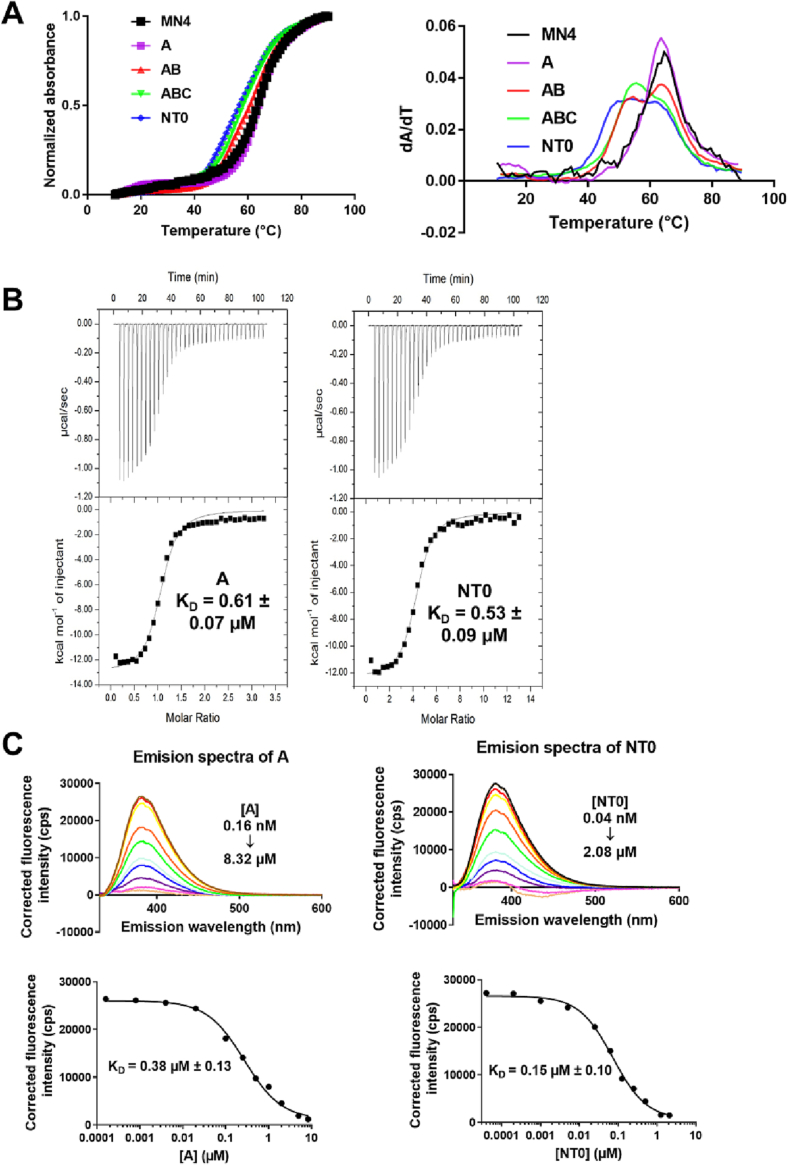
(A) Thermal stability of aptamer nanotrains. Left: normalized UV absorbance of nanotrains. Right: First derivatives of normalized absorbances for Tm quantification. [Aptamer] = 1 μM/boxcar, 20 mM sodium cacodylate buffer (pH 7.4) with 5 mM MgCl2, 10 to 90 °C, 0.2 °C/min. (B) ITC analysis of quinine (312 μM) binding by the boxcar A or nanotrain NT0 ([Aptamer] = 20 μM) (15 °C in PBS, pH 7.4, 5 mM MgCl2). (C) Top: Fluorescence analysis of quinine binding by boxcar A and nanotrain NT0 ([Quinine] = 0.1 μM, λexc = 315 nm, in PBS pH 7.4, 5 mM MgCl2 at 20 °C). Bottom: binding curves of corrected fluorescence intensity (λexc = 315 nm, λem = 384 nm) fitted with the [Inhibitor] vs. response model (three parameters).
Fig. 3
Fig. 3
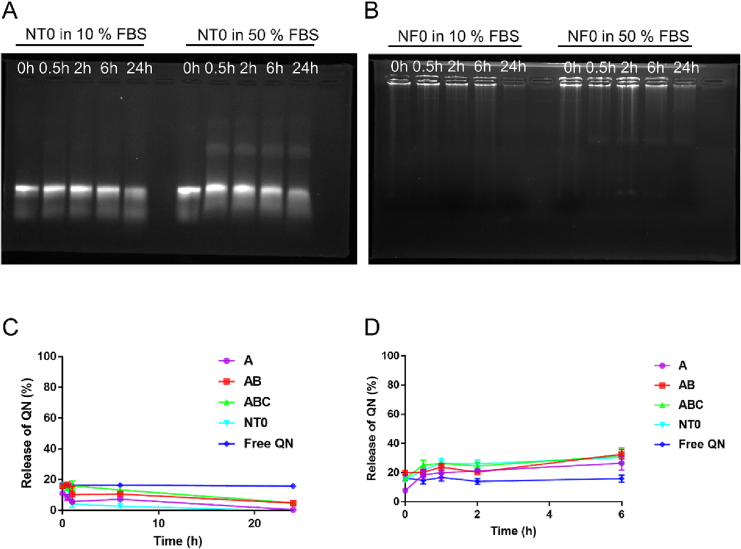
Serum stability of nanotrains and nanoflowers. The integrity of (A) Nanotrain NT0 ([Total aptamer] = 7.1 μM, equivalent to 137 ng/μL) or (B) Nanoflower NF0 (137 ng/μL) in 10% or 50% FBS within 24 h characterized by agarose gel (2%, 100 V, 30 min). Quinine (7.1 μM) release profiles of NT0 ([Total aptamer] = 7.1 μM) were monitored in (C) 10% FBS and (D) 50% FBS by fluorescence.
Fig. 4
Fig. 4
Cell viability and cytotoxicity of nanotrain NT0 and nanoflower NF0. Cell viability of HepG2 cells treated with increasing concentrations of (A) NT0 and (C) NF0 using PrestoBlue™ reagent. Cytotoxicity of (B) NT0 or (D) NF0 assessed through LDH leakage. DMSO is a positive control for cell viability and Triton X-100 for LDH release. QN: quinine. APAP: acetaminophen. Results are reported in mass concentration to compare nanotrains and nanoflowers, since NF polydispersity prevents from precise molar concentration determination. Data are presented as mean ± SD (n = 3 for NT0 and n = 2 for NF0).
Fig. 5
Fig. 5
Design and preparation of targeted nanotrains and nanoflowers. (A) Scheme of targeted nanotrains flanked with locomotives aptamers L2 or L3. (B) Characterization of the assembly of NT2 by native PAGE (8%, Acry/Bis 19:1, 4 W, 3.5 h, total [aptamer]: 1 μM). (C) Scheme of targeted nanoflowers NF2 (2008s + MN4) formation, by incorporation of targeted sequence into the primer (see full sequence in Table S1). (D) Characterization of formation of NF2 by agarose gel (2%, 100 V, 30 min, 10 μL of NF2 raw solution, [Template], [Ligated] = 0.3 μM, [Primer] = 0.6 μM).
Fig. 6
Fig. 6
Electrophoretic mobility shift assay (EMSA, 8% native PAGE, Acry/Bis 37.5:1, 4 W, 3 h) for locomotive aptamer L2 and nanotrain NT2 ([Locomotive] = 25 nM) binding to PfLDH (tetramer) in range of 0–6250 nM protein. Image obtained by ChemiDoc. EMSA data was fitted with the model of [Inhibitor] vs. response (three parameters) in GraphPad.
Fig. 7
Fig. 7
SPR analysis of PfLDH binding to the nanotrains or L2. PfLDH binding to the nanotrain assembled on the sensor chip (A) and to biotinylated L2 (B). The analysis was carried out by the SCK method which consisted in injecting successively increasing concentrations of the analyte (12.5, 50 and 200 nM) without regeneration step between each injection (binding cycles with injections in duplicate). The red, blue and grey curves represent the injections of PfLDH on the nanotrain, on the nanotrain without L2 (buffer injected), and of streptavidin (SA), respectively. The arrows represent the beginning of the injections. (C) Kinetic analysis of PfLDH binding to biotinylated L2 immobilized on the SA sensor chip by the MCK method. After each injection of the analytes (in duplicate) a regeneration step was performed with 1 min pulse of 20 mM sodium hydroxide. KD was determined by steady-state analysis (D) using the Biacore T200 Bia-Evaluation software by plotting as the function of the protein concentration the RU values averaged over 5 s, 1 min and 30 s before the end of the injections. (For interpretation of the references to colour in this figure legend, the reader is referred to the web version of this article.)

References

    1. Achan J., Talisuna A.O., Erhart A., Yeka A., Tibenderana J.K., Baliraine F.N., Rosenthal P.J., D’Alessandro U. Quinine, an old anti-malarial drug in a modern world: role in the treatment of malaria. Malar. J. 2011;10:144. doi: 10.1186/1475-2875-10-144. - DOI - PMC - PubMed
    1. Ali M.M., Li F., Zhang Z., Zhang K., Kang D.-K., Ankrum J.A., Le X.C., Zhao W. Rolling circle amplification: a versatile tool for chemical biology, materials science and medicine. Chem. Soc. Rev. 2014;43:3324–3341. doi: 10.1039/C3CS60439J. - DOI - PubMed
    1. Bagalkot V., Farokhzad O.C., Langer R., Jon S. An aptamer–doxorubicin physical conjugate as a novel targeted drug-delivery platform. Angew. Chem. Int. Ed. 2006;45:8149–8152. doi: 10.1002/anie.200602251. - DOI - PubMed
    1. Cheung Y.-W., Kwok J., Law A.W.L., Watt R.M., Kotaka M., Tanner J.A. Structural basis for discriminatory recognition of Plasmodium lactate dehydrogenase by a DNA aptamer. Proc. Natl. Acad. Sci. 2013;110:15967–15972. doi: 10.1073/pnas.1309538110. - DOI - PMC - PubMed
    1. Cheung Y.-W., Dirkzwager R.M., Wong W.-C., Cardoso J., D’Arc Neves Costa J., Tanner J.A. Aptamer-mediated Plasmodium-specific diagnosis of malaria. Bioch. Aptamer Technol. Appl. 2018;145:131–136. doi: 10.1016/j.biochi.2017.10.017. - DOI - PubMed

LinkOut - more resources