


Determinants of School dropouts among adolescents: Evidence from a longitudinal study in India
- PMID: 36862641
- PMCID: PMC9980764
- DOI: 10.1371/journal.pone.0282468
Determinants of School dropouts among adolescents: Evidence from a longitudinal study in India
Abstract
Introduction: India has the largest adolescent population in the world. However, many unprivileged Indian adolescents are still unable to complete schooling. Hence, there is a need to understand the reasons for school dropout among this population. The present study is an attempt to understand the determinants of school dropout among adolescents and identify the factors and reasons that contribute to it.
Material and methods: Longitudinal survey data- Understanding Adults and Young Adolescents (UDAYA) for Bihar and Uttar Pradesh has been used to identify the determinants of school dropout among adolescents aged 10-19. The first wave of the survey was conducted in 2015-2016, and the follow-up survey in 2018-2019. Descriptive statistics along with bivariate and multivariate analysis was used to observe school dropout rates and factors associated with it among adolescents.
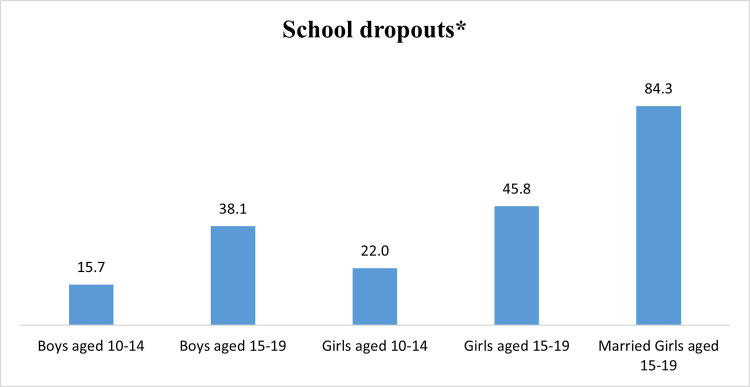
Results: Results show that the school dropout rate was highest among married girls aged 15-19 years (84%), followed by unmarried girls (46%), and boys (38%) of the same age group. The odds of school dropout among adolescents decreased with an increase in household wealth status. School dropout was significantly less likely among adolescents whose mothers were educated as compared to mothers who had no education. Younger boys [AOR: 6.67; CI: 4.83-9.23] and girls [AOR: 2.56; CI: 1.79-3.84] who engaged in paid work were 6.67 times and 2.56 times more likely to drop out of school than those who were not. The likelihood of school dropout was 3.14 times more likely among younger boys [AOR: 3.14; CI: 2.26-4.35], and it was 89% more likely among older boys [AOR: 1.89; CI: 1.55-2.30] who consumed any substances as compared to those who did not consume any substances. Both younger [AOR: 2.05; CI: 1.37-3.05] and older girls [AOR: 1.30; CI: 1.05-1.62] who acknowledged at least one form of discriminatory practice by parents were more likely to drop out of school than their counterparts. Lack of interest in studies/education not necessary (43%) was the predominant reason among younger boys for school dropout, followed by family reasons (23%) and paid work (21%).
Conclusions: Dropout was prevalent among lower social and economic strata. Mother's education, parental interaction, participation in sports and having role models reduce school dropout. Conversely, factors such as being engaged in paid work, substance abuse among boys, and gender discriminatory practices towards girls, are risk factors for dropout among adolescents. Lack of interest in studies and familial reasons also increase dropout. There is a need to improve the socio-economic status, delay the marital age of girls, and enhance the government incentives for education, give rightful work to girls after schooling, and provide awareness.
Copyright: © 2023 Kumar et al. This is an open access article distributed under the terms of the Creative Commons Attribution License, which permits unrestricted use, distribution, and reproduction in any medium, provided the original author and source are credited.
Conflict of interest statement
The authors have declared that no competing interests exist.
Figures
References
-
- Chellappan D.C., Emerging Education Patterns, 13 (2018) 6.
-
- Sridevi K., Nagpal M., TRENDS IN SCHOOL DROPOUT RATE IN INDIA, Res. Guild. 2 (2019) 2–24.
-
- United Nations, Sustainable Development Goal 4, Dep. Econ. Soc. Aff. (2015). https://sdgs.un.org/goals/goal4 (accessed May 28, 2021).
-
- MHRD, National Education Policy 2020, Government of India, 2020. https://www.education.gov.in/sites/upload_files/mhrd/files/NEP_Final_Eng... (accessed June 22, 2021).
MeSH terms
LinkOut - more resources
Full Text Sources
