


Focusing on severe infections with the respiratory syncytial virus (RSV) in adults: Risk factors, symptomatology and clinical course compared to influenza A / B and the original SARS-CoV-2 strain
- PMID: 36863135
- PMCID: PMC9927795
- DOI: 10.1016/j.jcv.2023.105399
Focusing on severe infections with the respiratory syncytial virus (RSV) in adults: Risk factors, symptomatology and clinical course compared to influenza A / B and the original SARS-CoV-2 strain
Erratum in
-
Corrigendum to Focusing on severe infections with the Respiratory Syncytial Virus (RSV) in adults: risk factors, symptomatology and clinical course compared to influenza A / B and the original SARS-CoV-2 strain: Journal of Clinical Virology, 161 (2023), 105399.J Clin Virol. 2023 Jul;164:105443. doi: 10.1016/j.jcv.2023.105443. Epub 2023 Apr 13. J Clin Virol. 2023. PMID: 37059614 Free PMC article. No abstract available.
Abstract
Background: The role and impact of RSV in the adult population is not well understood and comparative data of RSV infection, influenza A/B and SARS-CoV-2 in the elderly hospitalized for respiratory infections is limited.
Methods: In a retrospective, monocentric study we analyzed data of adult patients with respiratory infections tested positive by PCR for RSV, Influenza A/B and SARS-CoV-2 over a four-year period from 2017 to 2020. Symptoms on admission, laboratory results, and risk factors were assessed, and the clinical course and outcomes were studied.
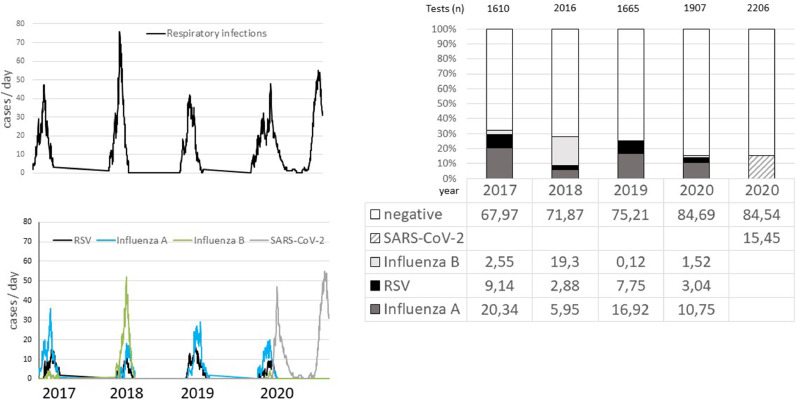
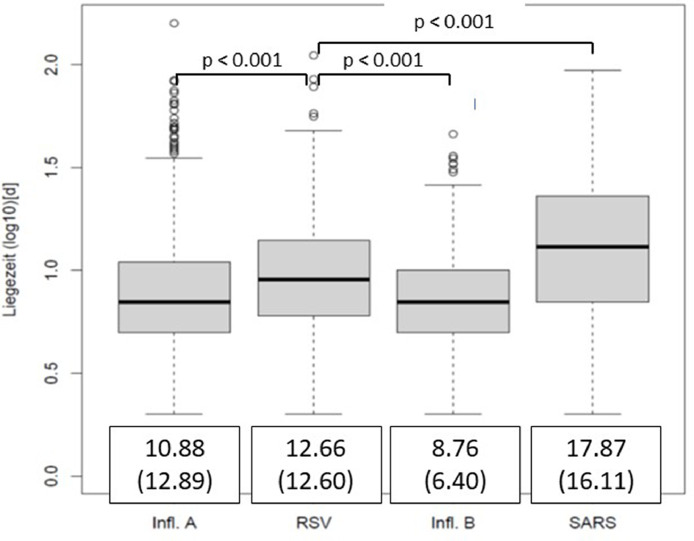
Results: A total of 1541 patients hospitalized with respiratory disease and PCR positive for one of the 4 viruses were enrolled in the study. RSV was the second most prevalent virus before the COVID-19 pandemic and RSV patients represent the oldest group in this study with an average age of 75 years. Neither clinical nor laboratory characteristics differ clearly between RSV, Influenza A / B and SARS-CoV-2 infections. Up to 85% of patients had risk factors, with COPD and kidney disease found particularly frequently in RSV infections. Hospital stay was 12.66 days for RSV patients and thus significantly longer than for influenza A / B (10.88 and 8.86, respectively, p < 0.001), but shorter than for SARS-CoV-2 (17.87 days, p < 0.001). The risk for ICU admission and the rate of mechanical ventilation were also higher for RSV than for influenza A (OR 1.69 (p = 0.020) and 1.59 (p = 0.050)) and influenza B: (1.98 (p = 0.018) and 2.33 (p < 0.001)), but lower than for SARS-CoV-2 (0.65 (p < 0.001) and 0.59 (p = 0.035)). The risk of hospital mortality for RSV was increased compared with influenza A (1.55 (p = 0.050)) and influenza B (1.42 (p = 0.262)), but lower compared to SARs-CoV-2 (0.37 (p < 0.001).
Conclusion: RSV infections in elderly are frequent and more severe than those with influenza A/B. While the impact of SARS-CoV-2 most likely decreased in the elderly population due to vaccination, RSV can be expected to continue to be problematic for elderly patients, especially those with comorbidities and thus, more awareness on the disastrous impact of RSV in this age group is urgently needed.
Keywords: Elderly; Influenza A/B; RSV; SARS-CoCV-2; Severe respiratory infections.
Copyright © 2023 Elsevier B.V. All rights reserved.
Conflict of interest statement
Declaration of Competing Interest None
Figures

References
-
- Shi T., McAllister D.A., O'Brien K.L., Simoes E.A.F., Madhi S.A., Gessner B.D., Polack F.P., Balsells E., Acacio S., Aguayo C., Alassani I., Ali A., Antonio M., Awasthi S., Awori J.O., Azziz-Baumgartner E., Baggett H.C., Baillie V.L., Balmaseda A., Barahona A., Basnet S., Bassat Q., Basualdo W., Bigogo G., Bont L., Breiman R.F., Brooks W.A., Broor S., Bruce N., Bruden D., Buchy P., Campbell S., Carosone-Link P., Chadha M., Chipeta J., Chou M., Clara W., Cohen C., de Cuellar E., Dang D.A., Dash-Yandag B., Deloria-Knoll M., Dherani M., Eap T., Ebruke B.E., Echavarria M., de Freitas Lázaro Emediato C.C., Fasce R.A., Feikin D.R., Feng L., Gentile A., Gordon A., Goswami D., Goyet S., Groome M., Halasa N., Hirve S., Homaira N., Howie S., Jara J., Jroundi I., Kartasasmita C.B., Khuri-Bulos N., Kotloff K.L., Krishnan A., Libster R., Lopez O., Lucero M., Lucion F., Lupisan S., Marcone D., McCracken J.P., Mejia M., Moisi J.C., Montgomery J.M., Moore D.P., Moraleda C., Moyes J., Munywoki P., Mutyara K., Nicol M.P., Nokes D.J., Nymadawa P., da Costa Oliveira M.T., Oshitani H., Pandey N., Paranhos-Baccalà G., Phillips L.N., Picot V.S., Rahman M., Rakoto-Andrianarivelo M., Rasmussen Z.A., Rath B.A., Robinson A., Romero C., Russomando G., Salimi V., Sawatwong P., Scheltema N., Schweiger B., Scott J.A.G., Seidenberg P., Shen K., Singleton R., Sotomayor V., Strand T.A., Sutanto A., Sylla M., Tapia M.D., Thamthitiwat T., Thomas E.D., Tokarz R., Turner C., Venter M., Waicharoen S., Wang J., Watthanaworawit W., Yoshida L.M., Yu H., Zar H., Campbell H., Nair H. RSV global epidemiology network. Global, regional, and national disease burden estimates of acute lower respiratory infections due to respiratory syncytial virus in young children in 2015: a systematic review and modelling study. Lancet. 2017 Sep 2;390(10098):946–958. doi: 10.1016/S0140-6736(17)30938-8. Epub 2017 Jul 7. PMID: 28689664; PMCID: PMC5592248. - DOI - PMC - PubMed
-
- Nguyen-Van-Tam J.S., O'Leary M., Martin E.T., Heijnen E., Callendret B., Fleischhackl R., Comeaux C., Tran T.M.P., Weber K. Burden of respiratory syncytial virus infection in older and high-risk adults: a systematic review and meta-analysis of the evidence from developed countries. Eur. Respir. Rev. 2022 Nov 15;31(166) doi: 10.1183/16000617.0105-2022. PMID: 36384703; PMCID: PMC9724807. - DOI - PMC - PubMed
-
- Jansen A.G., Sanders E.A., Hoes A.W., van Loo A.M., Hak E. Influenza- and respiratory syncytial virus-associated mortality and hospitalisations. Eur. Respir. J. 2007 Dec;30(6):1158–1166. doi: 10.1183/09031936.00034407. Epub 2007 Aug 22. Erratum in: Eur Respir J. 2008 Mar;31(3):691. PMID: 17715167. - DOI - PubMed
-
- Fowlkes A., Giorgi A., Erdman D., Temte J., Goodin K., Di Lonardo S., Sun Y., Martin K., Feist M., Linz R., Boulton R., Bancroft E., McHugh L., Lojo J., Filbert K., Finelli L. Viruses associated with acute respiratory infections and influenza-like illness among outpatients from the Influenza Incidence Surveillance Project, 2010-2011. J. Infect. Dis. 2014 Jun 1;209(11):1715–1725. doi: 10.1093/infdis/jit806. Epub 2013 Dec 12. PMID: 24338352; PMCID: PMC5749912. - DOI - PMC - PubMed
Publication types
MeSH terms
LinkOut - more resources
Full Text Sources
Medical
Miscellaneous
