


Age-specific disparities in fatal drug overdoses highest among older black adults and American Indian/Alaska native individuals of all ages in the United States, 2015-2020
- PMID: 36863284
- PMCID: PMC10050114
- DOI: 10.1016/j.drugpo.2023.103977
Age-specific disparities in fatal drug overdoses highest among older black adults and American Indian/Alaska native individuals of all ages in the United States, 2015-2020
Abstract
Introduction: Increasing disparities within and between racial/ethnic groups in overdose deaths underscore the need to identify drivers and patterns to optimize overdose prevention strategies. We assess age-specific mortality rates (ASMR) in drug overdose deaths by race/ethnicity in 2015-2019 and 2020.
Methods: Data were from the CDC Wonder, and included information for N = 411,451 deceased individuals in the United States (2015-2020) with a drug overdose-attributed cause of death (ICD-10 codes: X40-X44, X60-X64, X85, Y10-Y14). We compiled overdose death counts by age, race/ethnicity, and population estimates to derive ASMRs, mortality rate ratios (MRR), and cohort effects.
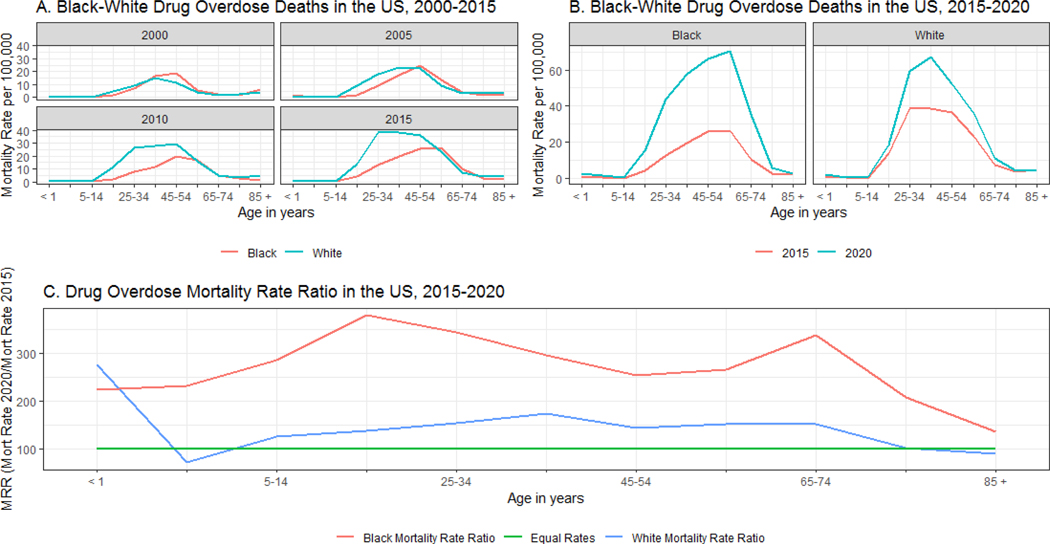
Results: The ASMRs for Non-Hispanic Black adults (2015-2019) followed a different pattern than other racial/ethnic groups-low ASMRs among young individuals and peaking between 55-64 years-a pattern exacerbated in 2020. Younger Non-Hispanic Black individuals had lower MRRs than young Non-Hispanic White individuals, yet, older Non-Hispanic Black adults had much higher MRRs than older Non-Hispanic White adults (45-54yrs:126%, 55-64yrs:197%; 65-74yrs:314%; 75-84:148%) in 2020. American Indian/Alaska Native adults had higher MRRs than Non-Hispanic White adults in death counts compiled from pre-pandemic years (2015-2019); however, MRRs increased in 2020 (15-24yrs:134%, 25-34yrs:132%, 35-44yrs:124%, 45-54yrs:134%, 55-64yrs:118%). Cohort analyses suggested a bimodal distribution of increasing fatal overdose rates among Non-Hispanic Black individuals aged 15-24 and 65-74.
Conclusions and relevance: Overdose fatalities unprecedently impact older Non-Hispanic Black adults and American Indian/Alaska Native populations of all ages, deviating from the pattern found for Non-Hispanic White individuals. Findings highlight the need for targeted naloxone and low-threshold buprenorphine programs to reduce racial disparities.
Keywords: Age; Cohort effects; Drug overdose deaths; Race/ethnicity.
Copyright © 2023 The Authors. Published by Elsevier B.V. All rights reserved.
Conflict of interest statement
Declarations of Interest Abenaa Jones (None) Alexis Santos (None), Amaya Perez-Brumer (None), Carl Latkin (None), Steve Shoptaw (None), Nabila El-Bassel (None).
Figures
References
-
- Barboza GE, & Angulski K. (2020). A descriptive study of racial and ethnic differences of drug overdoses and naloxone administration in Pennsylvania. International Journal of Drug Policy, 78, 102718. - PubMed
-
- Brave Heart MYH, Chase J, Elkins J, & Altschul DB (2011). Historical trauma among indigenous peoples of the Americas: Concepts, research, and clinical considerations. Journal of Psychoactive drugs, 43(4), 282–290. - PubMed
-
- Centers for Disease Control and Prevention. Drug Overdose Deaths in the U.S. Up 30% in 2020 (2021a) https://www.cdc.gov/nchs/pressroom/nchs_press_releases/2021/20210714.htm
-
- Centers for Disease Control and Prevention. CDC Wonder - Underlying Cause of Death, 1999–2019. (2021b) http://wonder.cdc.gov/
-
- Centers for Disease Control and Prevention. Drug Overdose Mortality by State. (2021c.) https://www.cdc.gov/nchs/pressroom/sosmap/drug_poisoning_mortality/drug_...
Publication types
MeSH terms
Grants and funding
LinkOut - more resources
Full Text Sources
Medical
