


nanoGold and µGold inhibit autoimmune inflammation: a review
- PMID: 36864314
- PMCID: PMC10006034
- DOI: 10.1007/s00418-023-02182-9
nanoGold and µGold inhibit autoimmune inflammation: a review
Abstract
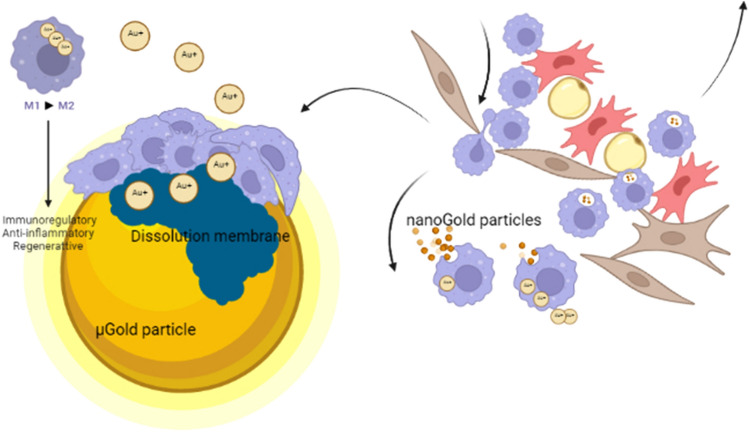
The newest data on metallic gold have placed the noble metal central in the fight for the safe treatment of autoimmune inflammation. There are two different ways to use gold for the treatment of inflammation: gold microparticles > 20 µm and gold nanoparticles. The injection of gold microparticles (µGold) is a purely local therapy. µGold particles stay put where injected, and gold ions released from them are relatively few and taken up by cells within a sphere of only a few millimeters in diameter from their origin particles. The macrophage-induced release of gold ions may continue for years. Injection of gold nanoparticles (nanoGold), on the other hand, is spread throughout the whole body, and the bio-released gold ions, therefore, affect multitudes of cells all over the body, as when using gold-containing drugs such as Myocrisin. Since macrophages and other phagocytotic cells take up and transport nanoGold and remove it after a short period, repeated treatment is necessary. This review describes the details of the cellular mechanisms that lead to the bio-release of gold ions in µGold and nanoGold.
Keywords: Gold microparticles; Gold nanoparticles; Inflammation; Macrophages; Mast cells.
© 2023. The Author(s).
Conflict of interest statement
The authors declare no competing interests.
Both authors are involved in companies working with gold and inflammation, Berlock ApS and ReGold ApS.
Figures



References
-
- Brown C, Bushell G, Whitehouse M, Agrawal DS, Tuoe SG, Paknikar KM, Tiekink E. Nanogold-pharmaceutics. Gold Bull. 2007;40:245–250. doi: 10.1007/BF03215588. - DOI
-
- Cardoso E, Rezin GT, Zanoni ET, de Souza Notoya F, Leffa DD, Damiani AP, Daumann F, Rodriguez JC, Benavides R, da Silva L, Andrade VM, da Silva Paula MM. Acute and chronic administration of gold nanoparticles cause DNA damage in the cerebral cortex of adult rats. Mutat Res. 2014 doi: 10.1016/j.mrfmmm.2014.05.009. - DOI - PubMed
Publication types
MeSH terms
Substances
LinkOut - more resources
Full Text Sources
Medical
