Review
. 2023 Aug 1;146(8):3117-3132.
doi: 10.1093/brain/awad064.

Impaired dopamine release in Parkinson's disease

Affiliations
Review

Impaired dopamine release in Parkinson's disease

Kaitlyn M L Cramb et al. Brain. .

Abstract

Parkinson's disease is the second most common neurodegenerative disease and yet the early pathophysiological events of the condition and sequences of dysfunction remain unclear. The loss of dopaminergic neurons and reduced levels of striatal dopamine are descriptions used interchangeably as underlying the motor deficits in Parkinson's disease. However, decades of research suggest that dopamine release deficits in Parkinson's disease do not occur only after cell death, but that there is dysfunction or dysregulation of axonal dopamine release before cell loss. Here we review the evidence for dopamine release deficits prior to neurodegeneration in Parkinson's disease, drawn from a large and emerging range of Parkinson's disease models, and the mechanisms by which these release deficits occur. The evidence indicates that impaired dopamine release can result from disruption to a diverse range of Parkinson's disease-associated genetic and molecular disturbances, and can be considered as a potential pathophysiological hallmark of Parkinson's disease.

Keywords: Parkinson’s disease; dopamine release; neurodegeneration.


Conflict of interest statement

The authors report no competing interests.

Figures
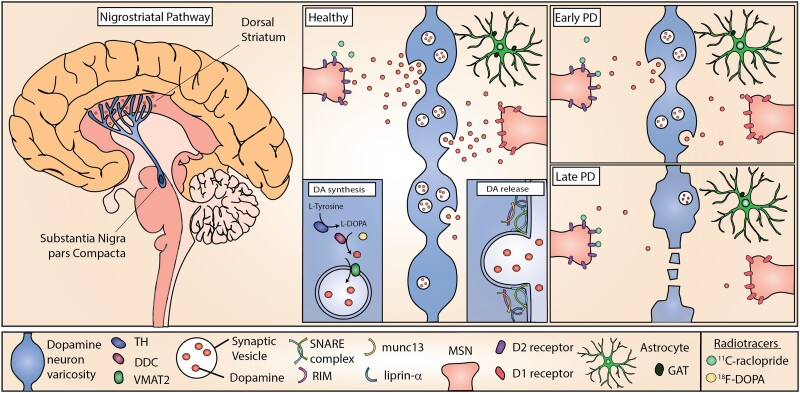
Figure 1
Figure 1
DA release in the nigrostriatal pathway and simplified working hypothesis for Parkinson’s disease progression. DAN cell bodies reside in the SNpc and project extensive axonal arbourizations to the dorsal striatum where they release DA (left). DA release occurs at active axonal varicosities and acts on D1 and D2 receptors on striatal cells (middle). In Parkinson’s disease, the nigrostriatal pathway is most affected and results in progressively decreased DA release (top right), and eventually axon degeneration and cell death (bottom right) impairing downstream signalling and movement modulation. Cellular dysfunction and altered striatal DA release precede cell death. DA release is modulated by neighbouring cell types including astrocytes, which can contribute to DA release defects observed in Parkinson’s disease models, such as by downregulation of GAT. Radiotracers used to image dopaminergic dysfunction in living human brains include 11C-raclopride that binds available D2 receptors and 18F-DOPA, which is a substrate for DOPA decarboxylase (DDC).
Figure 2
Figure 2
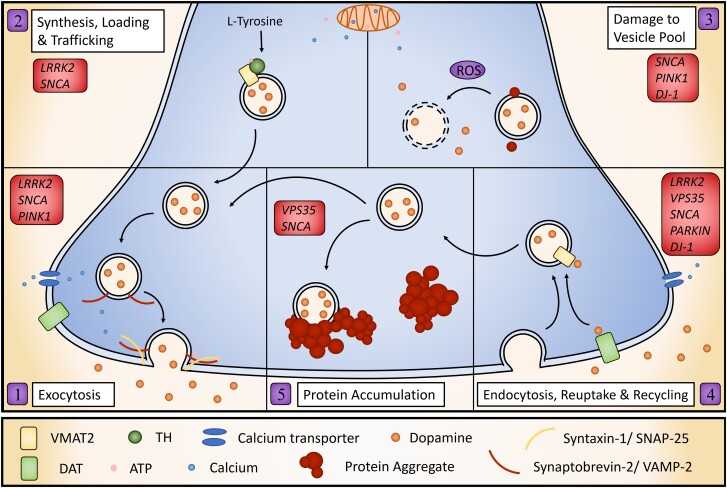
Cell-autonomous presynaptic mechanisms of dysfunctional DA release in Parkinson’s disease models. Defects in many different aspects of DA handling can lead to defective DA release. These include: defective exocytosis machinery including SNARE-complex formation and fusion (1); impaired DA synthesis, its loading into SVs via VMAT2 and trafficking to release sites (2); damage to the vesicular pool (3); recycling of DA following release, including recycling of SV through endocytosis and reuptake via DAT (4); and protein aggregation (5).
Figure 3
Figure 3
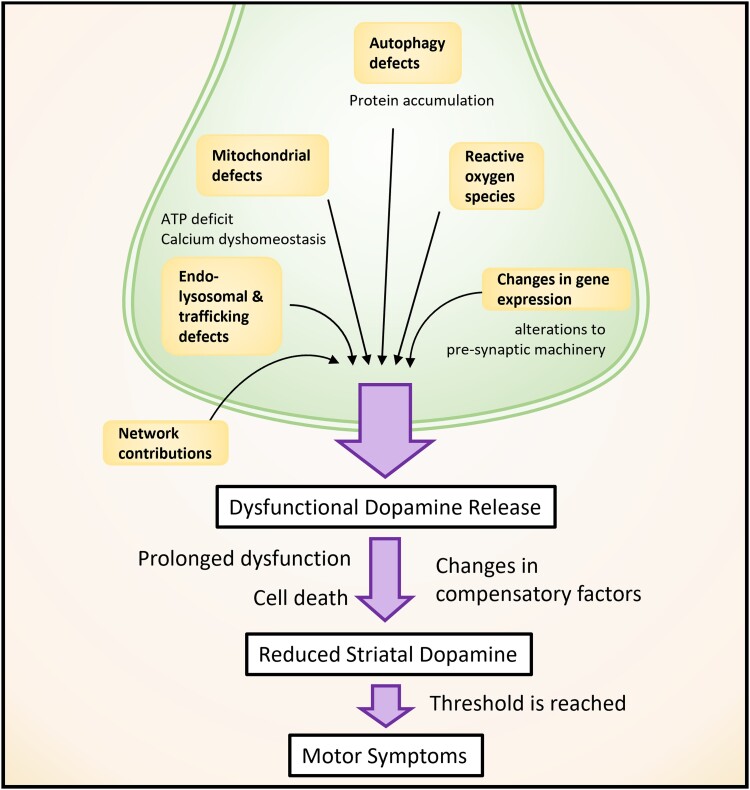
Overview of multifactorial cellular dysfunction converging on defective DA release. Dysfunction in several different cellular processes result in dysfunctional DA release in Parkinson’s disease models. Prolonged dysfunction, probably in combination with cell death, leads to reduced striatal DA that, once a threshold is reached, leads to the hallmark motor symptoms of Parkinson’s disease. The level of this threshold is modulated by compensatory factors.

References

    1. Zhang PL, Chen Y, Zhang CH, Wang YX, Fernandez-Funez P. Genetics of Parkinson's disease and related disorders. J Med Genet. 2018;55:73–80. - PubMed
    1. Dauer W, Przedborski S. Parkinson's disease: Mechanisms and models. Neuron. 2003;39:889–909. - PubMed
    1. Fearnley JM, Lees AJ. Ageing and Parkinson's disease: Substantia nigra regional selectivity. Brain. 1991;114(Pt 5):2283–2301. - PubMed
    1. Correia Guedes L, Mestre T, Outeiro TF, Ferreira JJ. Are genetic and idiopathic forms of Parkinson's disease the same disease? J Neurochem. 2020;152:515–522. - PubMed
    1. Surmeier DJ, Schumacker PT, Guzman JD, Ilijic E, Yang B, Zampese E. Calcium and Parkinson's disease. Biochem Biophys Res Commun. 2017;483:1013–1019. - PMC - PubMed

Publication types