This is a preprint.
Bortezomib, Lenalidomide and Dexamethasone (VRd) vs Carfilzomib, Lenalidomide and Dexamethasone (KRd) as Induction Therapy in Newly Diagnosed Multiple Myeloma
- PMID: 36865246
- PMCID: PMC9980212
- DOI: 10.21203/rs.3.rs-2583053/v1
Bortezomib, Lenalidomide and Dexamethasone (VRd) vs Carfilzomib, Lenalidomide and Dexamethasone (KRd) as Induction Therapy in Newly Diagnosed Multiple Myeloma
Update in
-
Bortezomib, lenalidomide and dexamethasone (VRd) vs carfilzomib, lenalidomide and dexamethasone (KRd) as induction therapy in newly diagnosed multiple myeloma.Blood Cancer J. 2023 Jul 25;13(1):112. doi: 10.1038/s41408-023-00882-y. Blood Cancer J. 2023. PMID: 37491332 Free PMC article.
Abstract
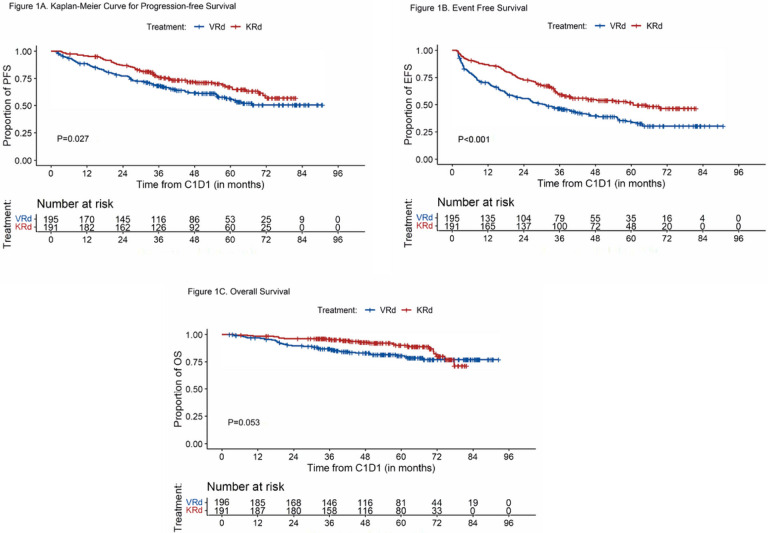
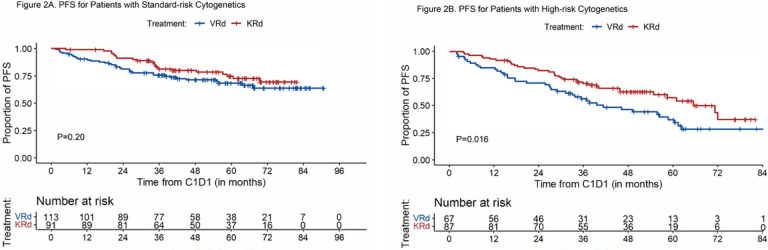
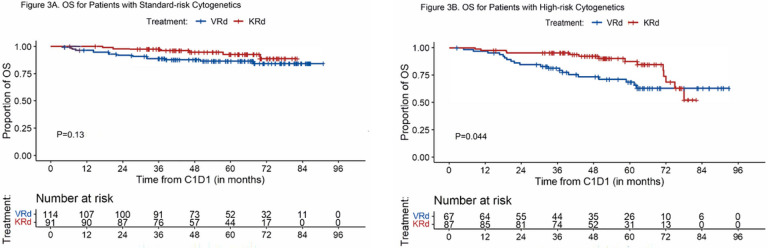
Lenalidomide and dexamethasone with bortezomib (VRd) or carfilzomib (KRd) are commonly used induction regimens in the U.S. This single-center, retrospective study evaluated outcomes and safety of VRd and KRd. Primary endpoint was progression-free survival (PFS). Of 389 patients with newly diagnosed multiple myeloma, 198 received VRd and 191 received KRd. Median PFS was not reached (NR) in both groups; 5-year PFS was 56% (95%CI, 48%-64%) for VRd and 67% (60%-75%) for KRd (P = 0.027). Estimated 5-year EFS was 34% (95%CI, 27%-42%) for VRd and 52% (45%-60%) for KRd (P < 0.001) with corresponding 5-year OS of 80% (95%CI, 75%-87%) and 90% (85%-95%), respectively (P = 0.053). For standard-risk patients, 5-year PFS was 68% (95%CI, 60%-78%) for VRd and 75% (65%-85%) for KRd (P = 0.20) with 5-year OS of 87% (95%CI, 81%-94%) and 93% (87%-99%), respectively (P = 0.13). For high-risk patients, median PFS was 41 months (95%CI, 32.8-61.1) for VRd and 70.9 months (58.2-NR) for KRd (P = 0.016). Respective 5-year PFS and OS were 35% (95%CI, 24%-51%) and 69% (58%-82%) for VRd and 58% (47%-71%) and 88% (80%-97%, P = 0.044) for KRd. Overall, KRd resulted in improved PFS and EFS with a trend toward improved OS compared to VRd with associations primarily driven by improvements in outcome for high-risk patients.
Figures
References
-
- Siegel RL, Miller KD, Jemal A. Cancer statistics, 2020. CA Cancer J Clin. 2020;70(1):7–30. - PubMed
-
- Kristinsson SY, Landgren O, Dickman PW, Derolf AR, Bjorkholm M. Patterns of survival in multiple myeloma: a population-based study of patients diagnosed in Sweden from 1973 to 2003. J Clin Oncol. 2007;25(15):1993–9. - PubMed
Publication types
Grants and funding
LinkOut - more resources
Full Text Sources