


Evaluating rescuer performance in response to opioid overdose in a community setting: Evidence for medically appropriate process measures
- PMID: 36865394
- PMCID: PMC9971518
- DOI: 10.1016/j.pmedr.2023.102145
Evaluating rescuer performance in response to opioid overdose in a community setting: Evidence for medically appropriate process measures
Abstract
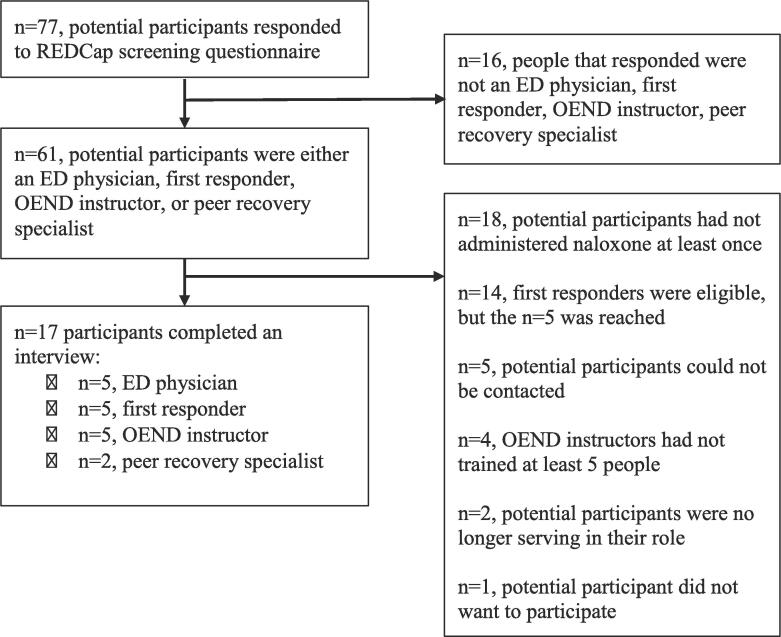
Overdose education and naloxone distribution (OEND) programs are widely accepted to reduce opioid overdose deaths. However, there is currently no validated instrument to evaluate the skills of learners completing these programs. Such an instrument could provide feedback to OEND instructors and allow researchers to compare different educational curricula. The aim of this study was to identify medically appropriate process measures with which to populate a simulation-based evaluation tool. Researchers conducted interviews with 17 content experts, including healthcare providers and OEND instructors from south-central Appalachia, to collect detailed descriptions of the skills taught in OEND programs. Researchers used three cycles of open coding, thematic analysis, and consulted currently available medical guidelines to identify thematic occurrences in qualitative data. There was consensus among content experts that the appropriate nature and sequence of potentially lifesaving actions during an opioid overdose is dependent on clinical presentation. Isolated respiratory depression requires a distinct response compared to opioid-associated cardiac arrest. To accommodate these different clinical presentations, raters populated an evaluation instrument with the detailed descriptions of overdose response skills, such as naloxone administration, rescue breathing, and chest compressions. Detailed descriptions of skills are essential to the development of an accurate and reliable scoring instrument. Furthermore, evaluation instruments, such as the one developed from this study, require a comprehensive validity argument. In future work, the authors will integrate the evaluation instrument in high-fidelity simulations, which are safe and controlled environments to study trainees' application of hands-on skills, and conduct formative assessments.
Keywords: AED; CPR; Cardiopulmonary arrest; Education; Naloxone; Respiratory depression.
© 2023 The Authors. Published by Elsevier Inc.
Conflict of interest statement
The authors declare that they have no known competing financial interests or personal relationships that could have appeared to influence the work reported in this paper.
Figures
References
-
- Ahmad FB, Rossen LM, Sutton P. Provisional drug overdose death counts. National Center for Health Statistics. (2022). https://www.cdc.gov/nchs/nvss/vsrr/drug-overdose-data.htm. Updated July 13, 2022.
-
- J.J. Carroll T.C. Green R.K. Noonan Evidence-based strategies for preventing opioid overdose: what’s working in the United States: an introduction for public heath, law enforcement, local organizations, and others striving to serve their community 2018 https://stacks.cdc.gov/view/cdc/59393.
LinkOut - more resources
Full Text Sources
