


Self-Medication Practices, Use of Brand-Name, and Over-the-Counter Medicines by Peruvian Older Adults
- PMID: 36865404
- PMCID: PMC9953501
- DOI: 10.5770/cgj.26.631
Self-Medication Practices, Use of Brand-Name, and Over-the-Counter Medicines by Peruvian Older Adults
Abstract
Background: Older adults are a particularly vulnerable group to drug use and self-medication. The aim of the study was to evaluate self-medication as a factor associated with the purchase of brand-name and over-the-counter (OTC) drugs in older adults in Peru.
Methods: A secondary analysis was performed using an analytical cross-sectional design of data from a nationally representative survey from 2014 to 2016. The exposure variable was self-medication, defined as the purchase of medicines without a prescription. The dependent variables were purchases of brand-name and OTC drugs, both as a dichotomous response (yes/no). Information of sociodemographic variables, health insurance, and the types of drugs purchased by the participants was collected. Crude prevalence ratios (PR) were calculated and adjusted using generalized linear models of the Poisson family, considering the complex sample of the survey.
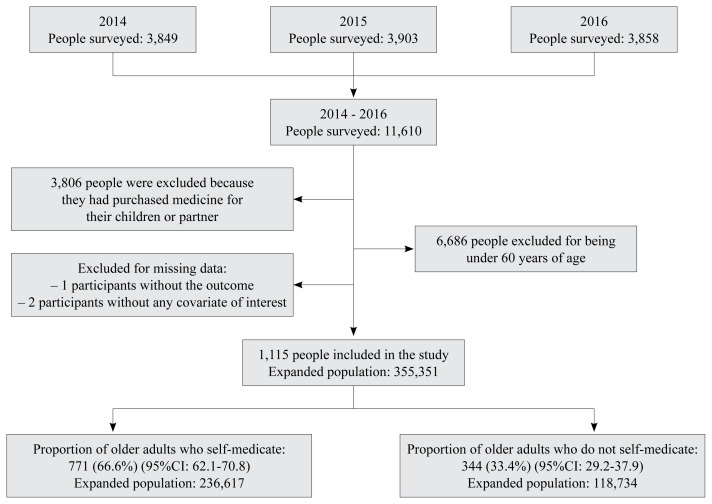
Results: In this study, 1,115 respondents were evaluated, with a mean age of 63.8 years and a male proportion of 48.2%. The prevalence of self-medication was 66.6%, while the proportions of purchases of brand-name and OTC drugs were 62.4% and 23.6%, respectively. The adjusted Poisson regression analysis revealed an association between self-medication and the purchase of brand-name drugs (adjusted PR [aPR]=1.09; 95% confidence interval [CI]: 1.01-1.19). Likewise, self-medication was associated with the purchase of OTC medications (aPR=1.97; 95%CI: 1.55-2.51).
Conclusions: This study evidenced a high prevalence of self-medication in Peruvian older adults. Two-thirds of the surveyed people bought brand-name drugs, whereas one-quarter bought OTC drugs. Self-medication was associated with a greater likelihood of buying brand-name and OTC drugs.
Keywords: Peru; aged; drugs; generic; health of the elderly; nonprescription drugs; pharmacies; self-medication.
© 2023 Author(s).
Conflict of interest statement
CONFLICT OF INTEREST DISCLOSURES We have read and understood the Canadian Geriatrics Journal’s policy on disclosing conflicts of interest and declare that we have none.
Figures
References
-
- Nordin Olsson I, Runnamo R, Engfeldt P. Medication quality and quality of life in the elderly, a cohort study. Health Qual Life Outcomes. 2011 Nov 3;9(1):1–9. doi: 10.1186/1477-7525-9-95. Available from: http://www.hqlo.com/content/9/1/95. - DOI - PMC - PubMed
-
- Lutz BH, Miranda VIA, Bertoldi AD. Potentially inappropriate medications among older adults in Pelotas, Southern Brazil. Rev Saude Publica. 2017 Jun 22;51:52. doi: 10.1590/s1518-8787.2017051006556. Available from: http://www.rsp.fsp.usp.br/ - DOI - PMC - PubMed
-
- Carmona-Torres JM, Cobo-Cuenca AI, Recio-Andrade B, Laredo-Aguilera JA, Martins MM, Rodríguez-Borrego MA. Prevalence and factors associated with polypharmacy in the older people: 2006–2014. J Clin Nurs. 2018 Aug 1;27(15–16):2942–52. doi: 10.1111/jocn.14371. Available from: https://pubmed.ncbi.nlm.nih.gov/29603814/ - DOI - PubMed
-
- Locquet M, Honvo G, Rabenda V, Van Hees T, Petermans J, Reginster JY, et al. Adverse health events related to self-medication practices among elderly: a systematic review [Internet] Drug Aging. 2017;34:359–65. doi: 10.1007/s40266-017-0445-y. Available from: https://link.springer.com/article/10.1007/s40266-017-0445-y. - DOI - PubMed
LinkOut - more resources
Full Text Sources
Research Materials
Miscellaneous