Review
. 2023 Feb 14:11:1116805.
doi: 10.3389/fcell.2023.1116805. eCollection 2023.

Epigenetic reprogramming in cancer: From diagnosis to treatment

Affiliations
Review

Epigenetic reprogramming in cancer: From diagnosis to treatment

Pedro Mikael da Silva Costa et al. Front Cell Dev Biol. .

Abstract

Disruption of the epigenetic program of gene expression is a hallmark of cancer that initiates and propagates tumorigenesis. Altered DNA methylation, histone modifications and ncRNAs expression are a feature of cancer cells. The dynamic epigenetic changes during oncogenic transformation are related to tumor heterogeneity, unlimited self-renewal and multi-lineage differentiation. This stem cell-like state or the aberrant reprogramming of cancer stem cells is the major challenge in treatment and drug resistance. Given the reversible nature of epigenetic modifications, the ability to restore the cancer epigenome through the inhibition of the epigenetic modifiers is a promising therapy for cancer treatment, either as a monotherapy or in combination with other anticancer therapies, including immunotherapies. Herein, we highlighted the main epigenetic alterations, their potential as a biomarker for early diagnosis and the epigenetic therapies approved for cancer treatment.

Keywords: DNA methylation; cancer; epidrugs; epigenetic reprograming; histone modifications; non-coding RNAs.


Conflict of interest statement

The authors declare that the research was conducted in the absence of any commercial or financial relationships that could be construed as a potential conflict of interest.

Figures
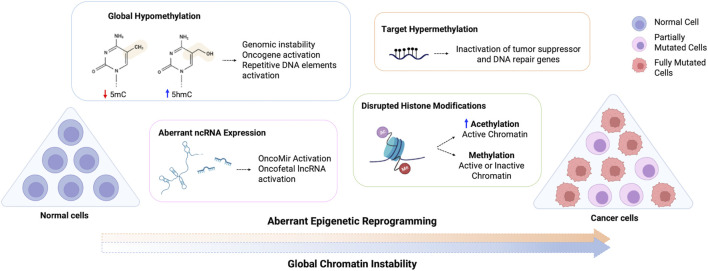
FIGURE 1
FIGURE 1
Schematic representation of the aberrant epigenetic reprogramming on cancer cells. Normal cells are aberrantly reprogramed through loss of global methylation, altered ncRNA expression, disrupted histone modifications and hypermethylation of target genes, which can inactivate tumor suppressor and DNA repair genes and activate oncogenes, resulting in the global chromatin instability observed in cancer cells. 5mC, 5-methylcytosine; 5hmC, 5-hydroxymethylcytosine.
FIGURE 2
FIGURE 2
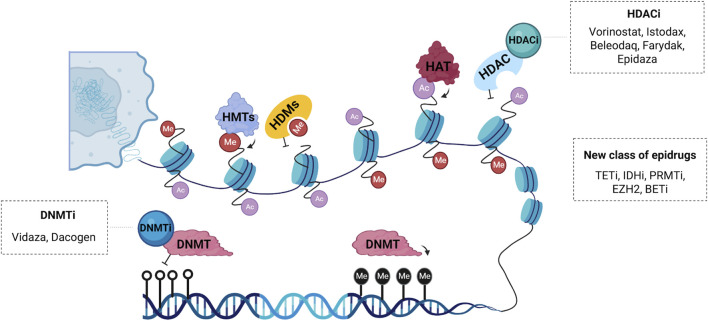
Schematic representation of the main epidrugs targets. Histone acetyltransferases (HATs) and deacetylases (HDACs) are enzymes responsible for post-translational acetylation and deacetylation, respectively. HDAC inhibitors (HDACi) such as Vorinostat®, Istodax®, Beleodaq®, Farydak® and Epidaza® induce acetylation thereby promoting transcriptional activation. Histone methyltransferases (HMTs) and demethylases (HDMs) can also be modulated by a new class of epigenetic drugs. DNA methyltransferases (DNMTs) are enzymes responsible for transferring a methyl group to carbon five of cytosine, a repressive epigenetic marker. DNMT inhibitors (DNMTi) like Vidaza® and Dacogen® promote loss of methylation and activation of aberrantly silenced genes. Other compounds with epigenetic activity are inhibitors of the enzyme ten-eleven translocation (TETi), inhibitors of the enzyme isocitrate dehydrogenase (IDHi), inhibitors of the protein arginine methyltransferase (PRMTi), inhibitors of the bromodomain and extra-terminal domain (BETi) and inhibitors of the enhancer of zeste homolog 2 (EZH2i), which is a histone-lysine n-methyltransferase enzyme.

References

    1. Amort T., Soulière M. F., Wille A., Jia X. Y., Fiegl H., Wörle H., et al. (2013). Long non-coding RNAs as targets for cytosine methylation. RNA Biol. 10, 1003–1008. 10.4161/rna.24454 - DOI - PMC - PubMed
    1. An J., Rao A., Ko M. (2017). TET family dioxygenases and DNA demethylation in stem cells and cancers. Exp. Mol. Med. 49, e323. 10.1038/emm.2017.5 - DOI - PMC - PubMed
    1. Aprile M., Katopodi V., Leucci E., Costa V. (2020). Lncrnas in cancer: From garbage to junk. Cancers (Basel) 12, 3220. 10.3390/cancers12113220 - DOI - PMC - PubMed
    1. Bannister A. J., Kouzarides T. (2011). Regulation of chromatin by histone modifications. Cell Res. 21, 381–395. 10.1038/cr.2011.22 - DOI - PMC - PubMed
    1. Barbieri I., Kouzarides T. (2020). Role of RNA modifications in cancer. Nat. Rev. Cancer 20, 303–322. 10.1038/s41568-020-0253-2 - DOI - PubMed

LinkOut - more resources