


Morphological factors associated with progression of subaneurysmal aortas
- PMID: 36869822
- PMCID: PMC10364530
- DOI: 10.1093/bjs/znad030
Morphological factors associated with progression of subaneurysmal aortas
Abstract
Background: The aim of this population-based cohort study was to assess the association between aortic morphological baseline factors in 65-year-old men with subaneurysmal aortic diameter (25-29 mm) and risk of later progression to abdominal aortic aneurysm (AAA) generally considered to be at a diameter for repair (at least 55 mm).
Methods: Men with a screening-detected subaneurysmal aorta between 2006 and 2015 in mid-Sweden were re-examined using ultrasonography after 5 and 10 years. Cut-off values for baseline subaneurysmal aortic diameter, aortic size index, aortic height index, and relative aortic diameter (with respect to proximal aorta) were analysed using receiver operating characteristic (ROC) curves, and their associations with progression to AAA diameter at least 55 mm evaluated by means of Kaplan-Meier curves and a multivariable Cox proportional hazard analysis adjusted for traditional risk factors.
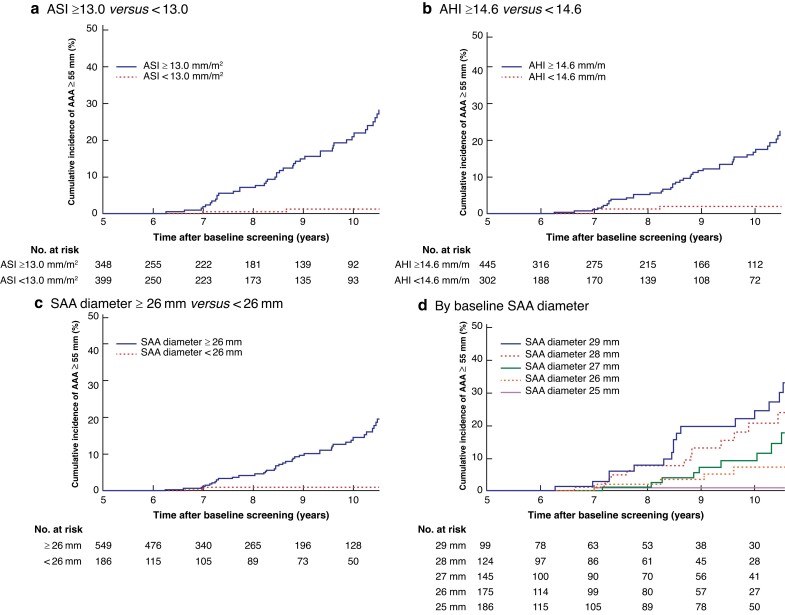
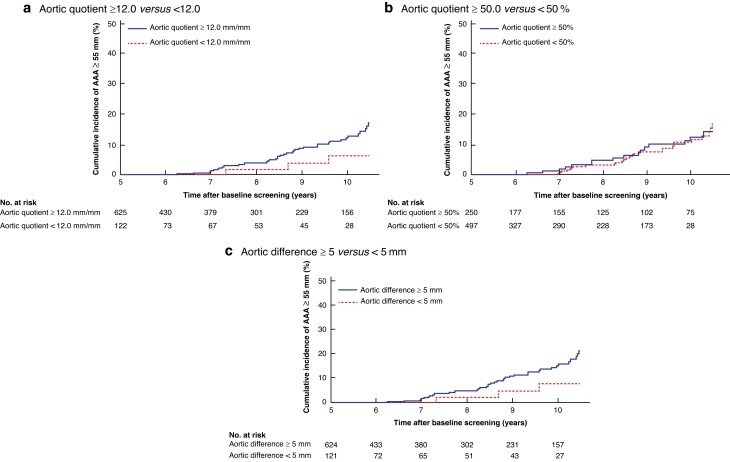
Results: Some 941 men with a subaneurysmal aorta and median follow-up of 6.6 years were identified. The cumulative incidence of AAA diameter at least 55 mm at 10.5 years was 28.5 per cent for an aortic size index of 13.0 mm/m2 or more (representing 45.2 per cent of the population) versus 1.1 per cent for an aortic size index of less than 13.0 mm/m2 (HR 9.1, 95 per cent c.i. 3.62 to 22.85); 25.8 per cent for an aortic height index of at least 14.6 mm/m (58.0 per cent of the population) versus 2.0 per cent for an aortic height index of less than 14.6 mm/m (HR 5.2, 2.23 to 12.12); and 20.7 per cent for subaneurysmal aortic diameter 26 mm or greater (73.6 per cent of the population) versus 1.0 per cent for a diameter of less than 26 mm (HR 5.9, 1.84 to 18.95). Relative aortic diameter quotient (HR 1.2, 0.54 to 2.63) and difference (HR 1.3, 0.57 to 3.12) showed no association with development of AAA of 55 mm or greater.
Conclusion: Baseline subaneurysmal aortic diameter, aortic size index, and aortic height index were all independently associated with progression to AAA at least 55 mm, with aortic size index as the strongest predictor, whereas relative aortic diameter was not. These morphological factors may be considered for stratification of follow-up at initial screening.
© The Author(s) 2023. Published by Oxford University Press on behalf of BJS Society Ltd. All rights reserved. For permissions, please e-mail: journals.permissions@oup.com.
Figures


References
-
- Wanhainen A, Hultgren R, Linné A, Holst J, Gottsäter A, Langenskiöld Met al. . Outcome of the Swedish nationwide abdominal aortic aneurysm screening program. Circulation 2016;134:1141–1148 - PubMed
-
- Stather PW, Dattani N, Bown MJ, Earnshaw JJ, Lees TA. International variations in AAA screening. Eur J Vasc Endovasc Surg 2013;45:231–234 - PubMed
-
- Guirguis-Blake J, Beil TL, Senger CA, Coppola EL. Primary care screening for abdominal aortic aneurysm: uppdated evidence report and systematic review for the US Preventive Services Task Force. JAMA 2019;322:2219–2238 - PubMed
-
- Wild JB, Stather PW, Biancari F, Choke EC, Earnshaw JJ, Grant SWet al. . A multicentre observational study of the outcomes of screening detected sub-aneurysmal aortic dilatation. Eur J Vasc Endovasc Surg 2013;45:128–134 - PubMed
