


Prevalence and sociodemographic characteristics of US community-dwelling older adults with communication disabilities, using the national health and aging trends survey
- PMID: 36870271
- PMCID: PMC10236317
- DOI: 10.1016/j.jcomdis.2023.106316
Prevalence and sociodemographic characteristics of US community-dwelling older adults with communication disabilities, using the national health and aging trends survey
Abstract
Introduction: Identifying the population-level prevalence of a disability group is a prerequisite to monitoring their inclusion in society. The prevalence and sociodemographic characteristics of older adults with communication disabilities (CDs) are not well established in the literature. In this study we sought to describe the prevalence and sociodemographic characteristics of community-dwelling older adults experiencing difficulties with understanding others or being understand when communicating in their usual language.
Methods: We conducted a cross-sectional analysis of the National Health and Aging Trends Survey (2015), a nationally representative survey of Medicare beneficiaries ages ≥ 65 years old (N = 7,029). We calculated survey weight-adjusted prevalence estimates by mutually exclusive subgroups of no, hearing only, expressive-only, cognitive only, multiple CDs, and an aggregate any-CD prevalence. We described race/ethnicity, age, gender, education, marital status, social network size, federal poverty status, and supplemental insurance for all groups. Pearson's chi-squared statistic was used to compare sociodemographic characteristics between the any-CD and no-CD groups.
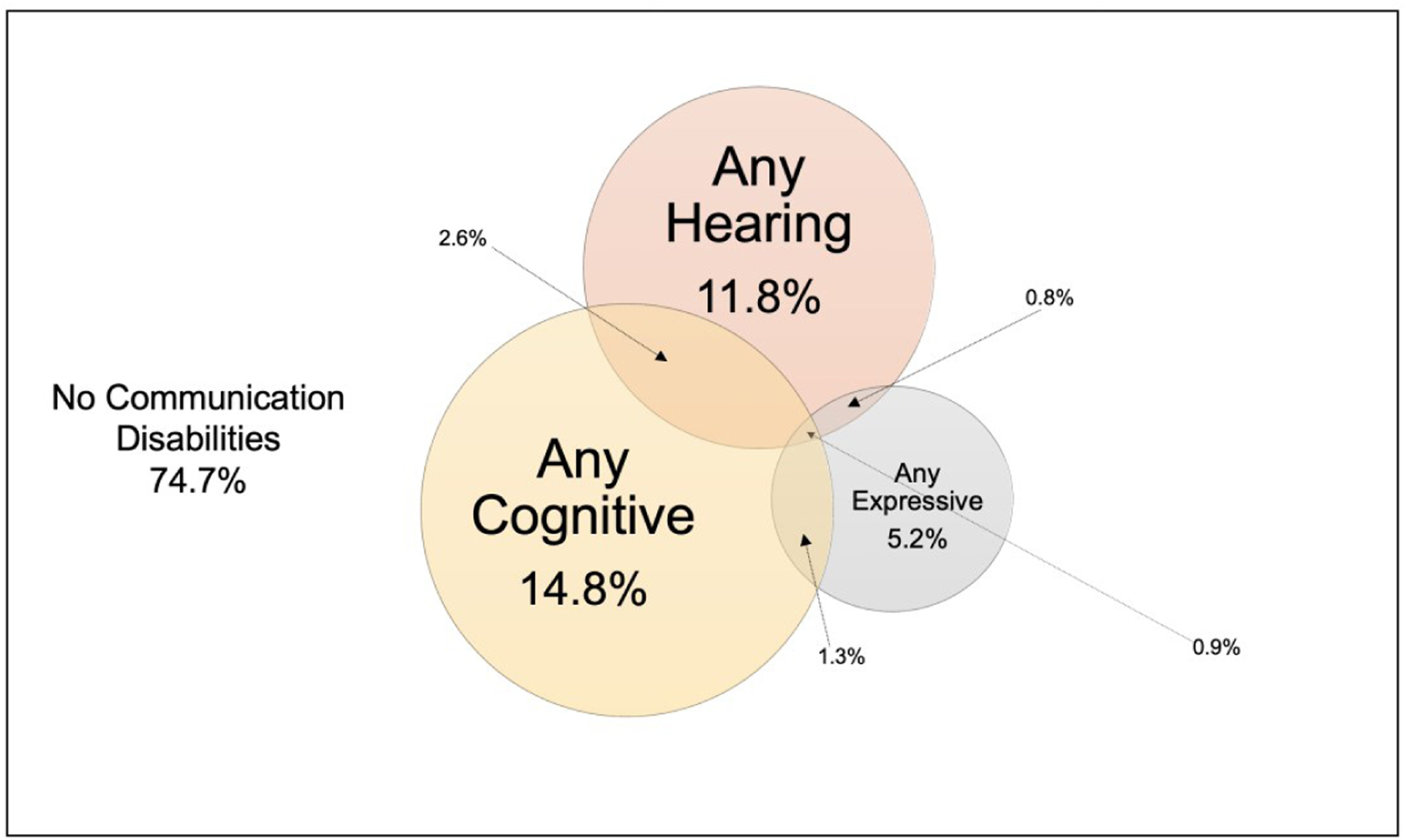
Results: An estimated 25.3% (10.7 million) of community-dwelling older adults in the US experienced any-CDs in 2015; approximately 19.9% (8.4 million) experienced only one CD while 5.6% (2.4 million) had multiple. Older adults with CDs were more likely to be of Black race or Hispanic ethnicity as compared to older adults without CDs (Black 10.1 vs. 7.6%; Hispanic: 12.5 vs. 5.4%; P < 0.001). They also had lower educational attainment (Less than high school: 31.0 vs 12.4%; P < 0.001), lower poverty levels (<100% Federal poverty level: 23.5% vs. 11.1%; P < 0.001) and less social supports (Married: 51.3 vs. 61.0%; P < 0.001; Social network ≤ 1 person: 45.3 vs 36.0%; P < 0.001).
Conclusions: The proportion of the older adult population experiencing any-CDs is large and disproportionately represented by underserved sociodemographic groups. These findings support greater inclusion of any-CDs into population-level efforts like national surveys, public health goals, health services, and community research aimed at understanding and addressing the access needs of older adults who have disabilities in communication.
Keywords: Audiology; Communication disabilities; Epidemiology; Health services research; Public health; Speech-language pathology.
Copyright © 2023. Published by Elsevier Inc.
Conflict of interest statement
Declaration of Competing Interest The authors have no conflicts of interests to disclose
Figures
References
-
- American Association of Retired Persons. Livable communities are age-friendly. Retrieved October 20 from https://www.aarp.org/livable-communities/about/
-
- American Speech-Language-Hearing Association. Cognitive-communication referral guidelines for adults Retrieved Aug 4 from https://www.asha.org/slp/cognitive-referral/
-
- American Speech-Language-Hearing Association. (2005). Roles of speech-language pathologists in the identification, diagnosis, and treatment of individuals with cognitive-communication disorders: Position statement [Position Statement]. www.asha.org/policy
-
- Bayles K, McCullough K, & Tomoeda CK (2018). Cognitive-communication disorders of MCI and dementia: definition, assessment, and clinical management. Plural Publishing.
Publication types
MeSH terms
Grants and funding
LinkOut - more resources
Full Text Sources
Medical
