


Accuracy of diagnosis among clinical malaria patients: comparing microscopy, RDT and a highly sensitive quantitative PCR looking at the implications for submicroscopic infections
- PMID: 36870966
- PMCID: PMC9985253
- DOI: 10.1186/s12936-023-04506-5
Accuracy of diagnosis among clinical malaria patients: comparing microscopy, RDT and a highly sensitive quantitative PCR looking at the implications for submicroscopic infections
Abstract
Background: The World Health Organization recommends parasitological confirmation of all suspected malaria cases by microscopy or rapid diagnostic tests (RDTs) before treatment. These conventional tools are widely used for point-of-care diagnosis in spite of their poor sensitivity at low parasite density. Previous studies in Ghana have compared microscopy and RDT using standard 18S rRNA PCR as reference with varying outcomes. However, how these conventional tools compare with ultrasensitive varATS qPCR has not been studied. This study, therefore, sought to investigate the clinical performance of microscopy and RDT assuming highly sensitive varATS qPCR as gold standard.
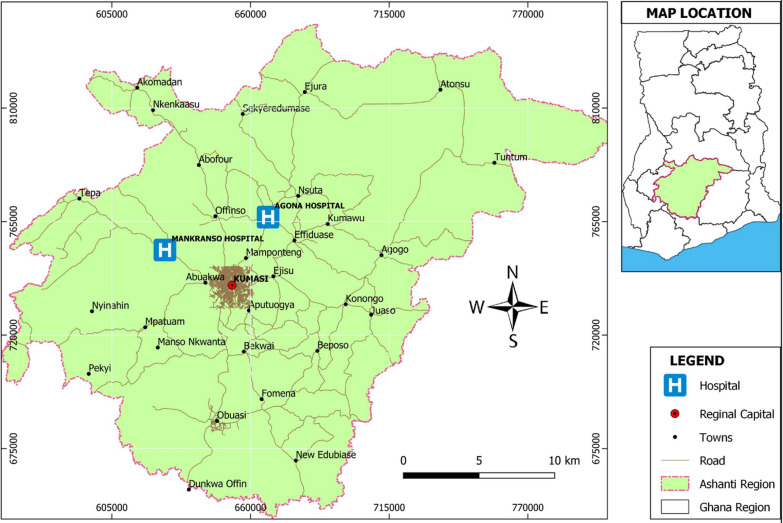
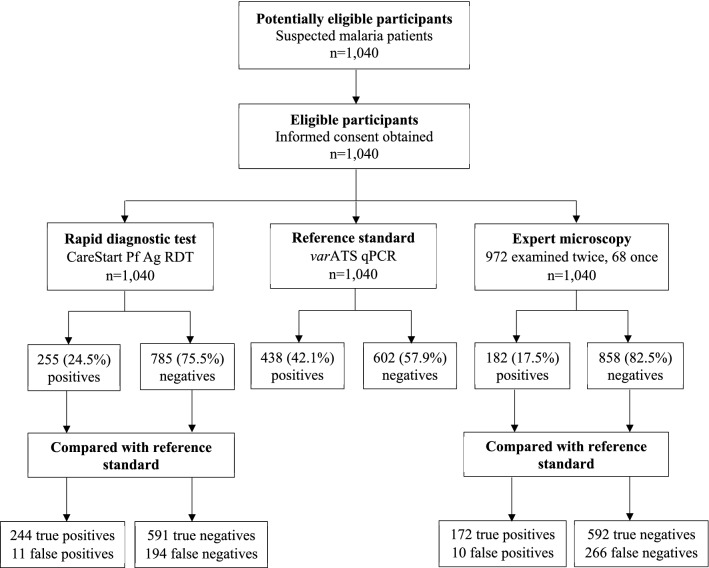
Methods: 1040 suspected malaria patients were recruited from two primary health care centers in the Ashanti Region of Ghana and tested for malaria by microscopy, RDT, and varATS qPCR. The sensitivity, specificity, and predictive values were assessed using varATS qPCR as gold standard.
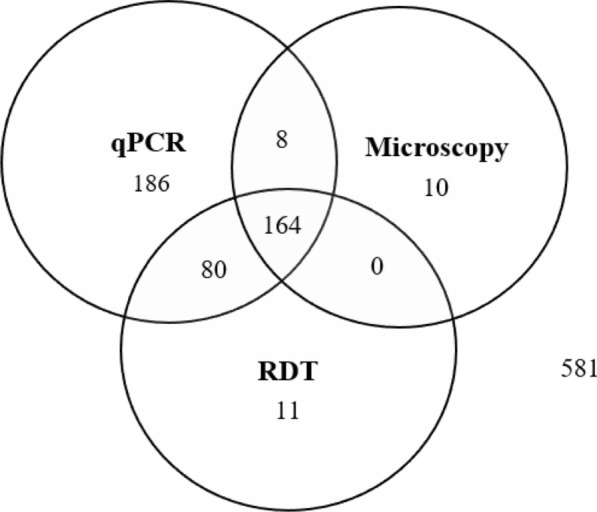
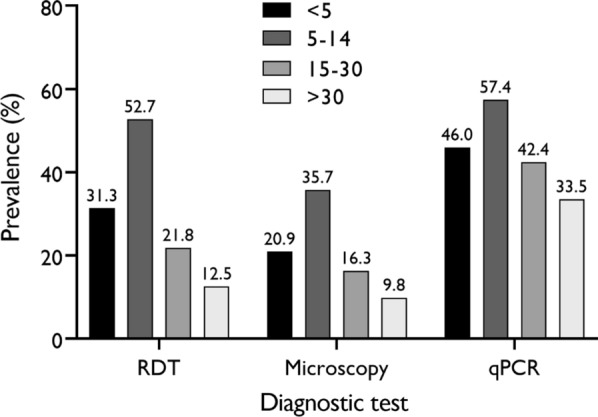
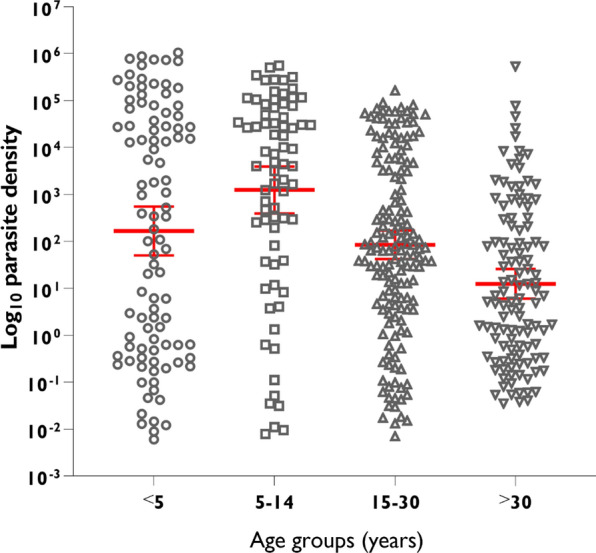
Results: Parasite prevalence was 17.5%, 24.5%, and 42.1% by microscopy, RDT, and varATS qPCR respectively. Using varATS qPCR as the standard, RDT was more sensitive (55.7% vs 39.3%), equally specific (98.2% vs 98.3%), and reported higher positive (95.7% vs 94.5%) and negative predictive values (75.3% vs 69.0%) than microscopy. Consequently, RDT recorded better diagnostic agreement (kappa = 0.571) with varATS qPCR than microscopy (kappa = 0.409) for clinical detection of malaria.
Conclusions: RDT outperformed microscopy for the diagnosis of Plasmodium falciparum malaria in the study. However, both tests missed over 40% of infections that were detected by varATS qPCR. Novel tools are needed to ensure prompt diagnosis of all clinical malaria cases.
Keywords: Malaria; Microscopy; Rapid diagnostic test; Sensitivity; varATS qPCR.
© 2023. The Author(s).
Conflict of interest statement
The authors declare that they have no competing interests.
Figures
References
-
- WHO . World Malaria Report 2021. Geneva: World Health Organization; 2021.
-
- NMCP. Ghana Malaria Programme Review. Accra, 2013.
-
- Anchimane VT, Shedge RT. A Review of Malaria Diagnostic Tools: Microscopy and Rapid Diagnostic Test. Asian J Med Sci. 2010;1:75–79. doi: 10.3126/ajms.v1i2.2965. - DOI
MeSH terms
Grants and funding
LinkOut - more resources
Full Text Sources
Medical
