. 2023 Jun;17(6):813-822.
doi: 10.1038/s41396-023-01390-4. Epub 2023 Mar 4.

Ecological divergence of syntopic marine bacterial species is shaped by gene content and expression

Affiliations

Ecological divergence of syntopic marine bacterial species is shaped by gene content and expression

Brent Nowinski et al. ISME J. 2023 Jun.

Abstract

Identifying mechanisms by which bacterial species evolve and maintain genomic diversity is particularly challenging for the uncultured lineages that dominate the surface ocean. A longitudinal analysis of bacterial genes, genomes, and transcripts during a coastal phytoplankton bloom revealed two co-occurring, highly related Rhodobacteraceae species from the deeply branching and uncultured NAC11-7 lineage. These have identical 16S rRNA gene amplicon sequences, yet their genome contents assembled from metagenomes and single cells indicate species-level divergence. Moreover, shifts in relative dominance of the species during dynamic bloom conditions over 7 weeks confirmed the syntopic species' divergent responses to the same microenvironment at the same time. Genes unique to each species and genes shared but divergent in per-cell inventories of mRNAs accounted for 5% of the species' pangenome content. These analyses uncover physiological and ecological features that differentiate the species, including capacities for organic carbon utilization, attributes of the cell surface, metal requirements, and vitamin biosynthesis. Such insights into the coexistence of highly related and ecologically similar bacterial species in their shared natural habitat are rare.


Conflict of interest statement

The authors declare no competing interests.

Figures
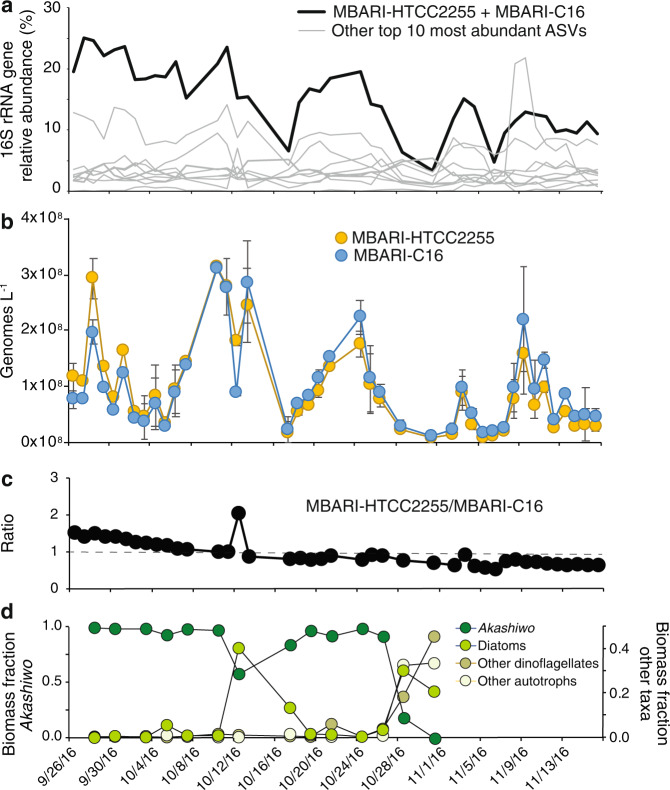
Fig. 1
Fig. 1. Abundance of NAC11-7 syntopic species.
a Relative abundance of the top 10 most abundant ASVs; the bolded line represents the ASV that is identical between MBARI-HTCC2255 and MBARI-C16, while the gray lines represent the nine other most abundant ASVs. b Copies per liter of seawater of each species’ genome. c Ratio of MBARI-HTCC2255 to MBARI-C16 genomes. d Phytoplankton biomass composition (September 28- through October 31, 2016). Akashiwo sanguinea was the dominant phytoplankton species through the majority of the bloom.
Fig. 2
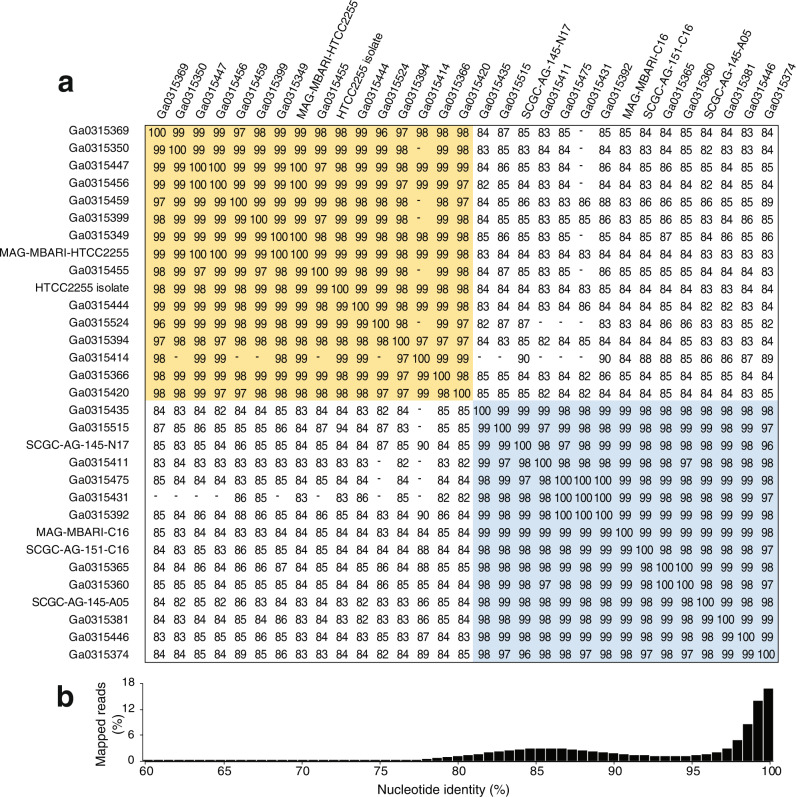
Fig. 2. Evidence for NAC11-7 lineage sequence-discrete clusters represented by a single ASV in Monterey Bay.
a Estimated all-vs-all Average Nucleotide Identity (ANI) distances and similarity clustering of 31 genomes from assembled metagenomic data (MAGs), single amplified genomes (SAGs), and the HTCC2255 isolate. Values are missing if the number of shared genes was too low for accurate ANI calculations. Gold shading indicates MBARI-HTCC2255 clade genomes, all clustering at >95% ANI, and blue shading indicates MBARI-C16 clade genomes, all clustering at >95% ANI. b Nucleotide percent identity of metagenomic reads mapping to the HTCC2255 isolate genome (example from metagenomic sample 46D).
Fig. 3
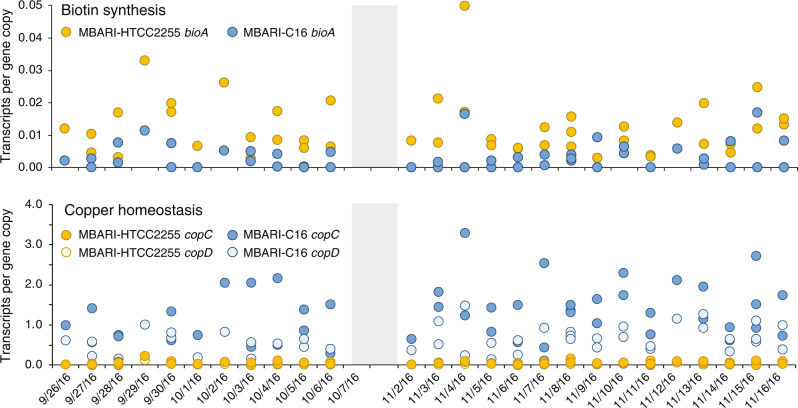
Fig. 3. Example core genes with significant differences in expression levels (transcripts per gene copy) during the Fall 2016 Monterey Bay bloom.
Gray shading indicates the time period when autonomous sample collection by the Environmental Sample Processor was not available.
Fig. 4
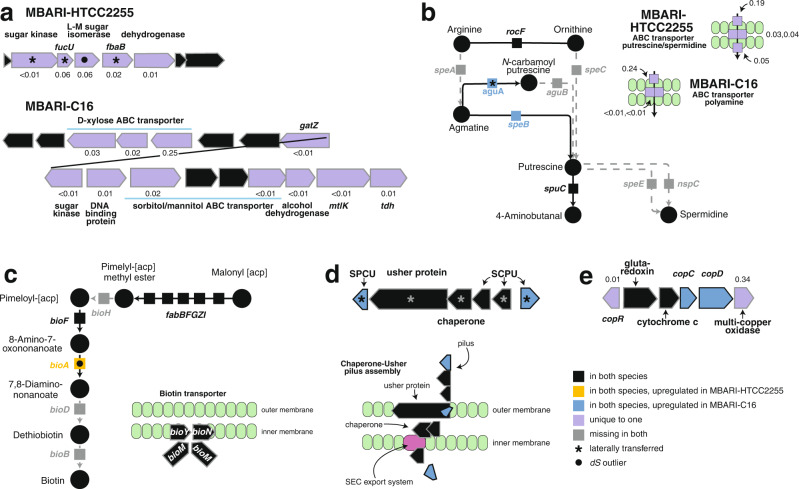
Fig. 4. Gene composition and expression divergence between MBARI-HTCC2255 and MBARI-C16.
a Sugar uptake and catabolism genes. fucU, L-fucose mutarotase; L-M, lyxose-mannose; fbA, fructose-bisphosphate aldolase; gatZ, tagatose-1,6-bisphosphate aldolase; mtlK, mannitol-2-dehydrogenase; tdh, threonine dehydrogenase. b Polyamine synthesis and uptake genes. speA, arginine carboxylase; speB, agmatinase; speC, ornithine decarboxylase; speE, spermidine synthase; aguA, agmatine deiminase; aguB, N-carbamoylputrescine amidase; spuC, putrescine-pyruvate transaminase; nspC, carboxynorspermidine decarboxylase. c Biotin synthesis and uptake genes. bioA, adenosylmethionine-8-amino-7-oxononanoate aminotransferase. d Chaperone-usher (CU) pilus synthesis genes. SCPU, spore coat U domain-containing protein. e Copper-related operon. copR, transcriptional regulator; copC, copper binding protein; copD, copper resistance protein. Expression levels are shown adjacent to each unique gene in units of transcripts per gene copy; the average expression level across all genes and all sample dates is 0.07 transcripts per gene copy.

References

    1. Cohan FM. Bacterial species and speciation. Syst Biol. 2001;50:513–24.. doi: 10.1080/10635150118398. - DOI - PubMed
    1. Delmont TO, Kiefl E, Kilinc O, Esen OC, Uysal I, Rappe MS, et al. Single-amino acid variants reveal evolutionary processes that shape the biogeography of a global SAR11 subclade. eLife. 2019;8:e46497. doi: 10.7554/eLife.46497. - DOI - PMC - PubMed
    1. Hunt DE, David LA, Gevers D, Preheim SP, Alm EJ, Polz MF. Resource partitioning and sympatric differentiation among closely related bacterioplankton. Science. 2008;320:1081–5. doi: 10.1126/science.1157890. - DOI - PubMed
    1. Moore LR, Rocap G, Chisholm SW. Physiology and molecular phylogeny of coexisting Prochlorococcus ecotypes. Nature. 1998;393:464–7. doi: 10.1038/30965. - DOI - PubMed
    1. Rivas LR. A reinterpretation of the concepts “sympatric” and “allopatric” with proposal for the additional terms “syntopic” and “allotopic”. Syst Zool. 1964;13:42–3. doi: 10.2307/2411436. - DOI

Publication types

Substances