


The importance of high quality real-life social interactions during the COVID-19 pandemic
- PMID: 36871079
- PMCID: PMC9985477
- DOI: 10.1038/s41598-023-30803-9
The importance of high quality real-life social interactions during the COVID-19 pandemic
Abstract
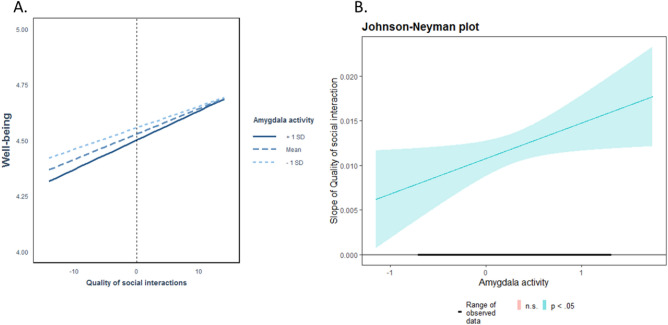
The coronavirus pandemic has brought about dramatic restrictions to real-life social interactions and a shift towards more online social encounters. Positive social interactions have been highlighted as an important protective factor, with previous studies suggesting an involvement of the amygdala in the relationship between social embeddedness and well-being. The present study investigated the effect of the quality of real-life and online social interactions on mood, and explored whether this association is affected by an individual's amygdala activity. Sixty-two participants of a longitudinal study took part in a one-week ecological momentary assessment (EMA) during the first lockdown, reporting their momentary well-being and their engagement in real-life and online social interactions eight times per day (N ~ 3000 observations). Amygdala activity was assessed before the pandemic during an emotion-processing task. Mixed models were calculated to estimate the association between social interactions and well-being, including two-way interactions to test for the moderating effect of amygdala activity. We found a positive relationship between real-life interactions and momentary well-being. In contrast, online interactions had no effect on well-being. Moreover, positive real-life social interactions augmented this social affective benefit, especially in individuals with higher amygdala being more sensitive to the interaction quality. Our findings demonstrate a mood-lifting effect of positive real-life social interactions during the pandemic, which was dependent on amygdala activity before the pandemic. As no corresponding effect was found between online social interactions and well-being, it can be concluded that increased online social interactions may not compensate for the absence of real-life social interactions.
© 2023. The Author(s).
Conflict of interest statement
T.B. served in an advisory or consultancy role for ADHS digital, Infectopharm, Lundbeck, Medice, Neurim Pharmaceuticals, Oberberg GmbH, Roche, and Takeda. He received conference support or speaker’s fees from Medice and Takeda. He received royalties from Hogrefe, Kohlhammer, CIP Medien, Oxford University Press; the present work is unrelated to these relationships. D.B. serves as an unpaid scientific consultant for an EU-funded neurofeedback trial unrelated to the present work. A.M.-L. has received consultancy fees from the American Association for the Advancement of Science, Atheneum Partners, Blueprint Partnership, Boehringer Ingelheim, Daimler und Benz Stiftung, Elsevier, F. Hoffmann-La Roche, ICARE Schizophrenia, K. G. Jebsen Foundation, L.E.K Consulting, Lundbeck International Foundation (LINF), R. Adamczak, Roche Pharma, Science Foundation, Sumitomo Dainippon Pharma, Synapsis Foundation – Alzheimer Research Switzerland, and System Analytics, and has received lecture fees including travel expenses from Boehringer Ingelheim, Fama Public Relations, Institut d'investigacions Biomèdiques August Pi i Sunyer (IDIBAPS), Janssen-Cilag, Klinikum Christophsbad, Göppingen, Lilly Deutschland, Luzerner Psychiatrie, LVR Klinikum Düsseldorf, LWL Psychiatrie Verbund Westfalen-Lippe, Otsuka Pharmaceuticals, Reunions i Ciencia S. L., Spanish Society of Psychiatry, Südwestrundfunk Fernsehen, Stern TV, and Vitos Klinikum Kurhessen. U. W. E.-P. has received consultancy fees from Boehringer Ingelheim.
Figures

References
Publication types
MeSH terms
LinkOut - more resources
Full Text Sources
Medical
Research Materials
