. 2023 Mar 21;329(11):899-909.
doi: 10.1001/jama.2023.2307.

Cardiovascular Risk Factor Prevalence, Treatment, and Control in US Adults Aged 20 to 44 Years, 2009 to March 2020

Affiliations

Cardiovascular Risk Factor Prevalence, Treatment, and Control in US Adults Aged 20 to 44 Years, 2009 to March 2020

Rahul Aggarwal et al. JAMA. .

Abstract

Importance: Declines in cardiovascular mortality have stagnated in the US over the past decade, in part related to worsening risk factor control in older adults. Little is known about how the prevalence, treatment, and control of cardiovascular risk factors have changed among young adults aged 20 to 44 years.

Objective: To determine if the prevalence of cardiovascular risk factors (hypertension, diabetes, hyperlipidemia, obesity, and tobacco use), treatment rates, and control changed among adults aged 20 to 44 years from 2009 through March 2020, overall and by sex and race and ethnicity.

Design, setting, and participants: Serial cross-sectional analysis of adults aged 20 to 44 years in the US participating in the National Health and Nutrition Examination Survey (2009-2010 to 2017-March 2020).

Main outcomes and measures: National trends in the prevalence of hypertension, diabetes, hyperlipidemia, obesity, and smoking history; treatment rates for hypertension and diabetes; and blood pressure and glycemic control in those receiving treatment.

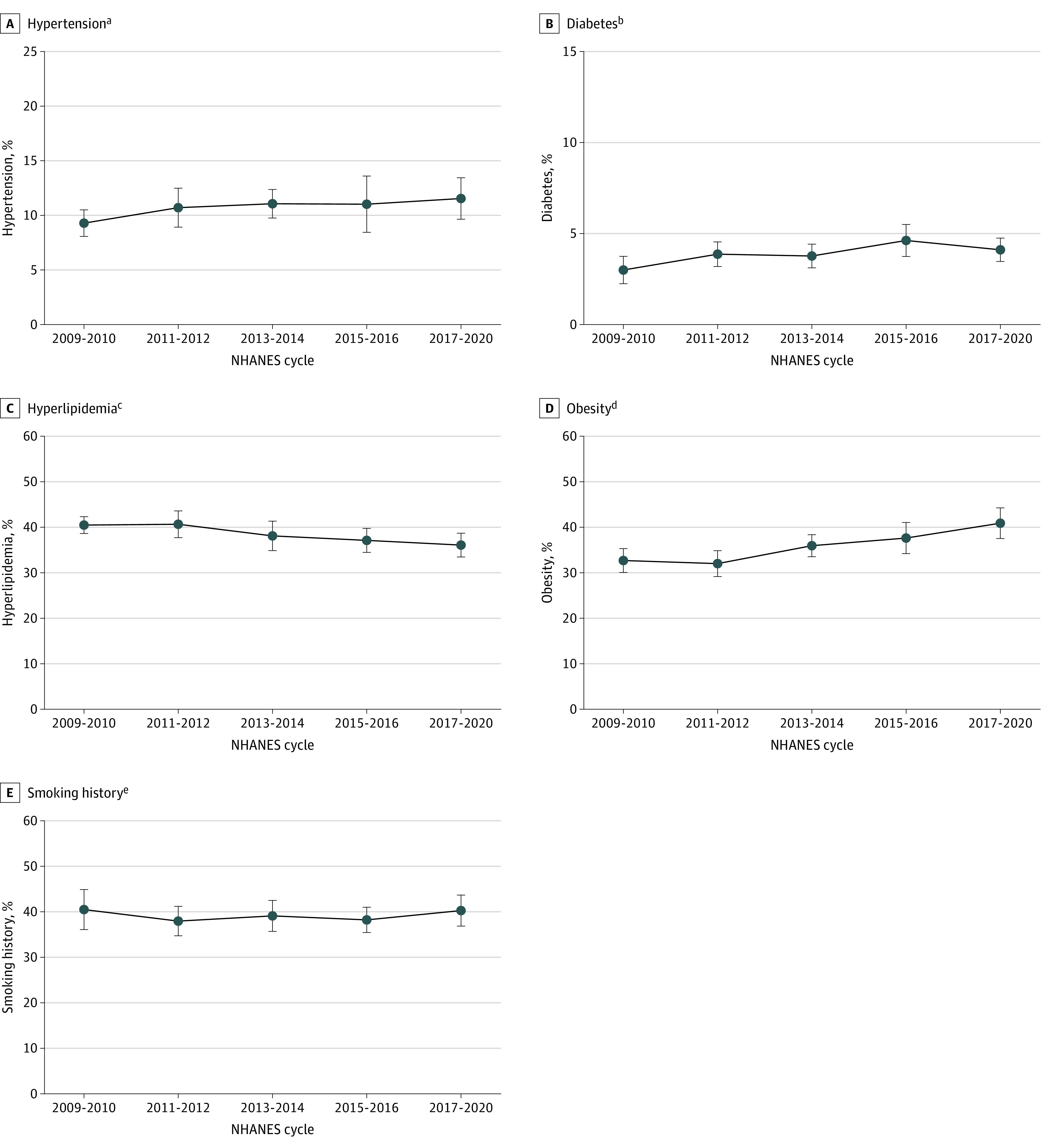
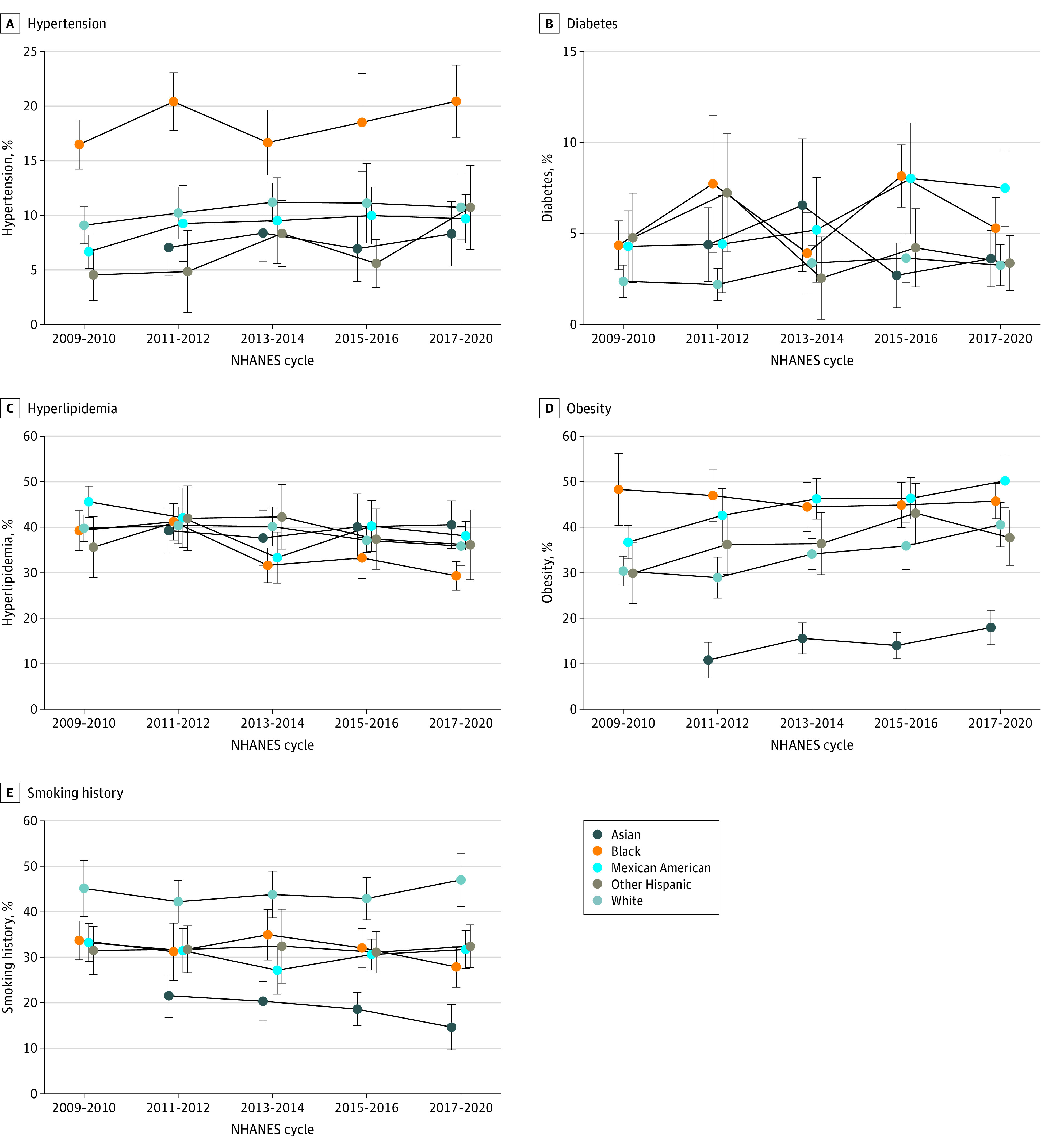
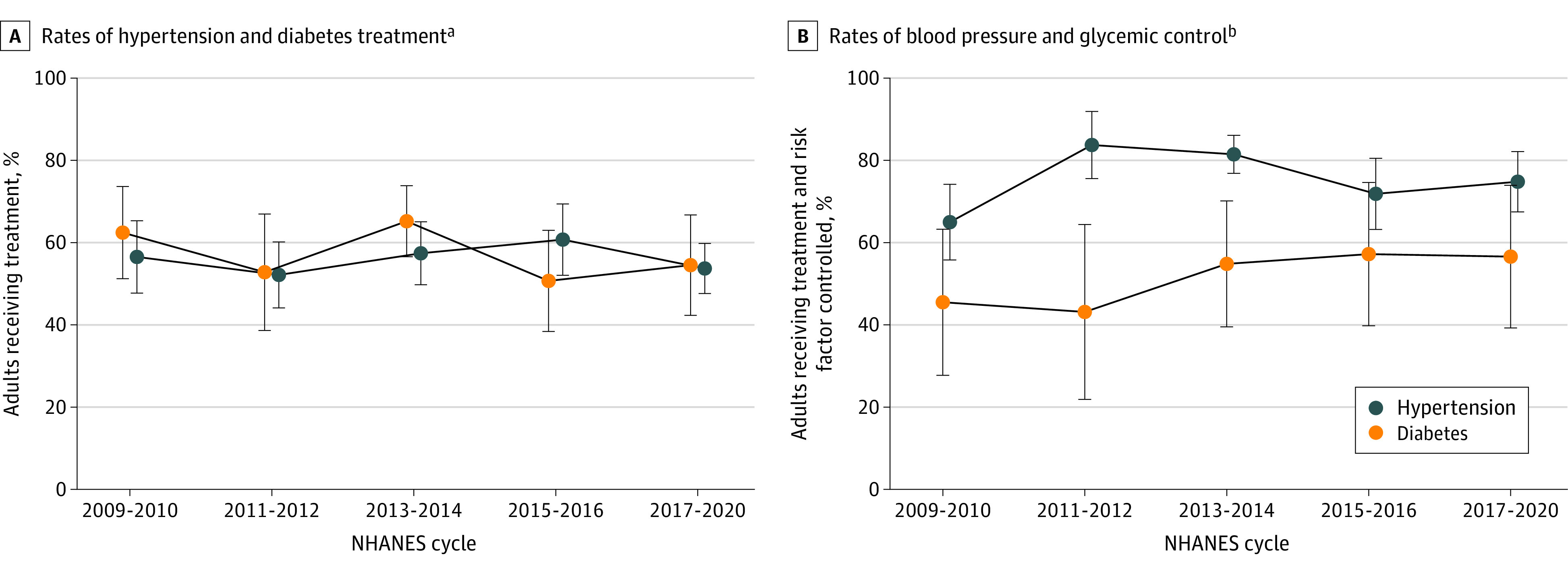
Results: Among 12 924 US adults aged 20 to 44 years (mean age, 31.8 years; 50.6% women), the prevalence of hypertension was 9.3% (95% CI, 8.1%-10.5%) in 2009-2010 and 11.5% (95% CI, 9.6%-13.4%) in 2017-2020. The prevalence of diabetes (from 3.0% [95% CI, 2.2%-3.7%] to 4.1% [95% CI, 3.5%-4.7%]) and obesity (from 32.7% [95% CI, 30.1%-35.3%] to 40.9% [95% CI, 37.5%-44.3%]) increased from 2009-2010 to 2017-2020, while the prevalence of hyperlipidemia decreased (from 40.5% [95% CI, 38.6%-42.3%] to 36.1% [95% CI, 33.5%-38.7%]). Black adults had high rates of hypertension across the study period (2009-2010: 16.2% [95% CI, 14.0%-18.4%]; 2017-2020: 20.1% [95% CI, 16.8%-23.3%]), and significant increases in hypertension were observed among Mexican American adults (from 6.5% [95% CI, 5.0%-8.0%] to 9.5% [95% CI, 7.3%-11.7%]) and other Hispanic adults (from 4.4% [95% CI, 2.1%-6.8%] to 10.5% [95% CI, 6.8%-14.3%]), while Mexican American adults had a significant rise in diabetes (from 4.3% [95% CI, 2.3%-6.2%] to 7.5% [95% CI, 5.4%-9.6%]). The percentage of young adults treated for hypertension who achieved blood pressure control did not significantly change (from 65.0% [95% CI, 55.8%-74.2%] in 2009-2010 to 74.8% [95% CI, 67.5%-82.1%] in 2017-2020], while glycemic control among young adults receiving treatment for diabetes remained suboptimal throughout the study period (2009-2010: 45.5% [95% CI, 27.7%-63.3%]) to 2017-2020: 56.6% [95% CI, 39.2%-73.9%]).

Conclusions and relevance: In the US, diabetes and obesity increased among young adults from 2009 to March 2020, while hypertension did not change and hyperlipidemia declined. There was variation in trends by race and ethnicity.


Conflict of interest statement

Conflict of Interest Disclosures: Dr Yeh reported receiving research support from the National Heart, Lung, and Blood Institute (outside the submitted work) and the Richard A. and Susan F. Smith Center for Outcomes Research in Cardiology and receiving personal fees from Biosense Webster and grants and personal fees from Abbott Vascular, AstraZeneca, Boston Scientific, and Medtronic. Dr Joynt Maddox reported receiving research support from the National Heart, Lung, and Blood Institute (outside the submitted work), the National Institute of Nursing Research, and the National Institute on Aging and receiving personal fees from Humana and Centene. Dr Wadhera reported receiving research support from the National Heart, Lung, and Blood Institute (outside the submitted work) and serving as a consultant for Abbott and CVS Health. No other disclosures were reported.

Figures

Figure 1.
Figure 1.. Age-Adjusted Trends in the Prevalence of Hypertension, Diabetes, Hyperlipidemia, Obesity, and Smoking History Among US Adults Aged 20 to 44 Years, 2009-2010 to 2017–March 2020
Nationally representative estimates of the prevalence of cardiovascular risk factors among US adults aged 20 to 44 years from the National Health and Nutrition Examination Survey (NHANES), 2009 to March 2020. Whiskers indicate 95% confidence intervals. aHypertension was defined as systolic blood pressure of ≥140 mm Hg, diastolic blood pressure of ≥90 mm Hg, or a prescription for antihypertensive therapy. bDiabetes was defined as a hemoglobin A1c of ≥6.5% or a health care diagnosis of diabetes. cHyperlipidemia was defined as total cholesterol level of ≥200 mg/dL or a health care diagnosis of high cholesterol. dObesity was defined as body mass index of ≥30 (calculated as weight in kilograms divided by height in meters squared). eSmoking history was defined as self-report of smoking at least 100 cigarettes ever.
Figure 2.
Figure 2.. Age-Adjusted Trends in the Prevalence of Hypertension, Diabetes, Hyperlipidemia, Obesity, and Smoking History Among US Adults Aged 20 to 44 Years by Race and Ethnicity, 2009-2010 to 2017–March 2020
Nationally representative estimates of US adults aged 20 to 44 years from the National Health and Nutrition Examination Survey (NHANES), 2009 to March 2020. Estimates are shown by race and ethnicity; whiskers indicate 95% confidence intervals. Race and ethnicity were based on self-report to closed-ended questions. Asian, Black, and White adults included only those self-reporting as non-Hispanic. Other Hispanic adults included those self-reporting as Hispanic but not as Mexican American. Data for Asian adults were collected only from 2011 onward. For definitions of hypertension, diabetes, hyperlipidemia, obesity, and smoking history, see Figure 1 legend.
Figure 3.
Figure 3.. Age-Adjusted Trends in Hypertension and Diabetes Treatment and Control Among US Adults Aged 20 to 44 Years, 2009-2010 to 2017–March 2020
Nationally representative estimates of US adults aged 20 to 44 years from the National Health and Nutrition Examination Survey (NHANES), 2009 to March 2020. Whiskers indicate 95% confidence intervals. aTreatment of hypertension was defined as a self-report of taking medications for blood pressure and was assessed among adults with hypertension (n = 1408). Treatment of diabetes was defined as a self-report of taking diabetes pills or insulin and was assessed among adults with diabetes (n = 631). bControl was assessed among adults receiving treatment, consistent with prior reports (n = 693 for hypertension and n = 350 for diabetes)., Hypertension was considered controlled if systolic blood pressure was <140 mm Hg and <90 mm Hg, diabetes was considered controlled if hemoglobin A1c was <7%.

Comment in

References

    1. Gooding HC, Gidding SS, Moran AE, et al. Challenges and opportunities for the prevention and treatment of cardiovascular disease among young adults: report from a National Heart, Lung, and Blood Institute working group. J Am Heart Assoc. 2020;9(19):e016115. doi: 10.1161/JAHA.120.016115 - DOI - PMC - PubMed
    1. Armstrong AC, Jacobs DR Jr, Gidding SS, et al. Framingham score and LV mass predict events in young adults: CARDIA study. Int J Cardiol. 2014;172(2):350-355. doi: 10.1016/j.ijcard.2014.01.003 - DOI - PMC - PubMed
    1. Jacobs DR Jr, Woo JG, Sinaiko AR, et al. Childhood cardiovascular risk factors and adult cardiovascular events. N Engl J Med. 2022;386(20):1877-1888. doi: 10.1056/NEJMoa2109191 - DOI - PMC - PubMed
    1. Muntner P, Hardy ST, Fine LJ, et al. Trends in blood pressure control among US adults with hypertension, 1999-2000 to 2017-2018. JAMA. 2020;324(12):1190-1200. doi: 10.1001/jama.2020.14545 - DOI - PMC - PubMed
    1. Wang L, Li X, Wang Z, et al. Trends in prevalence of diabetes and control of risk factors in diabetes among US adults, 1999-2018. JAMA. 2021;326(8):1-13. doi: 10.1001/jama.2021.9883 - DOI - PMC - PubMed

Publication types