


Knowledge, attitude, and practice of childhood myopia among Indian optometrists: A questionnaire-based study
- PMID: 36872716
- PMCID: PMC10229990
- DOI: 10.4103/IJO.IJO_2660_22
Knowledge, attitude, and practice of childhood myopia among Indian optometrists: A questionnaire-based study
Abstract
Purpose: To investigate the knowledge of myopia and its natural history including complications and clinical approaches for management adopted by optometrists across India.
Methods: An online survey was distributed to Indian optometrists. A pre-validated questionnaire was adopted from previous literature. Respondents provided information about their demographics (gender, age, practice location, and modality), myopia knowledge, self-reported practice behaviors relating to childhood myopia, the information and evidence base used to guide their practice, and perceived extent of adult caregiver engagement in making management decisions for myopic children.
Results: A total of 302 responses were collected from different regions of the country. Most respondents demonstrated knowledge of the association between high myopia and retinal breaks, retinal detachment and primary open-angle glaucoma. Optometrists used a range of techniques to diagnose childhood myopia, with a preference for non-cycloplegic refractive measures. The most common approaches to management were single-vision distance despite most optometrists identifying orthokeratology and low-dose (0.01%) topical atropine as two potentially more effective therapeutic interventions for controlling childhood myopia progression. Almost 90% of respondents considered increasing the time spent outdoors to be beneficial for reducing the rate of myopia progression. The main sources of information used to guide clinical practice were continuing education conferences, seminars, research articles, and workshops.
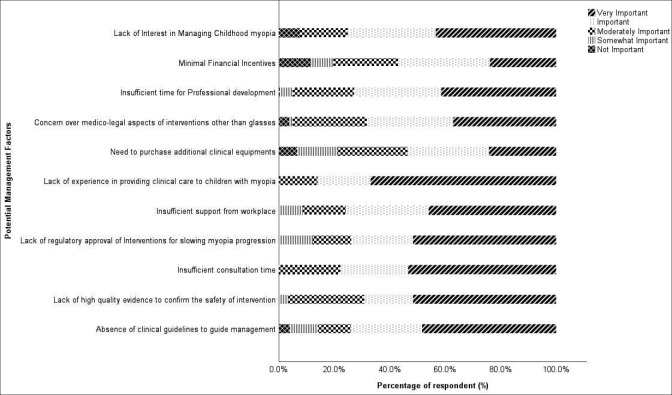
Conclusion: : Indian optometrists appear to be aware of emerging evidence and practices, but are not routinely adopting measures. Clinical guidelines, regulatory approval, and sufficient consultation time may be of value for assisting practitioners in making clinical decisions based on the current available research evidence.
Keywords: Indian optometrists; knowledge; myopia; myopia control; myopia progression.
Conflict of interest statement
None
Figures
Comment on
-
Association of Axial Length With Risk of Uncorrectable Visual Impairment for Europeans With Myopia.JAMA Ophthalmol. 2016 Dec 1;134(12):1355-1363. doi: 10.1001/jamaophthalmol.2016.4009. JAMA Ophthalmol. 2016. PMID: 27768171
References
-
- Holden B, Mariotti S, Kocur I. The impact of myopia and high myopia: Report of the Joint WHO–Brien Holden Vision Institute. Paper presented at: Global Scientific Meeting on Myopia 2015
-
- Bourne RR, Stevens GA, White RA, Smith JL, Flaxman SR, Price H, et al. Causes of vision loss worldwide, 1990–2010: A systematic analysis. Lancet Glob Health. 2013;1:e339–49. - PubMed
-
- Holden BA, Fricke TR, Wilson DA, Jong M, Naidoo KS, Sankaridurg P, et al. Global prevalence of myopia and high myopia and temporal trends from 2000 through 2050. Ophthalmology. 2016;123:1036–42. - PubMed
-
- Priscilla JJ, Verkicharla PK. Time trends on the prevalence of myopia in India–A prediction model for 2050. Ophthalmic Physiol Opt. 2021;41:466–74. - PubMed
Publication types
MeSH terms
LinkOut - more resources
Full Text Sources
