. 2023 Feb;13(2):804-818.
doi: 10.1016/j.apsb.2022.09.017. Epub 2022 Sep 30.

A tactical nanomissile mobilizing antitumor immunity enables neoadjuvant chemo-immunotherapy to minimize postsurgical tumor metastasis and recurrence

Affiliations

A tactical nanomissile mobilizing antitumor immunity enables neoadjuvant chemo-immunotherapy to minimize postsurgical tumor metastasis and recurrence

Tao He et al. Acta Pharm Sin B. 2023 Feb.

Abstract

Neoadjuvant chemotherapy has become an indispensable weapon against high-risk resectable cancers, which benefits from tumor downstaging. However, the utility of chemotherapeutics alone as a neoadjuvant agent is incapable of generating durable therapeutic benefits to prevent postsurgical tumor metastasis and recurrence. Herein, a tactical nanomissile (TALE), equipped with a guidance system (PD-L1 monoclonal antibody), ammunition (mitoxantrone, Mit), and projectile bodies (tertiary amines modified azobenzene derivatives), is designed as a neoadjuvant chemo-immunotherapy setting, which aims at targeting tumor cells, and fast-releasing Mit owing to the intracellular azoreductase, thereby inducing immunogenic tumor cells death, and forming an in situ tumor vaccine containing damage-associated molecular patterns and multiple tumor antigen epitopes to mobilize the immune system. The formed in situ tumor vaccine can recruit and activate antigen-presenting cells, and ultimately increase the infiltration of CD8+ T cells while reversing the immunosuppression microenvironment. Moreover, this approach provokes a robust systemic immune response and immunological memory, as evidenced by preventing 83.3% of mice from postsurgical metastasis or recurrence in the B16-F10 tumor mouse model. Collectively, our results highlight the potential of TALE as a neoadjuvant chemo-immunotherapy paradigm that can not only debulk tumors but generate a long-term immunosurveillance to maximize the durable benefits of neoadjuvant chemotherapy.

Keywords: Azobenzene derivatives; Chemotherapy; Immunotherapy; Melanoma; Mitoxantrone; Neoadjuvant; Reduction responsive; Vaccine.


Conflict of interest statement

The authors report no conflicts of interest.

Figures

Image 1
Graphical abstract
Figure 1
Figure 1
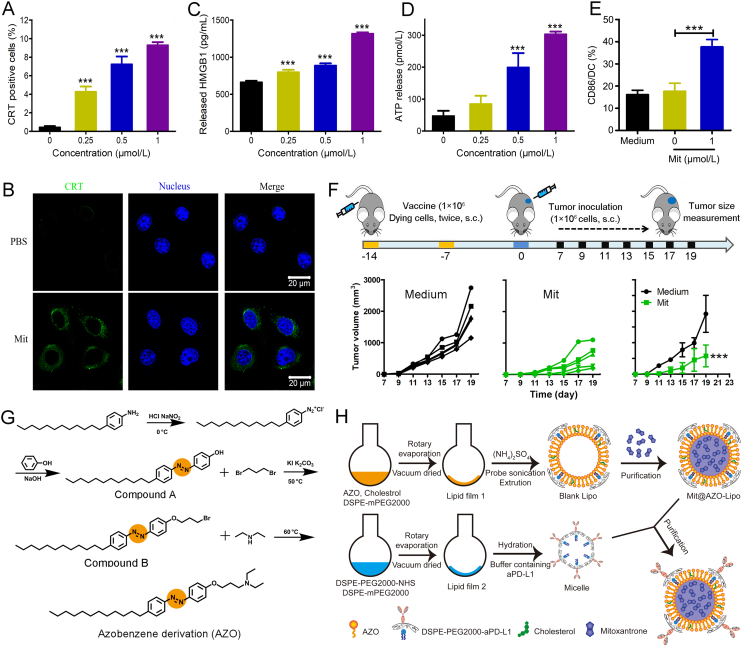
Mit elicited the immunogenic death of B16–F10 cells and the preparation diagram of mitoxantrone@anti-PD-L1/azobenzene-lipo (MPAL). (A) CRT detections on B16–F10 cells after being treated with different concentrations of Mit using flow cytometry. (B) CRT expression on B16–F10 cells in response to Mit was observed by confocal microscopy. Scale bar = 20 μm. Release of (C) HMGB1 and (D) ATP by B16–F10 cells after Mit treatment. (∗∗∗P < 0.001 indicates the statistical difference between each group and the group without Mit) (E) The expression of CD86 on BMDCs after co-cultured with Mit-treated B16–F10 cells. (F) The vaccination method was used to identify Mit-induced immunogenic B16–F10 cell death. (G) The synthesis routes of AZO. (H) Schematic illustration of the preparation steps of MPAL. Data are presented as mean ± SD (n = 3). ∗∗∗P < 0.001.
Figure 2
Figure 2
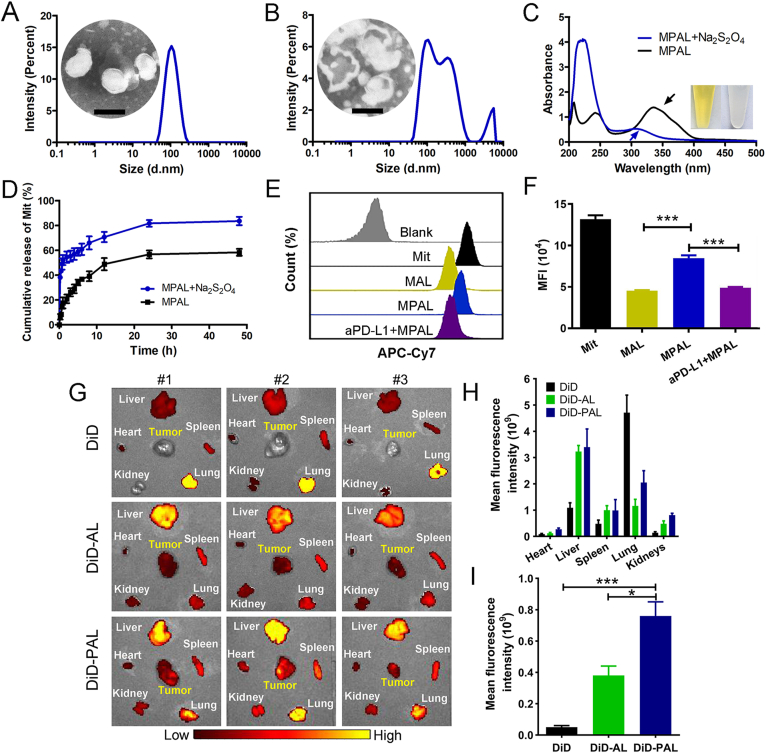
The azoreductase-responsive behavior and enhanced melanoma targeting capability of MPAL. (A) Size distribution and TEM image of MPAL (Scale bar: 100 nm). (B) Size distribution and TEM image of MPAL after Na2S2O4 treatment (Scale bar: 100 nm). (C) The UV absorption spectra of MPAL and MPAL after Na2S2O4 treatment, while the black arrow indicates the characteristic absorption peak of azo. The picture showed AL in centrifuge tubes before and after treated with Na2S2O4. (D) The release of Mit from MPAL or MPAL after treated with Na2S2O4 in PBS. (E) Flow cytometry histograms and (F) quantification of cellular uptake behavior. (G) Ex vivo fluorescence images of heart, liver, spleen, lung, kidney, and tumor after 24 h of intravenous injection of DiD, DiD-AL, and DiD-PAL in tumor-bearing mice. Quantitative fluorescence analysis of main organs (H) and tumors (I). Data are presented as mean ± SD (n = 3). P < 0.05, ∗∗∗P < 0.001.
Figure 3
Figure 3
Therapeutic activity of MPAL in B16–F10 subcutaneous xenograft model (n = 5). (A) Outline of inoculation, treatment, and tumor volume measurement. (B) Individual tumor growth kinetics in various groups. (C) Photographs of mice in each group on day 17 after inoculation, and yellow circles represent tumor sites. (D) Mean tumor volume growth curves of mice in each group (Results are presented as mean ± SEM, ∗∗∗P < 0.001). (E) Tumor weight of mice in each group on day 17 after inoculation. (F) H&E staining of tumor sections in each group (scale bar: 50 μm). TUNEL (G) and CRT immunofluorescence staining (H) of tumor sections in each group (Scale bar: 20 μm).
Figure 4
Figure 4
Therapeutic activity of MPAL in the B16–F10 tumor lung metastasis model. (A) In vivo bioluminescence imaging of B16–F10-Luc in control and treatment groups on days 11, 15, and 19, the figure shows 3 representative mice from each group (n = 5). Mean fluorescence intensity (B), representative pictures and H&E staining (scale bar: 200 μm) (C), weights (D), and metastatic nodules (E) of lungs in each group on day 19 after B16–F10-Luc tumor inoculation. Data are presented as mean ± SD. ∗∗P < 0.01, ∗∗∗P < 0.001.
Figure 5
Figure 5
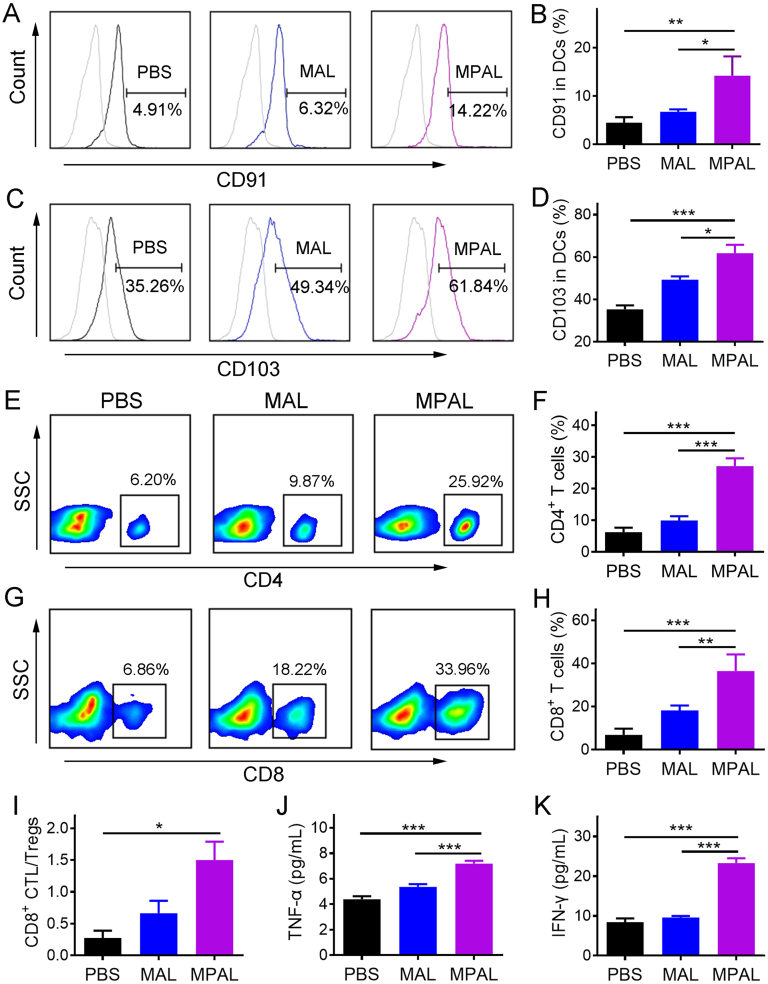
In situ tumor vaccine induced by MPAL activates and amplifies the immune response in vivo. (A, B) Flow cytometric analysis of CD91+ DCs in tumors. (C, D) Flow cytometric analysis of CD103+ DCs in tumor-draining lymph nodes. (E, F) Flow cytometric analysis of CD4+ T cells in tumors. (G, H) Flow cytometric analysis of CD8+ T cells in tumors. (I) The ratio of CD8+ T cells to Treg cells. The concentrations of TNF-α (J) and IFN-γ (K) in sera from mice after different treatments. Results are presented as mean ± SD (n = 3). P < 0.05, ∗∗P < 0.01, ∗∗∗P < 0.001.
Figure 6
Figure 6
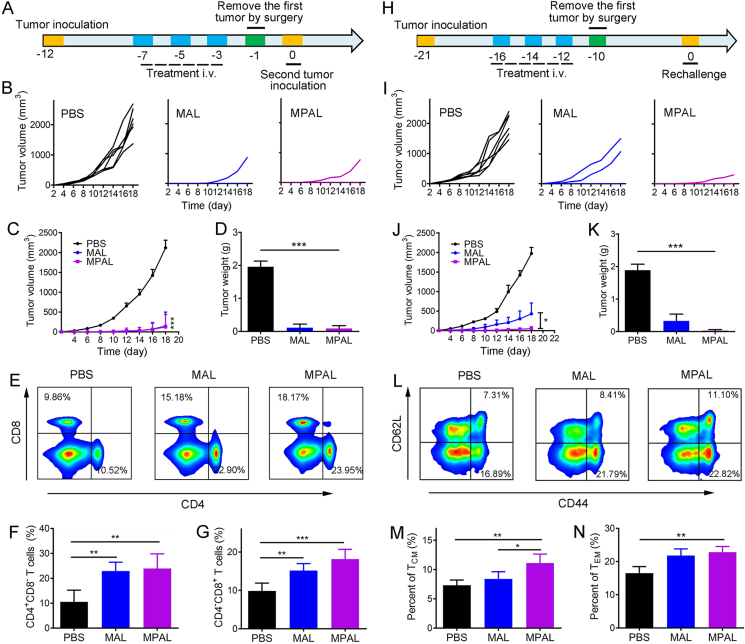
Neoadjuvant chemo-immunotherapy with MPAL suppressed the postsurgical metastasis and recurrence of B16–F10 tumors. (A) Schematic depicting the experimental procedure for evaluating postsurgical metastasis of B16–F10 tumors. (B) Individual tumor growth kinetics in PBS, MAL, and MPAL groups. (C) Mean tumor volume growth curves of mice in each group (Data are presented as mean ± SEM, ∗∗∗P < 0.001: MPAL versus PBS). (D) Tumor weight of mice in each group on day 19 after second tumor inoculation. (E, F, and G) Flow cytometric analysis of CD4+ and CD8+ T cells in the spleen. (H) Schematic depicting the experimental procedure for evaluation of postsurgical recurrence of B16–F10 tumors. (I) Individual tumor growth curves in PBS, MAL, and MPAL groups after tumor rechallenged. (J) Mean tumor volume growth curves of mice in each group (Data are presented as mean ± SEM, P < 0.05). (K) Tumor weight of mice in each group on day 19 after tumor rechallenged. (L, M, and N) Flow cytometric analysis of central memory T cells (CD44+CD62Llow, TCM) and effector memory T cells (CD44+CD62Lhigh, TEM) in the spleen (gated on CD3+CD8+ T cells, n = 5). (P < 0.05, ∗∗P < 0.01, ∗∗∗P < 0.001).
Figure 7
Figure 7
TALE mobilizing antitumor immunity through eliciting ICD of tumor cells and PD-1/PD-L1 blockade enables neoadjuvant chemo-immunotherapy to minimize postsurgical tumor metastasis and relapse.

References

    1. Amaria R.N., Reddy S.M., Tawbi H.A., Davies M.A., Ross M.I., Glitza I.C., et al. Neoadjuvant immune checkpoint blockade in high-risk resectable melanoma. Nat Med. 2018;24:1649–1654. - PMC - PubMed
    1. Ho W.J., Zhu Q.F., Durham J., Popovic A., Xavier S., Leatherman J., et al. Neoadjuvant cabozantinib and nivolumab convert locally advanced hepatocellular carcinoma into resectable disease with enhanced antitumor immunity. Nat Cancer. 2021;2:891–903. - PMC - PubMed
    1. Gao J.J., Navai N., Alhalabi O., Siefker-Radtke A., Campbell M.T., Tidwell R.S., et al. Neoadjuvant PD-L1 plus CTLA-4 blockade in patients with cisplatin-ineligible operable high-risk urothelial carcinoma. Nat Med. 2020;26:1845–1851. - PMC - PubMed
    1. Montemurro F., Nuzzolese I., Ponzone R. Neoadjuvant or adjuvant chemotherapy in early breast cancer? Expet Opin Pharmacother. 2020;21:1071–1082. - PubMed
    1. Pataer A., Weissferdt A., Vaporciyan A.A., Correa A.M., Sepesi B., Wistuba, et al. Evaluation of pathologic response in lymph nodes of patients with lung cancer receiving neoadjuvant chemotherapy. J Thorac Oncol. 2021;16:1289–1297. - PMC - PubMed