


Diagnostic yield of an insertable cardiac monitor in a large patient population
- PMID: 36873314
- PMCID: PMC9975005
- DOI: 10.1016/j.hroo.2022.11.005
Diagnostic yield of an insertable cardiac monitor in a large patient population
Abstract
Background: Insertable cardiac monitors (ICMs) are increasingly used for cardiac rhythm diagnosis with expanding indications. Little has been reported about their use and efficacy.
Objective: The study sought to evaluate the clinical utility of a novel ICM (Biotronik BIOMONITOR III) including the time to diagnosis in unselected patients with different ICM indications.
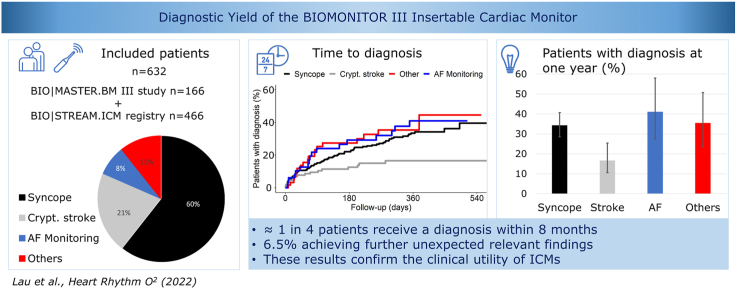
Methods: Patients from 2 prospective clinical studies were included to determine the diagnostic yield of the ICM. The primary endpoint was time to clinical diagnosis per implant indication or to the first change in atrial fibrillation (AF) therapy.
Results: A total of 632 patients were included with a mean follow-up of 233 ± 168 days. Of 384 patients with (pre)syncope, 34.2% had a diagnosis at 1 year. The most frequent therapy was permanent pacemaker implantation. Of 133 patients with cryptogenic stroke, 16.6% had an AF diagnosis at 1 year, resulting in oral anticoagulation. Of 49 patients with an indication for AF monitoring, 41.0% had a relevant change in AF therapy based on ICM data at 1 year. Of 66 patients with other indications, 35.4% received a rhythm diagnosis at 1 year. Moreover, 6.5% of the cohort had additional diagnoses: 26 of 384 patients with syncope, 8 of 133 patients with cryptogenic stroke, and 7 of 49 patients with AF monitoring.
Conclusion: In a large unselected patient population with heterogeneous ICM indications, the primary endpoint of rhythm diagnosis was achieved in ∼1 in 4, and additional clinically relevant findings was achieved in 6.5% of patients at short-term follow-up.
Keywords: Cardiac arrhythmia; Home monitoring; Implantable loop recorder; Insertable cardiac monitor; Remote monitoring.
© 2022 Heart Rhythm Society. Published by Elsevier Inc.
Figures

References
-
- Solbiati M., Casazza G., Dipaola F., et al. The diagnostic yield of implantable loop recorders in unexplained syncope: a systematic review and meta-analysis. Int J Cardiol. 2017;231:170–176. - PubMed
-
- Giancaterino S., Lupercio F., Nishimura M., Hsu J.C. Current and future use of insertable cardiac monitors. J Am Coll Cardiol EP. 2018;4:1383–1396. - PubMed
-
- Sakhi R., Theuns D.A.M.J., Szili-Torok T., Yap S.C. Insertable cardiac monitors: current indications and devices. Expert Rev Med Devices. 2019;16:45–55. - PubMed
LinkOut - more resources
Full Text Sources
