. 2023 Feb 15:14:1104371.
doi: 10.3389/fimmu.2023.1104371. eCollection 2023.

Donation type and the effect of pre-transplant donor specific antibodies - Data from the Swiss Transplant Cohort Study

Collaborators, Affiliations

Donation type and the effect of pre-transplant donor specific antibodies - Data from the Swiss Transplant Cohort Study

Olivier de Rougemont et al. Front Immunol. .

Abstract

Introduction: The type of donation may affect how susceptible a donor kidney is to injury from pre-existing alloimmunity. Many centers are, therefore, reluctant to perform donor specific antibody (DSA) positive transplantations in the setting of donation after circulatory death (DCD). There are, however, no large studies comparing the impact of pre-transplant DSA stratified on donation type in a cohort with a complete virtual cross-match and long-term follow-up of transplant outcome.

Methods: We investigated the effect of pre-transplant DSA on the risk of rejection, graft loss, and the rate of eGFR decline in 1282 donation after brain death (DBD) transplants and compared it to 130 (DCD) and 803 living donor (LD) transplants.

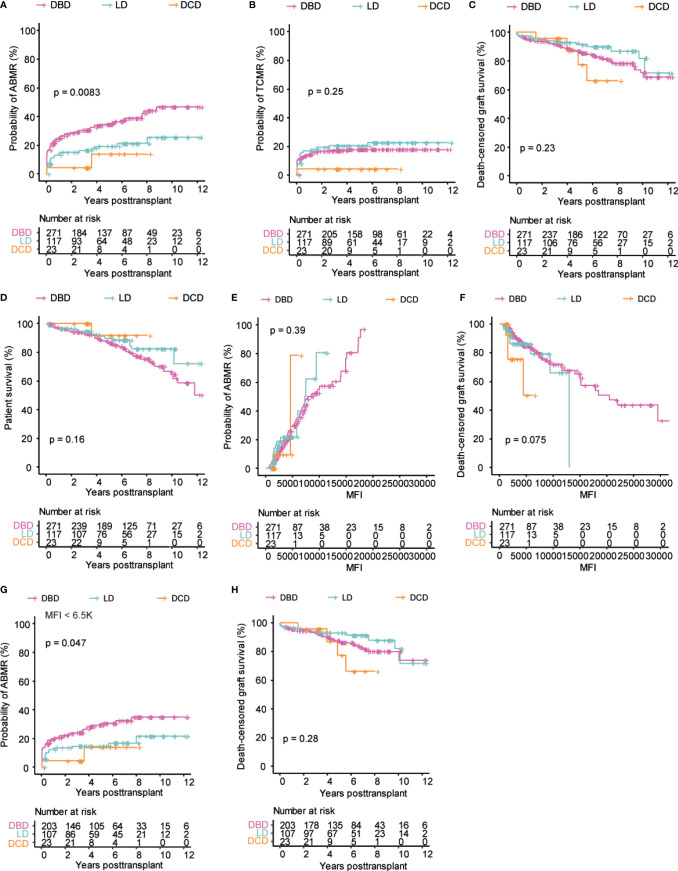
Results: There was a significant worse outcome associated with pre-transplant DSA in all of the studied donation types. DSA directed against Class II HLA antigens as well as a high cumulative mean fluorescent intensity (MFI) of the detected DSA showed the strongest association with worse transplant outcome. We could not detect a significant additive negative effect of DSA in DCD transplantations in our cohort. Conversely, DSA positive DCD transplants appeared to have a slightly better outcome, possibly in part due to the lower mean fluorescent intensity (MFI) of the pre-transplant DSA. Indeed when DCD transplants were compared to DBD transplants with similar MFI (<6.5k), graft survival was not significantly different.

Discussion: Our results suggest that the negative impact of pre-transplant DSA on graft outcome could be similar between all donation types. This suggests that immunological risk assessment could be performed in a similar way regardless of the type of donor kidney transplantation.

Keywords: ABMR; DBD; DCD; donor specific antibodies; graft loss; kidney transplantation; living donation; virtual cross-match.


Conflict of interest statement

The authors declare that the research was conducted in the absence of any commercial or financial relationships that could be construed as a potential conflict of interest.

Figures
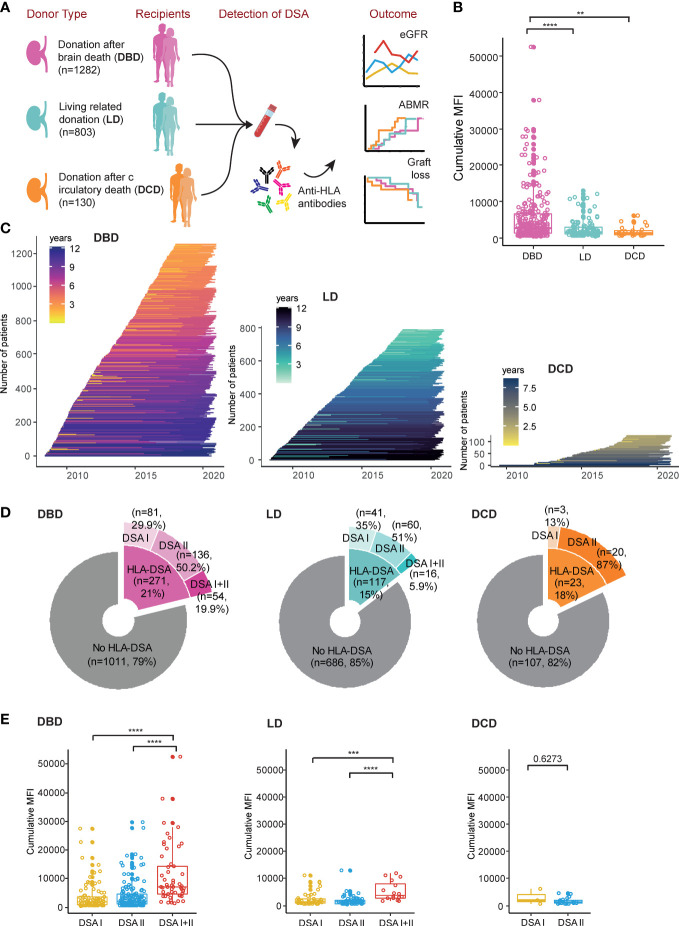
Figure 1
Figure 1
Overview of the STCT cohort and the grouping of patients based on donation type. (A) Flowchart indicating the number of patients for the different donation types (DBD, LD and DCD), detection of DSA and the major analyses performed in this study. (B) The distribution of the cumulative MFI value of DSA positive patients. (C) Follow-up time in each individual patient. (D) Details of the patients in the “no HLA-DSA” group and different DSA sub-groups. (E) The summary of the cumulative MFI value of different DSA classes in the different donation types. **p<0.01, ***p<0.001, ****p<0.0001.
Figure 2
Figure 2
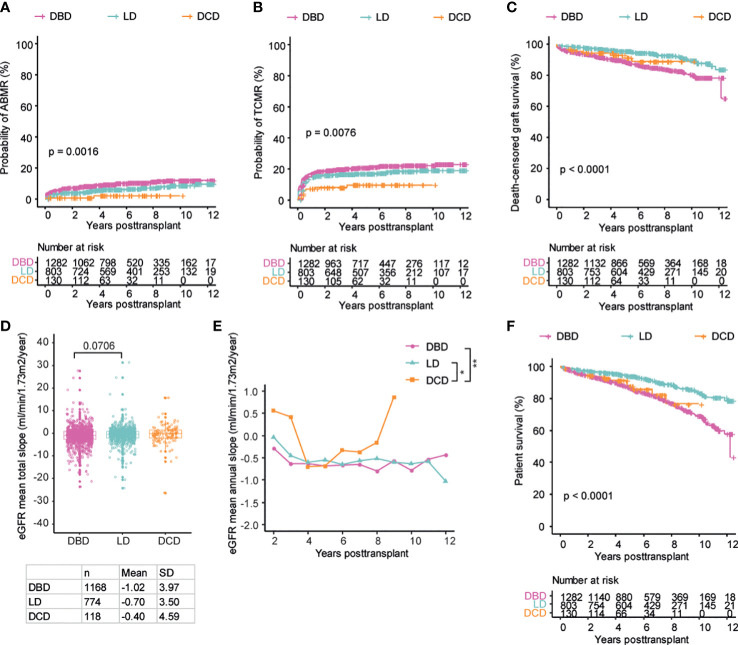
Patients receiving DCD transplants show similar outcomes as the DBD and LD patients regarding the development of ABMR, TCMR, graft survival and graft function. Cumulative incidence of ABMR (A), TCMR (B), death-censored graft survival (C), the total mean slope of eGFR (D), the collective longitudinal mean annual slope of eGFR (E), and overall patient survival (F) in patients with the three different donation types respectively. Log-rank test was used to test p value of the Kaplan-Meier survival curves for (A–C) and (F). One-way ANOVA analysis with Dunn’s post hoc test was used for (D) and two-way ANOVA analysis with Tukey’s multiple comparisons as a post hoc test was used for (E) to assess p values; *p<0.05, **p<0.01.
Figure 3
Figure 3
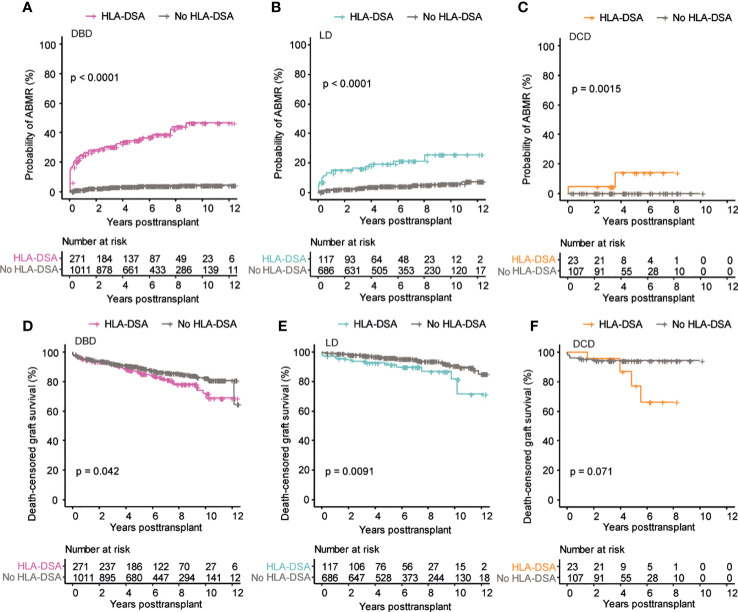
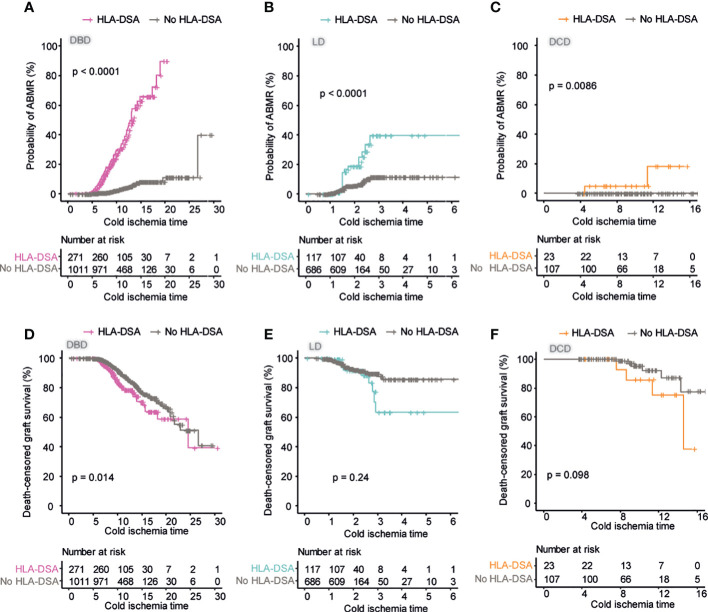
Pre-transplant DSA significantly impacts transplantation outcome in all the three donation types. Cumulative incidence of ABMR in patients who received DBD transplants (A), LD transplants (B), and DCD transplants (C). Cumulative incidence of death-censored graft survival in patients who received DBD transplants (D), LD transplants (E), and DCD transplants (F). Log-rank test was used to test p value of the Kaplan-Meier survival curves for all the graphs.
Figure 4
Figure 4
Comparable outcome in DSA positive patients among three different donation types. Cumulative incidence of ABMR (A), TCMR (B), patient survival (C), and death-censored graft survival (D) over time in DSA positive patients. Cumulative incidence of ABMR (E), and death-censored graft survival (F) with regards to cumulative DSA MFI value. Cumulative incidence of ABMR (G), and death-censored graft survival (H) in patients with a DSA MFI value below 6.5k. Log-rank test was used to test p value of the Kaplan-Meier survival curves for all the graphs.
Figure 5
Figure 5
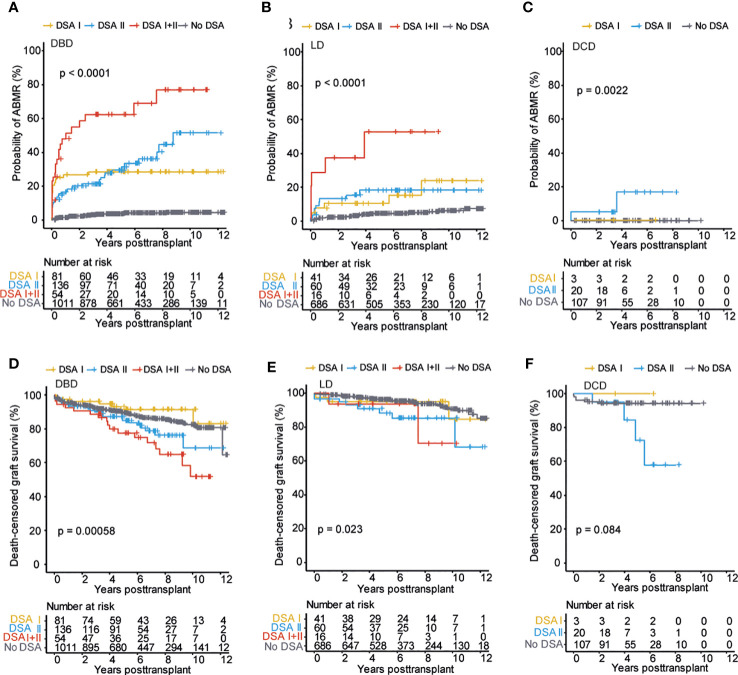
Class II directed pre-transplant DSA is associated with worse outcomes regardless of donation type. Cumulative incidence of ABMR in patients who received DBD transplants (A), LD transplants (B), and DCD transplants (C) stratified on DSA target HLA Class. Cumulative incidence of death-censored graft survival in patients who received DBD transplants (D), LD transplants (E), and DCD transplants (F) stratified on DSA target HLA Class. Log-rank test was used to test p value of the Kaplan-Meier survival curves for all the graphs.
Figure 6
Figure 6
Prolonged cold ischemia time has a large influence on ABMR risk in DSA positive patients. Cumulative incidence of ABMR in patients who received DBD transplants (A), LD transplants (B), and DCD transplants (C) in relation to cold ischemia time. Cumulative incidence of death-censored graft survival in patients who received DBD transplants (D), LD transplants (E), and DCD transplants (F) in relation to cold ischemia time. Log-rank test was used to test p value of the Kaplan-Meier survival curves for all the graphs.
Figure 7
Figure 7
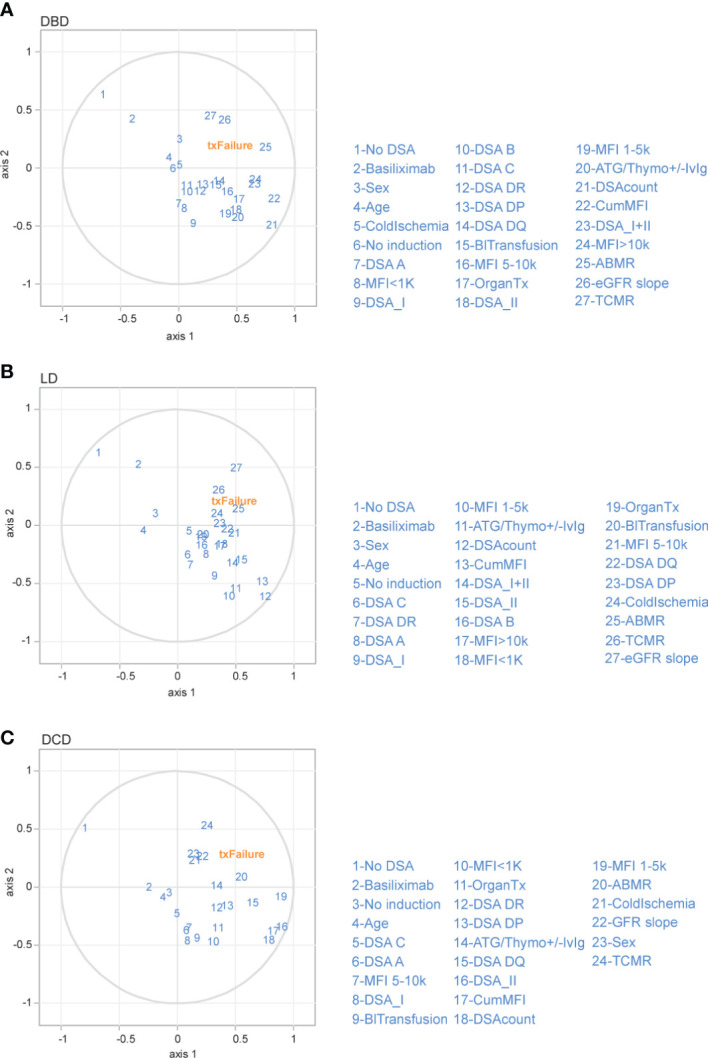
Partial least squares (PLS) regression exploratory biplot for the first two components describing the correlation among different immunological risk factors to graft loss in the different donation types. Correlation shown between graft loss (txFailure) and the risk factors (in blue numbers) for DBD (A), LD (B) and DCD (C) transplants. The first two axes which correspond to PLS components 1 and 2 are shown. The distance between the individual risk factors and the center indicates the strength of the correlation with each component and their alignments represent the correlation they contribute to the variation explained by each component. (OrganTx, Organ Transplantation; BlTransfusion, Blood Transfusion; DSAcount, Number of DSA).

References

    1. Sellarés J, de Freitas DG, Mengel M, Reeve J, Einecke G, Sis B, et al. Understanding the causes of kidney transplant failure: the dominant role of antibody-mediated rejection and nonadherence. Am J Transplant (2012) 12(2):388–99. doi: 10.1111/j.1600-6143.2011.03840.x - DOI - PubMed
    1. Wekerle T, Segev D, Lechler R, Oberbauer R. Strategies for long-term preservation of kidney graft function. Lancet (2017) 389(10084):2152–62. doi: 10.1016/S0140-6736(17)31283-7 - DOI - PubMed
    1. Loupy A, Lefaucheur C. Antibody-mediated rejection of solid-organ allografts. N Engl J Med (2018) 379(12):1150–60. doi: 10.1056/NEJMra1802677 - DOI - PubMed
    1. Lefaucheur C, Loupy A, Hill GS, Andrade J, Nochy D, Antoine C, et al. Preexisting donor-specific HLA antibodies predict outcome in kidney transplantation. J Am Soc Nephrol (2010) 21(8):1398–406. doi: 10.1681/ASN.2009101065 - DOI - PMC - PubMed
    1. Kamburova EG, Wisse BW, Joosten I, Allebes WA, van der Meer A, Hilbrands LB, et al. Differential effects of donor-specific HLA antibodies in living versus deceased donor transplant. Am J Transplant (2018) 18(9):2274–84. doi: 10.1111/ajt.14709 - DOI - PMC - PubMed

Publication types