


Artificial neural network modeling for deciphering the in vitro induced salt stress tolerance in chickpea (Cicer arietinum L)
- PMID: 36875725
- PMCID: PMC9981858
- DOI: 10.1007/s12298-023-01282-z
Artificial neural network modeling for deciphering the in vitro induced salt stress tolerance in chickpea (Cicer arietinum L)
Abstract
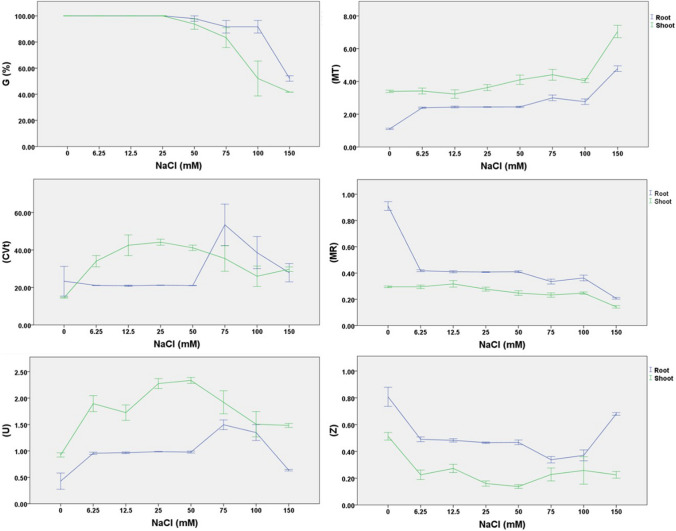
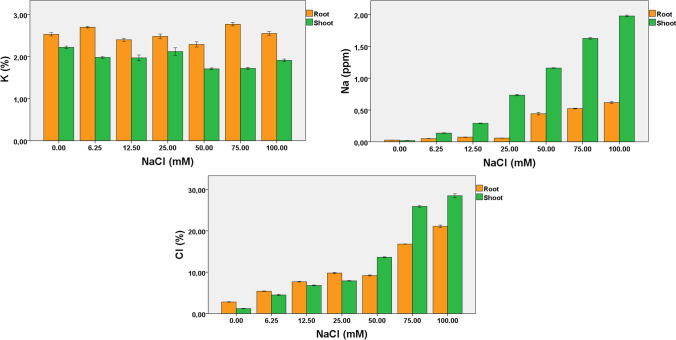
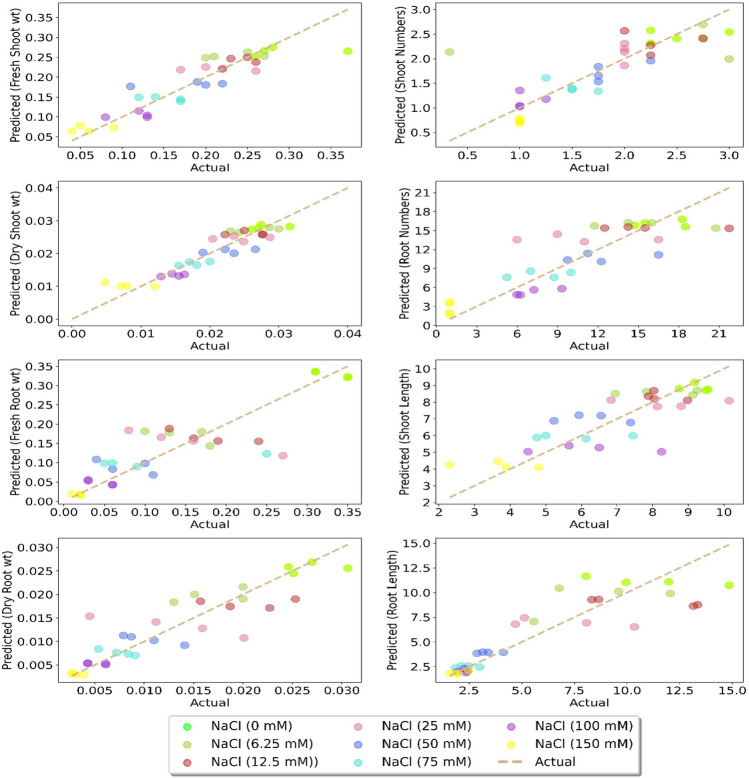
Salt stress is one of the most critical abiotic stresses having significant contribution in global agriculture production. Chickpea is sensitive to salt stress at various growth stages and a better knowledge of salt tolerance in chickpea would enable breeding of salt tolerant varieties. During present investigation, in vitro screening of desi chickpea by continuous exposure of seeds to NaCl-containing medium was performed. NaCl was applied in the MS medium at the rate of 6.25, 12.50, 25, 50, 75, 100, and 125 mM. Different germination indices and growth indices of roots and shoots were recorded. Mean germination (%) of roots and shoots ranged from 52.08 to 100%, and 41.67-100%, respectively. The mean germination time (MGT) of roots and shoots ranged from 2.40 to 4.78 d and 3.23-7.05 d. The coefficient of variation of the germination time (CVt) was recorded as 20.91-53.43% for roots, and 14.53-44.17% for shoots. The mean germination rate (MR) of roots was better than shoots. The uncertainty (U) values were tabulated as 0.43-1.59 (roots) and 0.92-2.33 (shoots). The synchronization index (Z) reflected the negative impact of elevated salinity levels on both root and shoot emergence. Application of NaCl exerted a negative impact on all growth indices compared to control and decreased gradually with elevated NaCl concentration. Results on salt tolerance index (STI) also revealed the reduced STI with elevated NaCl concentration and STI of roots was less than shoot. Elemental analysis revealed more Na and Cl accumulation with respective elevated NaCl concentrations. The In vitro growth parameters and STI values validated and predicted by multilayer perceptron (MLP) model revealed the relatively high R 2 values of all growth indices and STI. Findings of this study will be helpful to broaden the understanding about the salinity tolerance level of desi chickpea seeds under in vitro conditions using various germination indices and seedling growth indices.
Supplementary information: The online version contains supplementary material available at 10.1007/s12298-023-01282-z.
Keywords: Artificial neural network; Chickpea; Mathematical expressions; NaCl stress; Salt tolerance.
© Prof. H.S. Srivastava Foundation for Science and Society 2023, Springer Nature or its licensor (e.g. a society or other partner) holds exclusive rights to this article under a publishing agreement with the author(s) or other rightsholder(s); author self-archiving of the accepted manuscript version of this article is solely governed by the terms of such publishing agreement and applicable law.
Conflict of interest statement
Conflict of interestThe authors declare no conflict of interest.
Figures
References
-
- Aasim M, Ali SA, Bekiş P, Nadeem MA. Light-emitting diodes induced in vitro regeneration of Alternanthera reineckii mini and validation via machine learning algorithms. Vitr Cell Dev Biol. 2022;58:1–10.
-
- Aasim M, Katırcı R, Akgur O, et al. Machine learning (ML) algorithms and artificial neural network for optimizing in vitro germination and growth indices of industrial hemp (Cannabis sativa L) Ind Crops Prod. 2022;181:114801. doi: 10.1016/j.indcrop.2022.114801. - DOI
-
- Aasim M, Khan AA (2019) Nutritional values, health benefits and multiple uses of desi chickpea. In: Lund AT, Schultz ND (eds) Handbook of chickpeas: nutritional value, health benefits and management. pp 57–73
-
- Aharon S, Hana B, Liel G, et al. Total phenolic content and antioxidant activity of chickpea (Cicer arietinum L.) as affected by soaking and cooking conditions. Food Nutr Sci. 2011;2011:1–7.
LinkOut - more resources
Full Text Sources