


Daily impulsivity and alcohol expectancies: A multilevel examination of the acquired preparedness model
- PMID: 36877150
- PMCID: PMC10240390
- DOI: 10.1111/acer.15023
Daily impulsivity and alcohol expectancies: A multilevel examination of the acquired preparedness model
Abstract
Background: The acquired preparedness model (APM) integrates personality traits and psychosocial learning to posit amechanism whereby individuals initiate and continue alcohol use. The present study examined within-person associations between impulsivity, alcohol expectancies, alcohol use, and alcohol problems to inform daily process models of drinking and test the APM.
Methods: Participants were 89 college student drinkers who completed momentary reports (three random and two user-initiated reports) for 14 days. Multilevel mediation analyses examined whether daily associations between impulsivity and alcohol use and problems were mediated by positive and negative expectancies.
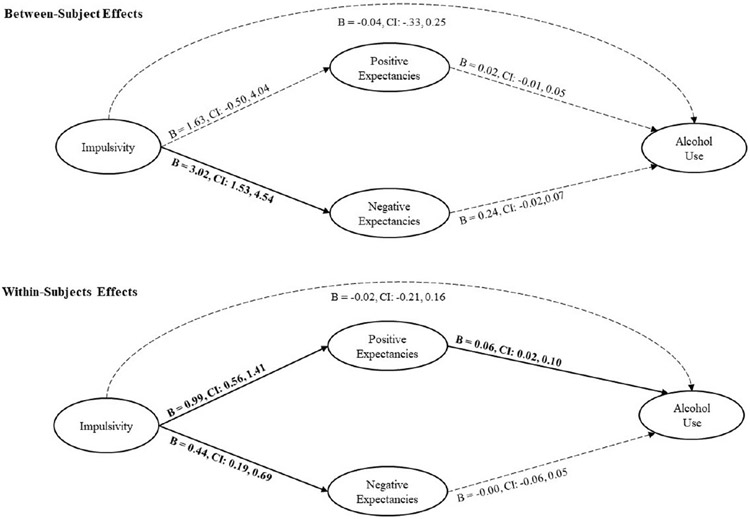
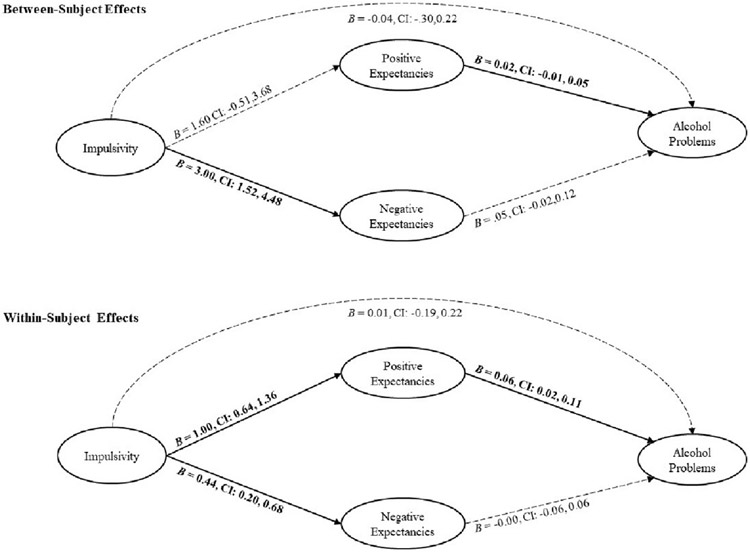
Results: Daily impulsivity was positively associated with daily positive expectancies, prior to drinking. Greater daily positive expectancies were associated with more alcohol consumed and alcohol problems that day. The indirect effects were significant, indicating greater than usual impulsivity was associated with greater alcohol use and alcohol problems through greater positive expectancies. Impulsivity was positively associated with negative expectancies at the within-subject and between-subject levels, but negative expectancies did not serve as a mediator between impulsivity and either alcohol outcome.
Conclusions: This is the first study to test the APM at the day level. Findings supported daily fluctuations in beliefs regarding the positive effects of alcohol as a salient mechanism explaining the link between daily impulsivity and level of alcohol use. Because impulsivity was linked to changes in expectancy states that were proximal to drinking that day, this information may be used to develop prevention and intervention programs to reduce alcohol harms.
Keywords: alcohol expectancies; alcohol use; ecological momentary assessment; impulsivity; young adults.
© 2023 Research Society on Alcohol.
Conflict of interest statement
CONFLICTS OF INTEREST
The authors declare that they have no conflicts of interest to disclose.
Figures
References
-
- Adams SL & McNeil DW (1991) Negative alcohol expectancies reconsidered. Psychology of Addictive Behaviors, 5, 9–14. Available from: 10.1037/h0080576 - DOI
-
- Barnow S, Schultz G, Lucht M, Ulrich I, Preuss UW & Freyberger HJ (2004) Do alcohol expectancies and peer delinquency/substance use mediate the relationship between impulsivity and drinking behaviour in adolescence? Alcohol and Alcoholism, 39, 213–219. Available from: 10.1093/alcalc/agh048 - DOI - PubMed
-
- Bartholow BD, Sher KJ & Strathman A (2000) Moderation of the expectancy-alcohol use relation by private self-consciousness: data from a longitudinal study. Personality and Social Psychology Bulletin, 26, 1409–1420.
Publication types
MeSH terms
Substances
Grants and funding
LinkOut - more resources
Full Text Sources
