


Cognitive and Neuropathophysiological Outcomes of Gamma-tACS in Dementia: A Systematic Review
- PMID: 36877327
- PMCID: PMC10920470
- DOI: 10.1007/s11065-023-09589-0
Cognitive and Neuropathophysiological Outcomes of Gamma-tACS in Dementia: A Systematic Review
Abstract
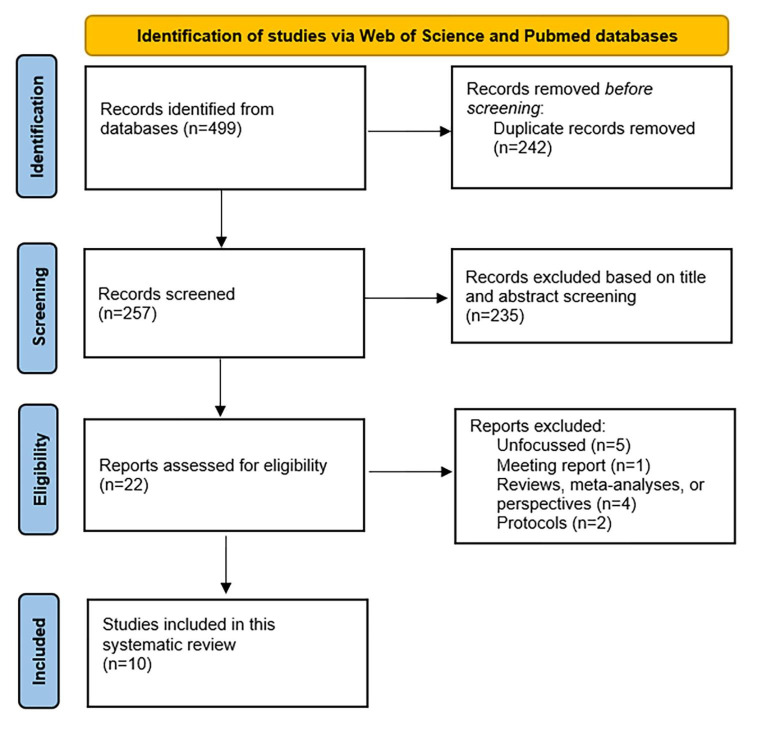
Despite the numerous pharmacological interventions targeting dementia, no disease-modifying therapy is available, and the prognosis remains unfavorable. A promising perspective involves tackling high-frequency gamma-band (> 30 Hz) oscillations involved in hippocampal-mediated memory processes, which are impaired from the early stages of typical Alzheimer's Disease (AD). Particularly, the positive effects of gamma-band entrainment on mouse models of AD have prompted researchers to translate such findings into humans using transcranial alternating current stimulation (tACS), a methodology that allows the entrainment of endogenous cortical oscillations in a frequency-specific manner. This systematic review examines the state-of-the-art on the use of gamma-tACS in Mild Cognitive Impairment (MCI) and dementia patients to shed light on its feasibility, therapeutic impact, and clinical effectiveness. A systematic search from two databases yielded 499 records resulting in 10 included studies and a total of 273 patients. The results were arranged in single-session and multi-session protocols. Most of the studies demonstrated cognitive improvement following gamma-tACS, and some studies showed promising effects of gamma-tACS on neuropathological markers, suggesting the feasibility of gamma-tACS in these patients anyhow far from the strong evidence available for mouse models. Nonetheless, the small number of studies and their wide variability in terms of aims, parameters, and measures, make it difficult to draw firm conclusions. We discuss results and methodological limitations of the studies, proposing possible solutions and future avenues to improve research on the effects of gamma-tACS on dementia.
Keywords: Alzheimer’s Disease; Mild Cognitive Impairment; Neurodegenerative Diseases; Neuromodulation; Non-invasive brain stimulation; Transcranial Alternating Current Stimulation.
© 2023. The Author(s).
Conflict of interest statement
The authors declare that this systematic review was conducted in the absence of any commercial or financial relationships that could be construed as a potential conflict of interest.
Figures
References
-
- Albert MS, DeKosky ST, Dickson D, Dubois B, Feldman HH, Fox NC, Gamst A, Holtzman DM, Jagust WJ, Petersen RC, Snyder PJ, Carrillo MC, Thies B, Phelps CH. The diagnosis of mild cognitive impairment due to Alzheimer’s disease: recommendations from the National Institute on Aging-Alzheimer’s Association workgroups on diagnostic guidelines for Alzheimer’s disease. Alzheimer’s & Dementia: The Journal of the Alzheimer’s Association. 2011;7(3):270–279. doi: 10.1016/j.jalz.2011.03.008. - DOI - PMC - PubMed
Publication types
MeSH terms
Grants and funding
LinkOut - more resources
Full Text Sources
Other Literature Sources
Medical
