


Trust In US Federal, State, And Local Public Health Agencies During COVID-19: Responses And Policy Implications
- PMID: 36877902
- PMCID: PMC11318038
- DOI: 10.1377/hlthaff.2022.01204
Trust In US Federal, State, And Local Public Health Agencies During COVID-19: Responses And Policy Implications
Abstract
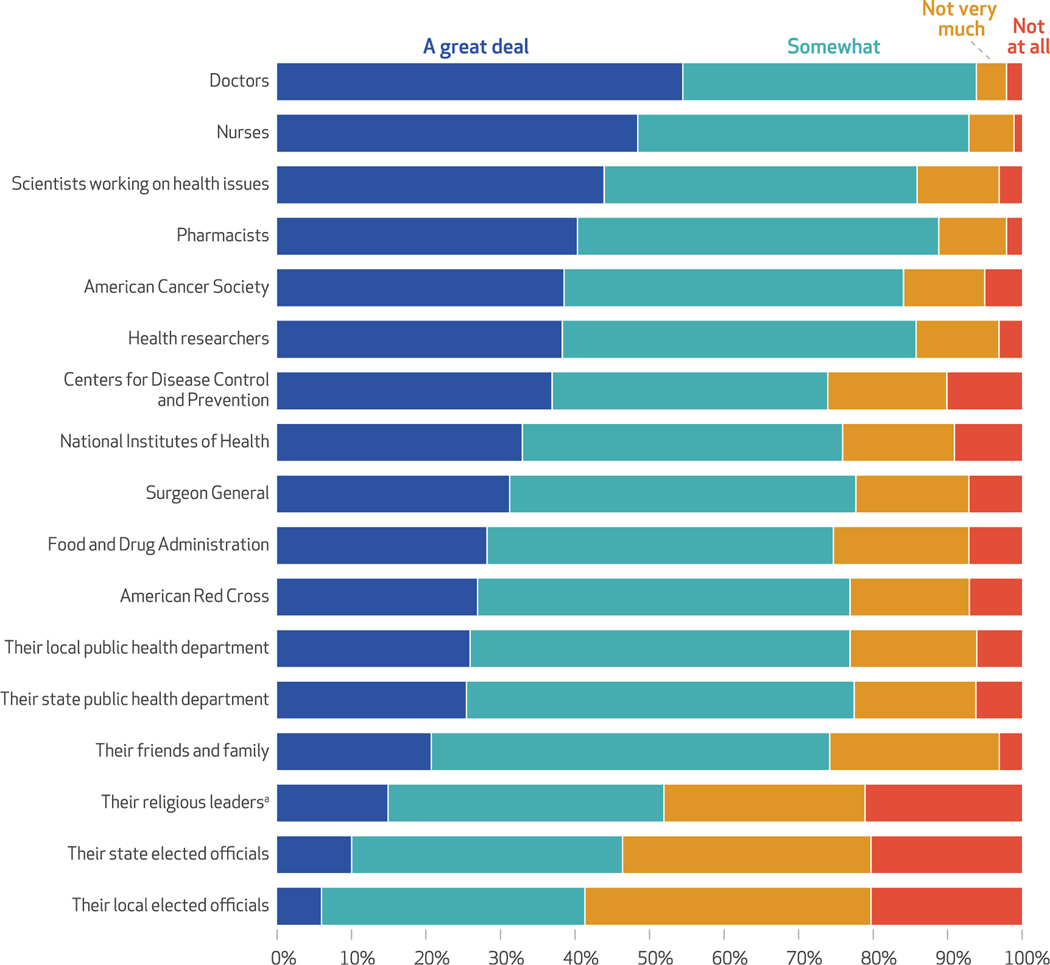
Public health agencies' ability to protect health in the wake of COVID-19 largely depends on public trust. In February 2022 we conducted a first-of-its-kind nationally representative survey of 4,208 US adults to learn the public's reported reasons for trust in federal, state, and local public health agencies. Among respondents who expressed a "great deal" of trust, that trust was not related primarily to agencies' ability to control the spread of COVID-19 but, rather, to beliefs that those agencies made clear, science-based recommendations and provided protective resources. Scientific expertise was a more commonly reported reason for "a great deal" of trust at the federal level, whereas perceptions of hard work, compassionate policy, and direct services were emphasized more at the state and local levels. Although trust in public health agencies was not especially high, few respondents indicated that they had no trust. Lower trust was related primarily to respondents' beliefs that health recommendations were politically influenced and inconsistent. The least trusting respondents also endorsed concerns about private-sector influence and excessive restrictions and had low trust in government overall. Our findings suggest the need to support a robust federal, state, and local public health communications infrastructure; ensure agencies' authority to make science-based recommendations; and develop strategies for engaging different segments of the public.
Figures
References
-
- Quinn SC, Jamison AM, An J, Hancock GR, Freimuth VS. Measuring vaccine hesitancy, confidence, trust, and flu vaccine uptake: results of a national survey of White and African American adults. Vaccine. 2019;37(9):1168–73. - PubMed
-
- Siegrist M, Zingg A. The role of public trust during pandemics. Eur Psychol. 2014;19(1):23–32.
Publication types
MeSH terms
Grants and funding
LinkOut - more resources
Full Text Sources
Medical
