


Hearing Loss in Bacterial Meningitis Revisited-Evolution and Recovery
- PMID: 36879624
- PMCID: PMC9985150
- DOI: 10.1093/ofid/ofad056
Hearing Loss in Bacterial Meningitis Revisited-Evolution and Recovery
Abstract
Background: Hearing loss and deafness are well-known sequelae from bacterial meningitis (ABM) and may result in social dysfunction and learning difficulties. Yet, the timely development of hearing loss and restitution is poorly studied, especially among adults. Hearing loss was revisited using otoacoustic emissions (OAEs) to determine the occurrence, magnitude, and development of hearing loss among adults with ABM.
Methods: Distortion product OAEs were measured in patients with ABM the day of admission and days 2, 3, 5-7, and 10-14 and at follow-up 30-60 days after discharge. Frequencies were categorized as low (1, 1.5, 2 kHz), mid (3, 4, 5 kHz), mid-high (6, 7, 8 kHz), and high (9, 10 kHz). Audiometry was performed on discharge and 60 days after. Results were compared with 158 healthy controls.
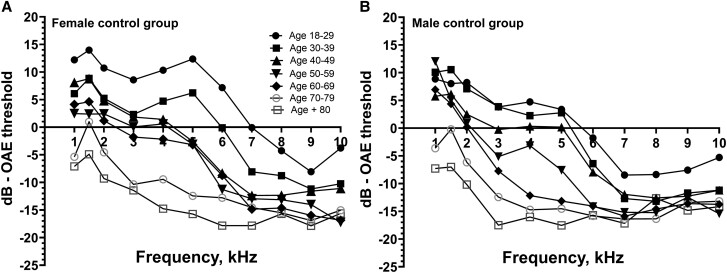
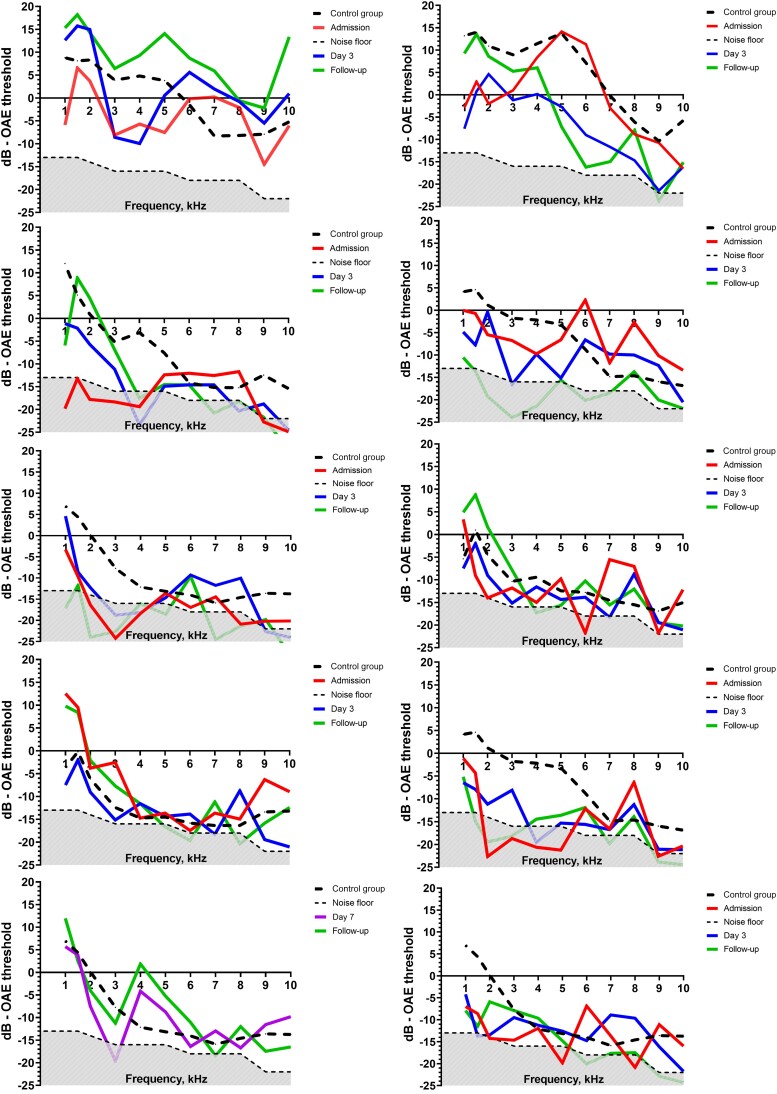
Results: OAE was obtained in 32 patients. ABM was due to S. pneumoniae in 12 patients (38%). All patients were treated with dexamethasone. OAE emission threshold levels (ETLs) were significantly decreased upon admission and at follow-up in all frequencies compared with healthy controls. A substantial and significant decrease in ETLs was found in S. pneumoniae meningitis. Sensorineural hearing loss (SNHL) >20 dB was present in 13 of 23 (57%) at discharge and in 11 of 18 patients (61%) 60 days after discharge. Hearing recovery decreased from day 3.
Conclusions: Hearing loss in ABM still affects >60% of patients despite treatment with dexamethasone. In S. pneumoniae meningitis, SNHL is profound and permanent. A window of opportunity for systemic or local treatments aiming to preserve cochlear function is proposed.
Keywords: OAE; bacterial meningitis; cochlea; hearing loss; otoacoustic emissions.
© The Author(s) 2023. Published by Oxford University Press on behalf of Infectious Diseases Society of America.
Conflict of interest statement
Potential conflicts of interest. All other authors report no potential conflicts.
Figures
References
-
- Dodge PR, Davis H, Feigin RD, et al. Prospective evaluation of hearing impairment as a sequela of acute bacterial meningitis. N Engl J Med 1984; 311:869–74. - PubMed
-
- Heckenberg SGB, Brouwer MC, van der Ende A, Hensen EF, van de Beek D. Hearing loss in adults surviving pneumococcal meningitis is associated with otitis and pneumococcal serotype. Clin Microbiol Infect 2012; 18:849–55. - PubMed
-
- Worsøe L, Cayé-Thomasen P, Brandt CT, Thomsen J, Østergaard C. Factors associated with the occurrence of hearing loss after pneumococcal meningitis. Clin Infect Dis 2010; 51:917–24. - PubMed
-
- Smith RJH, Bale JF, White KR. Sensorineural hearing loss in children. Lancet 2005; 365:879–90. - PubMed
-
- Peltola H, Roine I, Fernández J, et al. Hearing impairment in childhood bacterial meningitis is little relieved by dexamethasone or glycerol. Pediatrics 2010; 125:e1–8. - PubMed
LinkOut - more resources
Full Text Sources
Miscellaneous
