Clinical Trial
. 2023 Mar 7;329(9):725-734.
doi: 10.1001/jama.2023.1084.

Effect of Induction Therapy With Olamkicept vs Placebo on Clinical Response in Patients With Active Ulcerative Colitis: A Randomized Clinical Trial

Affiliations
Clinical Trial

Effect of Induction Therapy With Olamkicept vs Placebo on Clinical Response in Patients With Active Ulcerative Colitis: A Randomized Clinical Trial

Shenghong Zhang et al. JAMA. .

Abstract

Importance: Olamkicept, a soluble gp130-Fc-fusion-protein, selectively inhibits interleukin 6 (IL-6) trans-signaling by binding the soluble IL-6 receptor/IL-6 complex. It has anti-inflammatory activities in inflammatory murine models without immune suppression.

Objective: To assess the effect of olamkicept as induction therapy in patients with active ulcerative colitis.

Design, setting, and participants: Randomized, double-blind, placebo-controlled phase 2 trial of olamkicept in 91 adults with active ulcerative colitis (full Mayo score ≥5, rectal bleeding score ≥1, endoscopy score ≥2) and an inadequate response to conventional therapy. The study was conducted at 22 clinical study sites in East Asia. Patients were recruited beginning in February 2018. Final follow-up occurred in December 2020.

Interventions: Eligible patients were randomized 1:1:1 to receive a biweekly intravenous infusion of olamkicept 600 mg (n = 30) or 300 mg (n = 31) or placebo (n = 30) for 12 weeks.

Main outcomes and measures: The primary end point was clinical response at week 12 (defined as ≥3 and ≥30% decrease from baseline total Mayo score; range, 0-12 [worst] with ≥1 decrease and ≤1 in rectal bleeding [range, 0-3 {worst}]). There were 25 secondary efficacy outcomes, including clinical remission and mucosal healing at week 12.

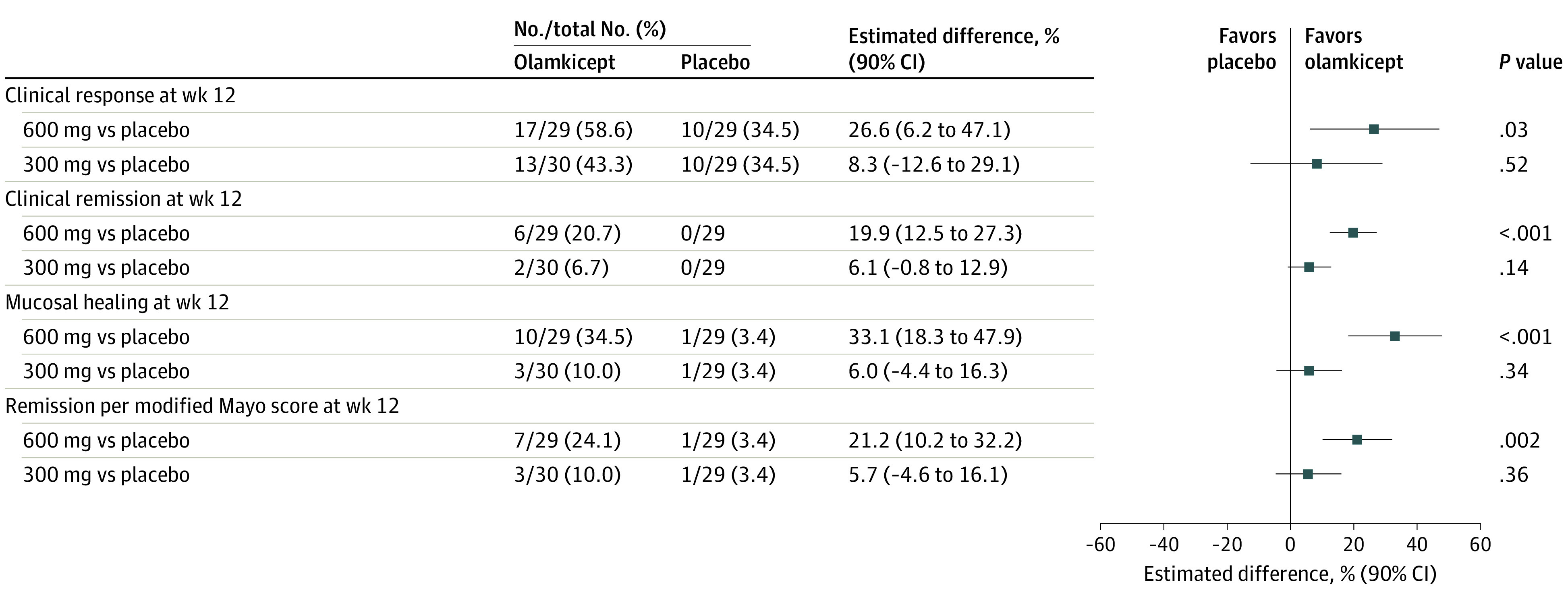
Results: Ninety-one patients (mean age, 41 years; 25 women [27.5%]) were randomized; 79 (86.8%) completed the trial. At week 12, more patients receiving olamkicept 600 mg (17/29 [58.6%]) or 300 mg (13/30 [43.3%]) achieved clinical response than placebo (10/29 [34.5%]), with adjusted difference vs placebo of 26.6% (90% CI, 6.2% to 47.1%; P = .03) for 600 mg and 8.3% (90% CI, -12.6% to 29.1%; P = .52) for 300 mg. Among patients randomized to receive 600 mg olamkicept, 16 of 25 secondary outcomes were statistically significant compared with placebo. Among patients randomized to receive 300 mg, 6 of 25 secondary outcomes were statistically significant compared with placebo. Treatment-related adverse events occurred in 53.3% (16/30) of patients receiving 600 mg olamkicept, 58.1% (18/31) receiving 300 mg olamkicept, and 50% (15/30) receiving placebo. The most common drug-related adverse events were bilirubin presence in the urine, hyperuricemia, and increased aspartate aminotransferase levels, and all were more common in the olamkicept groups compared with placebo.

Conclusions and relevance: Among patients with active ulcerative colitis, biweekly infusion of olamkicept 600 mg, but not 300 mg, resulted in a greater likelihood of clinical response at 12 weeks compared with placebo. Further research is needed for replication and to assess longer-term efficacy and safety.

Trial registration: ClinicalTrials.gov Identifier: NCT03235752.


Conflict of interest statement

Conflict of Interest Disclosures: Dr Shenghong Zhang reported personal fees (for consulting) from I-Mab Biopharma during the conduct of the study; and personal fees (for lectures) from Takeda, AbbVie, Abbott, and Janssen outside the submitted work. Dr B. Chen reported personal fees (for consulting) from I-Mab Biopharma during the conduct of the study; and personal fees (for lectures) from Takeda, AbbVie, Abbott, and Janssen outside the submitted work. Dr H. Chen reported personal fees (for lectures) from Janssen, Takeda, AbbVie, and Abbott outside the submitted work. Dr Li reported personal fees (for lectures) from Janssen, Takeda, AbbVie, and Abbott outside the submitted work. Dr Tang reported personal fees from I-Mab Biopharma during the conduct of the study; and personal fees from Takeda outside the submitted work. Ms Yang reported being an employee of I-Mab Biopharma and stock ownership with I-Mab Biopharma. Dr Xu reported being an employee of I-Mab Biopharma and stock ownership with I-Mab Biopharma. Dr Q. Wang reported being an employee of I-Mab Biopharma and stock ownership with I-Mab Biopharma. Dr Liu reported being an employee of I-Mab Biopharma and stock ownership with I-Mab Biopharma. Dr Ma reported stock ownership with I-Mab Biopharma during the conduct of the study. Dr Schreiber reported personal fees (for consulting) from Ferring and from I-Mab (lecture fees) during the conduct of the study; personal fees (lectures and/or consulting) from Abbvie, Amgen, Biogen, Bristol Myers Squibb, Falk, Galapagos, Gilead, Hikma, MSD, Pfizer, Janssen, and Takeda outside the submitted work. Dr M. Chen reported personal fees (for advisory functions) from I-Mab Biopharma and grants from National Key S&T Special Project during the conduct of the study; and personal fees (for lectures) from Takeda, AbbVie, and Janssen outside the submitted work. No other disclosures were reported.

Figures

Figure 1.
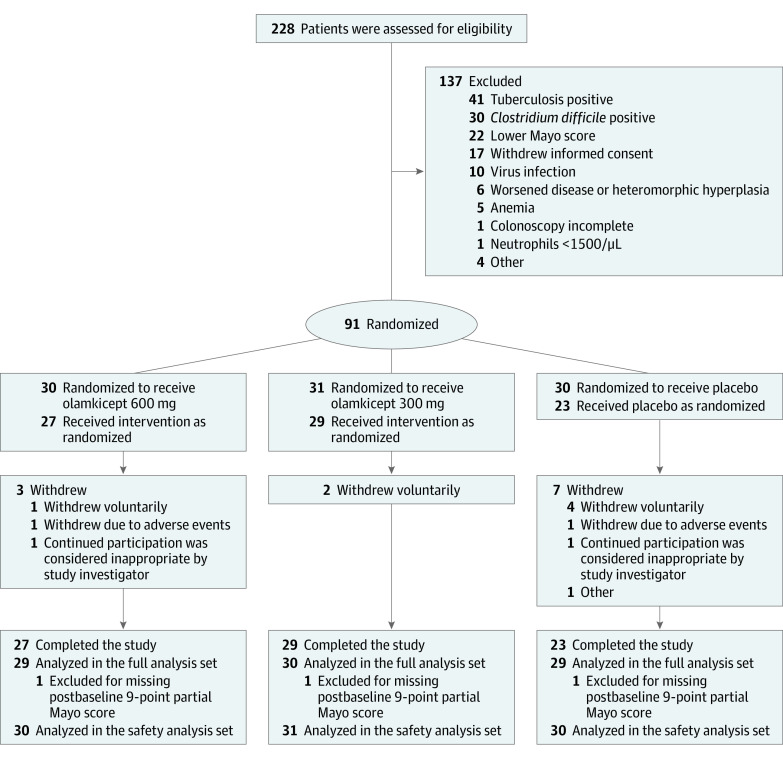
Figure 1.. Flow of Participants in the Trial of Olamkicept for Active Ulcerative Colitis
The study had a run-in period (if stable conventional treatment was needed), a 4-week screening period, a 12-week double-blind treatment period, and a 3-week safety follow-up period (to day 105). The first patient signed the informed consent form on February 6, 2018, and the last patient completed the trial on December 16, 2020. During the double-blind treatment period, patients with active ulcerative colitis were randomized in a 1:1:1 ratio to receive olamkicept every 2 weeks at doses of 600 mg or 300 mg or placebo by intravenous infusion at days 0 (baseline), 14, 28, 42, 56, and 70. Disease activity was assessed at screening visit, baseline, and weeks 2 to 12. During screening and at week 12, assessments of disease activity included endoscopy (colonoscopy or sigmoidoscopy).
Figure 2.
Figure 2.. Primary End Point and Selected Secondary End Points in the Trial of Olamkicept for Active Ulcerative Colitis
Clinical response at week 12 was defined as a decrease of 3 or greater and of 30% or greater from baseline in total Mayo score, including a decrease of 1 or greater from baseline in rectal bleeding subscore or of 1 or less1 in rectal bleeding subscore. Clinical remission at week 12 was defined as a total Mayo score of 2 or less, no individual subscore greater than 1, and a rectal bleeding subscore of 0. Mucosal healing at week 12 was defined as a Mayo endoscopic subscore of 0 or 1. Remission per modified Mayo score (ie, total Mayo score excluding Physician’s Global Assessment subscore) at week 12 was defined as a stool frequency subscore of 1 or less, a rectal bleeding subscore of 0, and an endoscopy subscore of 0 or 1. The 90% CI and P value for treatment difference were derived from a logistic regression model adjusted for treatment group, randomization stratification factors, and total Mayo score at baseline as covariates. The numbers of patients were based on the full analysis set, consisting of all randomized patients with at least 1 postbaseline 9-point partial Mayo score value, and patients with missing outcomes were imputed as nonresponders (4 patients in the olamkicept 600-mg group, 3 in the 300-mg group, and 8 patients in the placebo group).
Figure 3.
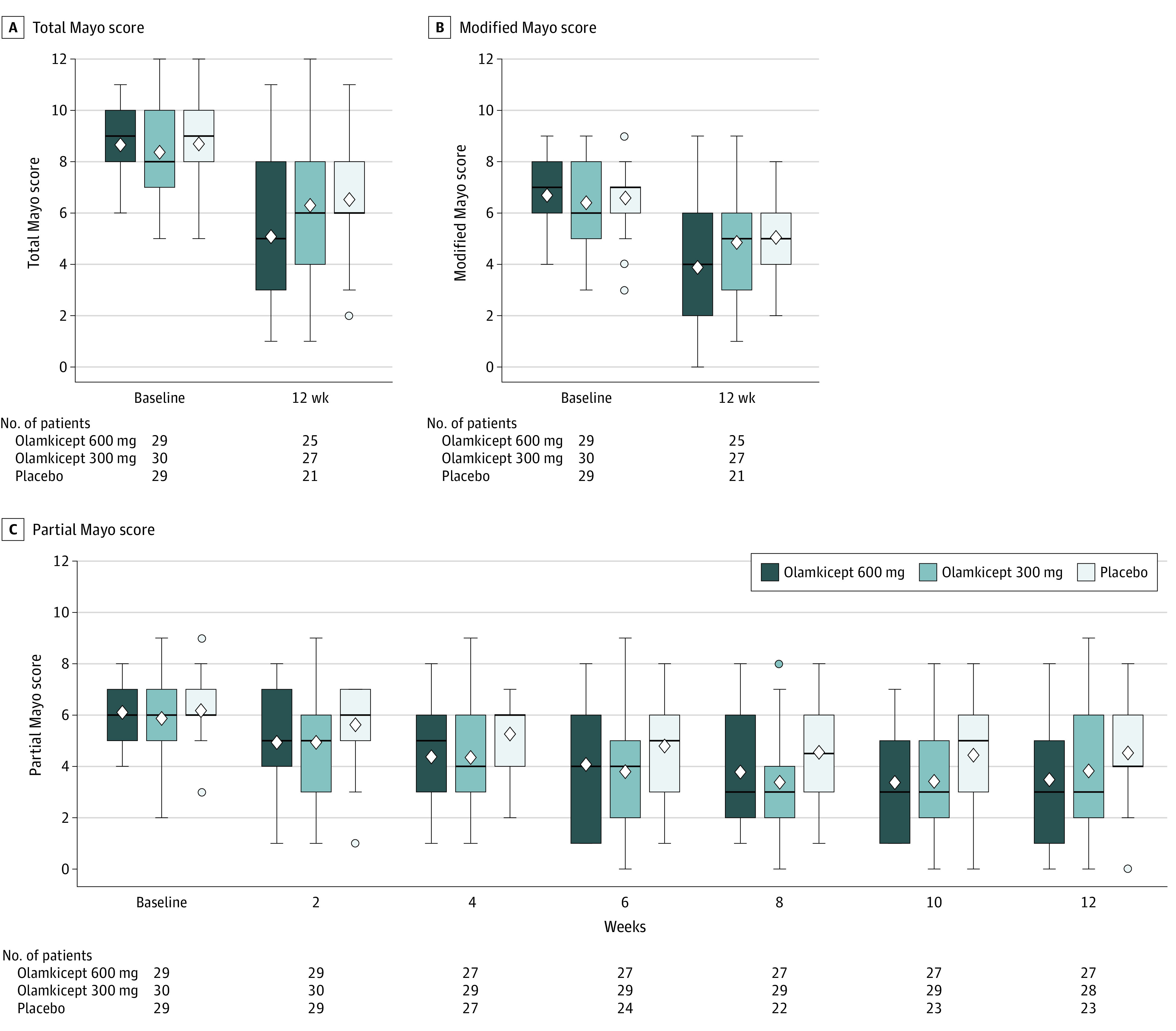
Figure 3.. Efficacy Over Time in the Trial in the Randomized Clinical Trial of Olamkicept, Compared With Placebo, for Active Ulcerative Colitis
The boxplots of Mayo scores per treatment group present the median (the horizontal line in the box), mean (the diamond in the box), and IQR (25th to 75th percentiles), with whisker length equal to 1.5 times the IQR and dots indicating outliers. Summaries were based on the full analysis set, and patients with missing outcomes were not imputed. Amount of missing at each visit in each treatment group can be quantified via the No. of patients.

References

    1. Ng SC, Shi HY, Hamidi N, et al. . Worldwide incidence and prevalence of inflammatory bowel disease in the 21st century: a systematic review of population-based studies. Lancet. 2017;390(10114):2769-2778. doi:10.1016/S0140-6736(17)32448-0 - DOI - PubMed
    1. Ng SC, Tang W, Ching JY, et al. ; Asia–Pacific Crohn’s and Colitis Epidemiologic Study (ACCESS) Study Group . Incidence and phenotype of inflammatory bowel disease based on results from the Asia-Pacific Crohn’s and Colitis Epidemiology Study. Gastroenterology. 2013;145(1):158-165.e2. doi:10.1053/j.gastro.2013.04.007 - DOI - PubMed
    1. Prideaux L, Kamm MA, De Cruz PP, Chan FK, Ng SC. Inflammatory bowel disease in Asia: a systematic review. J Gastroenterol Hepatol. 2012;27(8):1266-1280. doi:10.1111/j.1440-1746.2012.07150.x - DOI - PubMed
    1. GBD 2017 Inflammatory Bowel Disease Collaborators . The global, regional, and national burden of inflammatory bowel disease in 195 countries and territories, 1990-2017: a systematic analysis for the Global Burden of Disease Study 2017. Lancet Gastroenterol Hepatol. 2020;5(1):17-30. doi:10.1016/S2468-1253(19)30333-4 - DOI - PMC - PubMed

    1. Olfatifar M, Zali MR, Pourhoseingholi MA, et al. . The emerging epidemic of inflammatory bowel disease in Asia and Iran by 2035: a modeling study. BMC Gastroenterol. 2021;21(1):204. doi:10.1186/s12876-021-01745-1 - DOI - PMC - PubMed

Publication types

Associated data