


doi: 10.1038/s41598-023-30860-0.
Quantum asymmetric key crypto scheme using Grover iteration
Affiliations
- PMID: 36882516
- PMCID: PMC9992374
- DOI: 10.1038/s41598-023-30860-0
Item in Clipboard
Quantum asymmetric key crypto scheme using Grover iteration
Sci Rep.
.
Abstract
Here, we propose a quantum asymmetric key cryptography scheme using Grover's quantum search algorithm. In the proposed scheme, Alice generates a pair of public and private keys, keeps the private keys safe, and only discloses public keys to the outside. Bob uses Alice's public key to send a secret message to Alice and Alice uses her private key to decrypt the secret message. Furthermore, we discuss the safety of quantum asymmetric key encryption techniques based on quantum mechanical properties.
© 2023. The Author(s).
Conflict of interest statement
The authors declare no competing interests.
Figures

Asymmetric cryptography system uses an encryption key that consists of a public key and private key pair. Security in asymmetric key encryption systems relies on managing private keys without exposing them to the outside world. In contrast, public keys can be released to others. Anyone with a public key can create and send a secret message at any time, whereas someone with a private key can open the secret message at any time. In this figure, Bob, who shares Alice's public key P(A), encrypts the message m he wants to send to Alice, and Alice decrypts the message using her private key S(A).
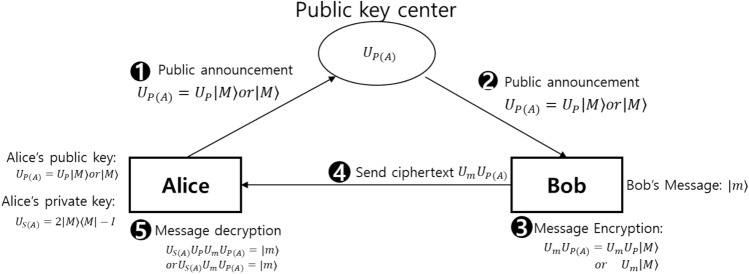
Quantum asymmetric key cipher scheme: This figure is a quantum version of the classical asymmetric key cipher scheme depicted in Fig. 1.
References
-
- Menezes, A. J., Paul, C., Van, O., & Scott A. Vanstone. Handbook of Applied Cryptography. (CRC press, Boca Raton, 1996)
-
- Forouzan, B. A., & Mukhopadhyay, D. Cryptography And Network Security (Sie). (McGraw-Hill Education, Noida, 2011).
-
- Stallings, W. & Tahiliani, M. P. (2014). Cryptography and network security: principles and practice, vol 6. Editor: Pearson London.
-
- Nielsen, M. A., & Chuang, I. Quantum Computation and Quantum Information. (American Association of Physics Teachers, College Park, 2002), pp. 558–559.
-
- Bennett, C. H. & Brassard, G. Quantum cryptography: Public key distribution and coin tossing. In Proc. of IEEE International Conf. on Computers, Systems and Signal Processing, vol 175. p. 8. (NY, 1984).
LinkOut - more resources
Full Text Sources
