


Chronic critical illness in critically ill COVID-19 patients
- PMID: 36883242
- PMCID: PMC9996170
- DOI: 10.1177/17423953231161333
Chronic critical illness in critically ill COVID-19 patients
Abstract
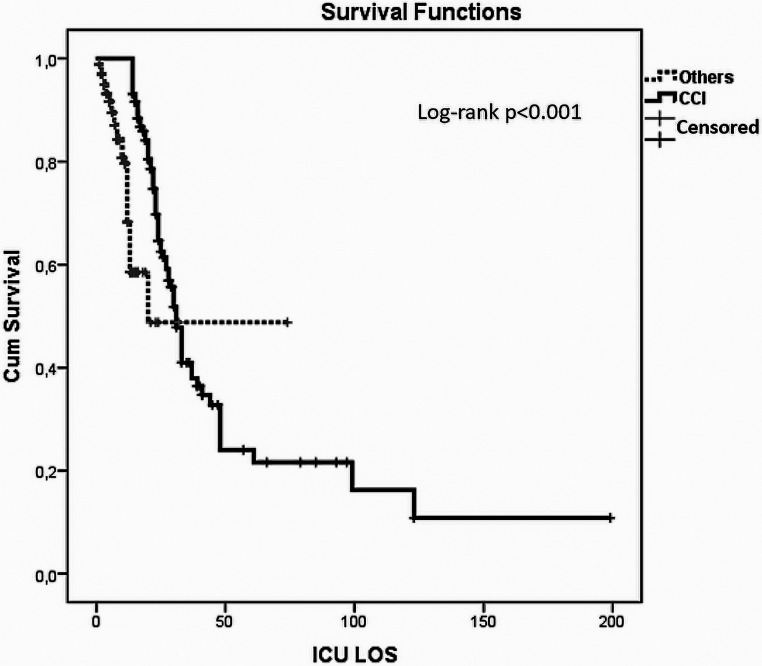
Objectives: To evaluate the presence of chronic critical illness (CCI) in COVID-19 patients and compare clinical characteristics and prognosis of patients with and without CCI admitted to intensive care unit (ICU).
Methods: It was a retrospective, observational study at a university hospital ICU. Patients were accepted as CCI if they had prolonged ICU stay (≥14 days) and got ≥1 score for cardiovascular sequential organ failure assessment (SOFA) score and ≥2 score in other parameters on day 14 of ICU admission which was described as persistent organ dysfunction.
Results: 131 of 397 (33%) patients met CCI criteria. CCI patients were older (p = 0.003) and frailer (p < 0.001). Their Acute Physiology and Chronic Health Evaluation (APACHE) II and SOFA scores were higher, PaO2/FiO2 ratio was lower (p < 0.001). Requirement of invasive mechanical ventilation (IMV), steroid use, and septic shock on admission were higher in the CCI group (p < 0.001). CCI patients had higher ICU and hospital mortality than other patients (54.2% vs. 19.9% and 55.7% vs. 22.6%, p < 0.001, respectively). Regression analysis revealed that IMV (OR: 8.40, [5.10-13.83], p < 0.001) and PaO2/FiO2 < 150 on admission (OR: 2.25, [1.36-3.71], p = 0.002) were independent predictors for CCI.
Discussion: One-third of the COVID-19 patients admitted to the ICU were considered as CCI with significantly higher ICU and hospital mortality.
Keywords: Coronavirus; SARS-CoV-2; mortality; outcome; post-intensive care syndrome.
Conflict of interest statement
Declaration of conflicting interestsThe author(s) declared no potential conflicts of interest with respect to the research, authorship, and/or publication of this article.
Figures

References
-
- Wu Q, Hu D, Ren J. Chronic critical illness should be considered in long-term mortality study among critical illness patients. Crit Care Med 2015; 43: 57. - PubMed
-
- Prescott HC. Preventing chronic critical illness and rehospitalization: a focus on sepsis. Crit Care Clin 2018; 34: 501–513. - PubMed
-
- Desarmenien M, Blanchard-Courtois AL, Ricou B. The chronic critical illness: a new disease in intensive care. Swiss Med Wkly 2016; 146: w14336. - PubMed
-
- Girard K, Raffin TA. The chronically critically ill: to save or let die? Respir Care 1985; 30: 339–347. - PubMed
Publication types
MeSH terms
LinkOut - more resources
Full Text Sources
Medical
Miscellaneous
