


Empirical evidence of transmission over a school-household network for SARS-CoV-2; exploration of transmission pairs stratified by primary and secondary school
- PMID: 36889158
- PMCID: PMC9968452
- DOI: 10.1016/j.epidem.2023.100675
Empirical evidence of transmission over a school-household network for SARS-CoV-2; exploration of transmission pairs stratified by primary and secondary school
Abstract
Background: Children play a key role in the transmission of many infectious diseases. They have many of their close social encounters at home or at school. We hypothesized that most of the transmission of respiratory infections among children occur in these two settings and that transmission patterns can be predicted by a bipartite network of schools and households.
Aim and methods: To confirm transmission over a school-household network, SARS-CoV-2 transmission pairs in children aged 4-17 years were analyzed by study year and primary/secondary school. Cases with symptom onset between 1 March 2021 and 4 April 2021 identified by source and contact-tracing in the Netherlands were included. In this period, primary schools were open and secondary school students attended class at least once per week. Within pairs, spatial distance between the postcodes was calculated as the Euclidean distance.
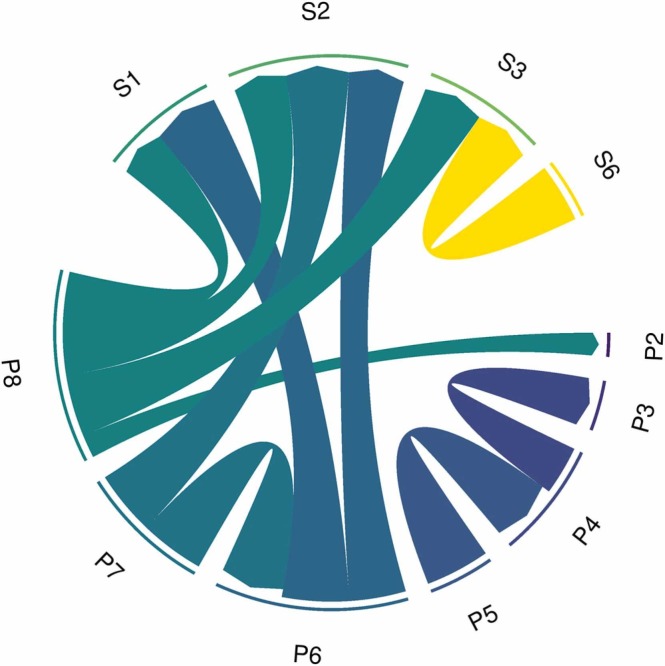
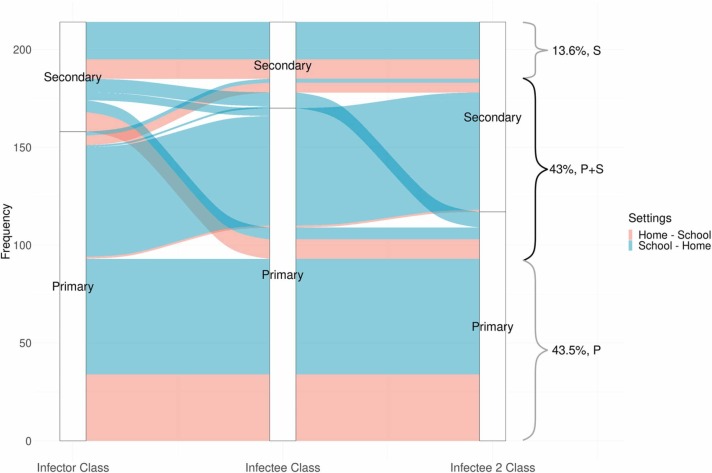
Results: A total of 4059 transmission pairs were identified; 51.9% between primary schoolers; 19.6% between primary and secondary schoolers; 28.5% between secondary schoolers. Most (68.5%) of the transmission for children in the same study year occurred at school. In contrast, most of the transmission of children from different study years (64.3%) and most primary-secondary transmission (81.7%) occurred at home. The average spatial distance between infections was 1.2 km (median 0.4) for primary school pairs, 1.6 km (median 0) for primary-secondary school pairs and 4.1 km (median 1.2) for secondary school pairs.
Conclusion: The results provide evidence of transmission on a bipartite school-household network. Schools play an important role in transmission within study years, and households play an important role in transmission between study years and between primary and secondary schools. Spatial distance between infections in a transmission pair reflects the smaller school catchment area of primary schools versus secondary schools. Many of these observed patterns likely hold for other respiratory pathogens.
Keywords: Children; Covid-19; Network; Transmission.
Copyright © 2023 The Authors. Published by Elsevier B.V. All rights reserved.
Figures


References
-
- Cib-R.I.V.M. JvD. Briefing to Dutch parliament regarding the COVID-19 situation in the Netherlands, March 2021 2021 [Available from: https://www.tweedekamer.nl/downloads/document?id=16a7cccb-5083–491f-a732... dhr. Van Dissel - Directeur van het Centrum voor Infectieziektebestrijding van het RIVM.pdf.
MeSH terms
LinkOut - more resources
Full Text Sources
Medical
Miscellaneous
