


The exposome and liver disease - how environmental factors affect liver health
- PMID: 36889360
- PMCID: PMC10448911
- DOI: 10.1016/j.jhep.2023.02.034
The exposome and liver disease - how environmental factors affect liver health
Abstract
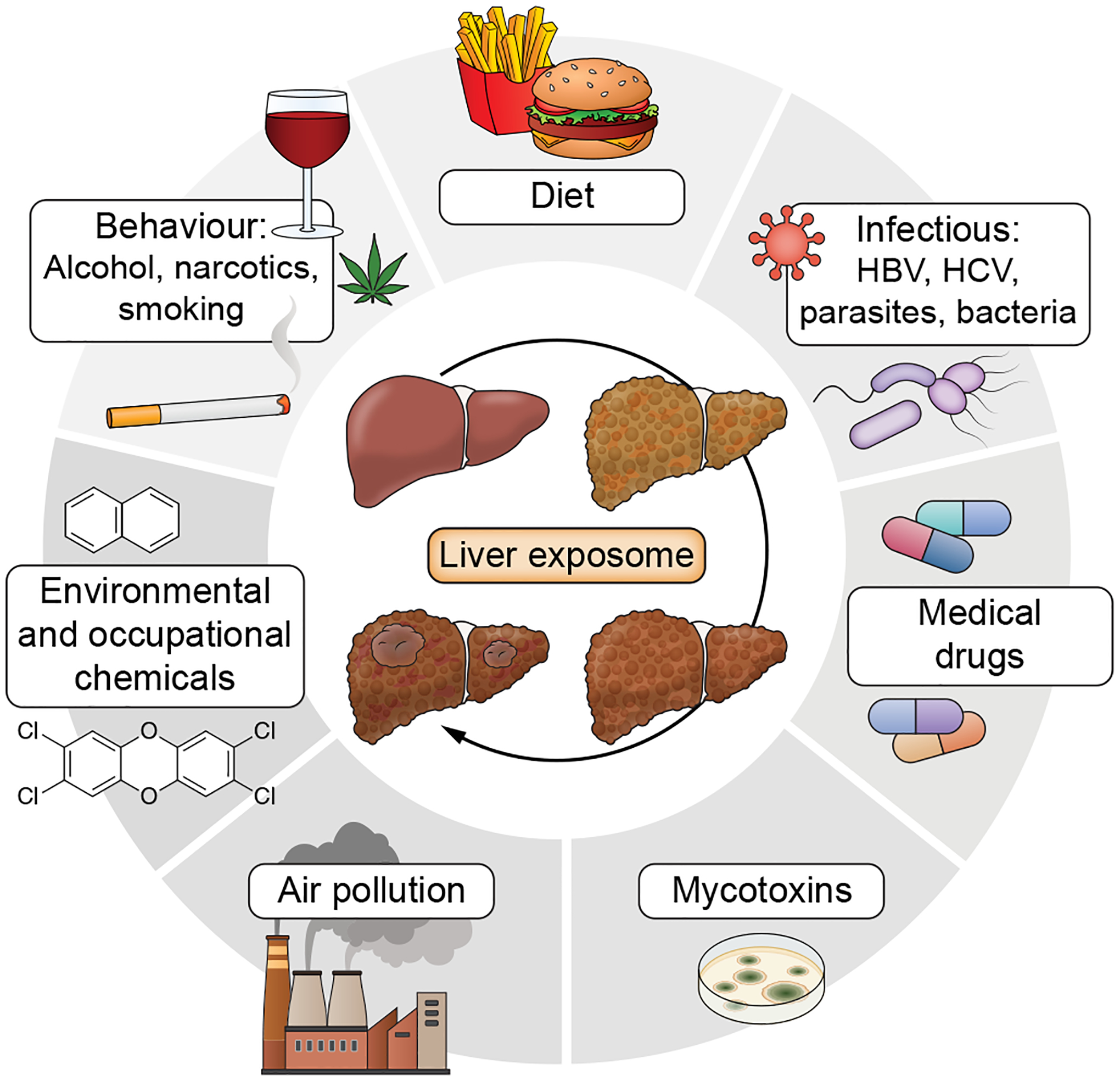
Since the initial development of the exposome concept, much effort has been devoted to the characterisation of the exposome through analytical, epidemiological, and toxicological/mechanistic studies. There is now an urgent need to link the exposome to human diseases and to include exposomics in the characterisation of environment-linked pathologies together with genomics and other omics. Liver diseases are particularly well suited for such studies since major functions of the liver include the detection, detoxification, and elimination of xenobiotics, as well as inflammatory responses. It is well known that several liver diseases are associated with i) addictive behaviours such as alcohol consumption, smoking, and to a certain extent dietary imbalance and obesity, ii) viral and parasitic infections, and iii) exposure to toxins and occupational chemicals. Recent studies indicate that environmental exposures are also significantly associated with liver diseases, and these include air pollution (particulate matter and volatile chemicals), contaminants such as polyaromatic hydrocarbons, bisphenol A and per-and poly-fluorinated substances, and physical stressors such as radiation. Furthermore, microbial metabolites and the "gut-liver" axis play a major role in liver diseases. Exposomics is poised to play a major role in the field of liver pathology. Methodological advances such as the exposomics-metabolomics framework, the determination of risk factors' genomic and epigenomic signatures, and cross-species biological pathway analysis should further delineate the impact of the exposome on the liver, opening the way for improved prevention, as well as the identification of new biomarkers of exposure and effects, and additional therapeutic targets.
Keywords: MAFLD; biliary disease; exposomics; hepatocellular carcinoma; metabolomics; microbiota; mutational signature; toxicological pathways; viral hepatitis; xenobiotic metabolism.
Copyright © 2023 The Author(s). Published by Elsevier B.V. All rights reserved.
Conflict of interest statement
Conflict of interest
M Colombo: speaker bureau and advisory boards (Target HCC COST Galapagos Exelixis).
Please refer to the accompanying ICMJE disclosure forms for further details.
Figures
References
-
- Wild CP. Complementing the genome with an « exposome »: the outstanding challenge of environmental exposure measurement in molecular epidemiology. Cancer Epidemiol Biomark Prev Publ Am Assoc Cancer Res Cosponsored Am Soc Prev Oncol Août 2005;14(8):1847–1850. - PubMed
Publication types
MeSH terms
Grants and funding
LinkOut - more resources
Full Text Sources
Medical
