


Spontaneous skull base cerebrospinal fluid leak during pregnancy: a case report and review of the literature
- PMID: 36890487
- PMCID: PMC9993356
- DOI: 10.1186/s12884-023-05460-5
Spontaneous skull base cerebrospinal fluid leak during pregnancy: a case report and review of the literature
Abstract
Background: Idiopathic intracranial hypertension can lead to dural defects and spontaneous leakage of cerebrospinal fluid (CSF) from the skull base. Skull base CSF leaks are rarely reported in pregnancy but pose unique challenges for obstetricians and anesthesiologists.
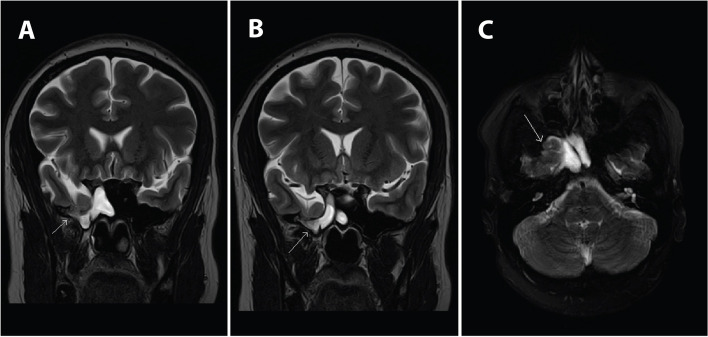
Case presentation: A 31-year-old G4P1021 at 14 weeks developed debilitating headaches and CSF rhinorrhea. Brain imaging revealed a bony defect of the sphenoid sinus with a meningoencephalocele and a partially empty sella, consistent with CSF leakage from a skull base defect. The patient was neurologically stable without signs of meningitis; thus, management was focused on symptomatic alleviation. A planned cesarean section was performed at 38 weeks under spinal anesthesia. The patient had spontaneous marked improvement of her symptoms postpartum.
Conclusion: Pregnancy may exacerbate skull base CSF leaks, requiring careful management with a multidisciplinary team. Neuraxial anesthesia can safely be performed in pregnant individuals with spontaneous skull base CSF leakage, but further studies are needed to determine the safest mode of delivery in these patients.
Keywords: Case report; Cerebrospinal fluid leak; Idiopathic intracranial hypertension; Neuraxial anesthesia; Pregnancy; Rhinorrhea.
© 2023. The Author(s).
Conflict of interest statement
The authors declare that they have no competing interests.
Figures
Similar articles
-
Multiple skull base defects in the setting of spontaneous cerebrospinal fluid rhinorrhea; a dual institution view.Am J Otolaryngol. 2024 Jan-Feb;45(1):104048. doi: 10.1016/j.amjoto.2023.104048. Epub 2023 Sep 22. Am J Otolaryngol. 2024. PMID: 37769505
-
A Unique Case of Bilateral Recurrent Sphenoid Sinus Cerebrospinal Fluid Leaks: Primary Acquired Leak Within the Lateral Sphenoid Sinus Recess, Followed by a Leak via Sternberg's Canal.Ann Otol Rhinol Laryngol. 2015 Aug;124(8):593-7. doi: 10.1177/0003489415570936. Epub 2015 Feb 4. Ann Otol Rhinol Laryngol. 2015. PMID: 25653256
-
Venous Sinus Stenting in the Management of Patients with Intracranial Hypertension Manifesting with Skull Base Cerebrospinal Fluid Leaks.World Neurosurg. 2017 Oct;106:103-112. doi: 10.1016/j.wneu.2017.06.087. Epub 2017 Jun 20. World Neurosurg. 2017. PMID: 28645586
-
Imaging of Acquired Skull Base Cerebrospinal Fluid Leaks.Neuroimaging Clin N Am. 2021 Nov;31(4):509-522. doi: 10.1016/j.nic.2021.05.009. Neuroimaging Clin N Am. 2021. PMID: 34689930 Review.
-
Primary spontaneous cerebrospinal fluid leaks and idiopathic intracranial hypertension.J Neuroophthalmol. 2013 Dec;33(4):330-7. doi: 10.1097/WNO.0b013e318299c292. J Neuroophthalmol. 2013. PMID: 24042170 Free PMC article. Review.
Cited by
-
Idiopathic Intracranial Hypertension in Pregnancy. A Systematic Review on Clinical Course, Treatments, Delivery and Maternal-Fetal Outcome.Eur J Neurol. 2025 May;32(5):e70186. doi: 10.1111/ene.70186. Eur J Neurol. 2025. PMID: 40391885 Free PMC article.
